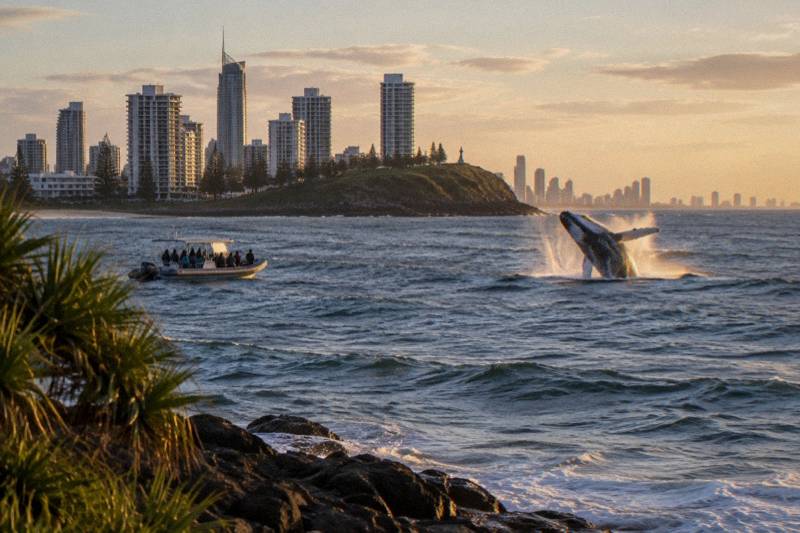
Do Whales Come Close To The Boat On The Gold Coast?
How close Gold Coast whale watching boats may legally get to a humpback, what happens when a curious whale closes the gap itself, and which cruises are built for close encounters.
Do Whales Come Close To The Boat On The Gold Coast?
Yes, and often closer than people expect, but the approach is nearly always the whale's choice. Queensland law requires every vessel to stay at least 100 metres from a humpback, so a Gold Coast cruise never chases a whale down. What the crews do instead is stop, sit in neutral, and let a curious animal close the distance itself, and juvenile humpbacks in particular will drift over to inspect a stationary hull for minutes at a time. If you're curious whether a smaller departure point up the coast gives you a different style of encounter, this Byron Bay vs Gold Coast whale watching comparison lays out how the two locations differ.
That distinction, the boat holding back while the whale decides, is the whole shape of a close encounter on the Gold Coast. The rules are strict and the crews that work these waters every day follow them, because a breach of approach distances is an offence under Queensland regulation, not a guideline. Yet the same rules that keep boats at arm's length say nothing at all about what a whale does next. A humpback that chooses to swim under the Spirit of Gold Coast catamaran, or to rise beside the low freeboard of a Cooly Eco safari boat, is acting on its own curiosity, and the crew's job in that moment is to hold still and let it happen. Whether that curiosity counts as genuine friendliness is a fair question, and our guide to how friendly humpback whales really are answers it plainly.
The practical answer for a visitor planning a trip: close approaches do occur regularly through the season, they are more likely on the smaller vessels, and they cannot be promised on any day. Whales are wild animals and quiet days happen. What you can control is the kind of boat you book, because a 47-guest cruise out of Marina Mirage and a 12-guest eye-level safari boat out of Chinderah offer very different versions of "close". The Whale Watching On The Gold Coast comparison pages sort the whole roster by exactly this kind of difference, and the three listings below are the ones most often chosen for encounter quality rather than price alone.
The rest of this article walks through what the law actually permits, what a curious whale does when a boat stops, and how the Tweed-side small boats and the Gold Coast cruises differ in the encounters they can host. Along the way it names the specific vessels, because on this stretch of coast the boat is the single biggest factor in how close the whales come.
How Close Are Boats Allowed To Get To A Whale?
In Queensland waters a boat must stay at least 100 metres from a whale, and 300 metres in front of or behind it, and inside a 300-metre caution zone it may travel no faster than 6 knots. No more than three boats may share one whale's caution zone at a time. Drones must stay 100 metres away and helicopters 500 metres.
These are the Rules for watching marine mammals as published by the Queensland Government, and they bind every commercial whale watching operation on the coast, from the Sea World Cruises terminal at Main Beach to the Aqua Adventures departure point at Southport. The numbers matter to a visitor for one reason: when a cruise crew says they are "with the whales", they mean they are sitting at the legal boundary, engines quiet, waiting. The boat is not closing the last hundred metres. Ever.
Two details in the rules surprise people. The first is the three-boat limit: if three vessels are already inside a whale's caution zone, a fourth cannot enter, which is why a good crew will move on from a crowded pod rather than stack up with it. The second is the white-whale clause. A predominantly white humpback, Migaloo or any animal more than 90 percent white, carries a 500-metre boat exclusion and a 610-metre aircraft exclusion, double the normal distance. Migaloo's 2026 reports remain unconfirmed and none were verified off the Gold Coast, but the rule stands regardless of whether he passes through.
The Tweed-side boats work under different numbers. Blue Seafaris departs Tweed Heads South and Cooly Eco Adventures departs Chinderah, both in New South Wales, so their trips fall under NSW approach rules. The distances are similar for boats, 100 metres to a whale, but the swimmer provisions differ and matter for the one swim product on the roster: NSW rules require a swimmer to enter the water at least 100 metres from a whale and then keep 30 metres clear. That swim trip departs Chinderah on the Tweed River in New South Wales, not from the Gold Coast itself, and no authorised swim-with-whales operation departs the Gold Coast. Licensed swim operations in Queensland sit at Hervey Bay and the Sunshine Coast.
Here is the full distance framework in one view:
| Who or what | Distance from a whale | Notes |
|---|---|---|
| Boat (Queensland) | 100 m, plus 300 m in front of and behind | No-approach zone surrounds the animal |
| Boat speed inside 300 m | Maximum 6 knots | Caution zone, no wake |
| Boats per whale | Maximum three in the caution zone | A fourth boat must stay out |
| Drone | 100 m horizontal and vertical | Applies to all operators and passengers |
| Helicopter | 500 m, no hovering above | Fixed-wing aircraft 300 m |
| Jet ski | 300 m | Classified as a prohibited vessel |
| Swimmer (Queensland) | 100 m | No authorised swim tours from the Gold Coast |
| Swimmer (NSW, Tweed side) | Enter 100 m away, then keep 30 m clear | Governs the Chinderah swim trip |
| Predominantly white whale | 500 m for boats, 610 m for aircraft | The Migaloo clause |
One more point worth knowing: these are state rules in coastal waters, and the Australian Whale Sanctuary covers the Commonwealth marine area beyond them, where it is an offence to harass, chase or herd any whale. A commercial cruise operating twenty minutes offshore, as the Sea World Cruises listing places its trip, is working inside that sanctuary framework. The rules are not paperwork for the crews; they are the reason a close encounter feels like a gift rather than a stunt.
What Do Curious Whales Do When A Boat Stops?
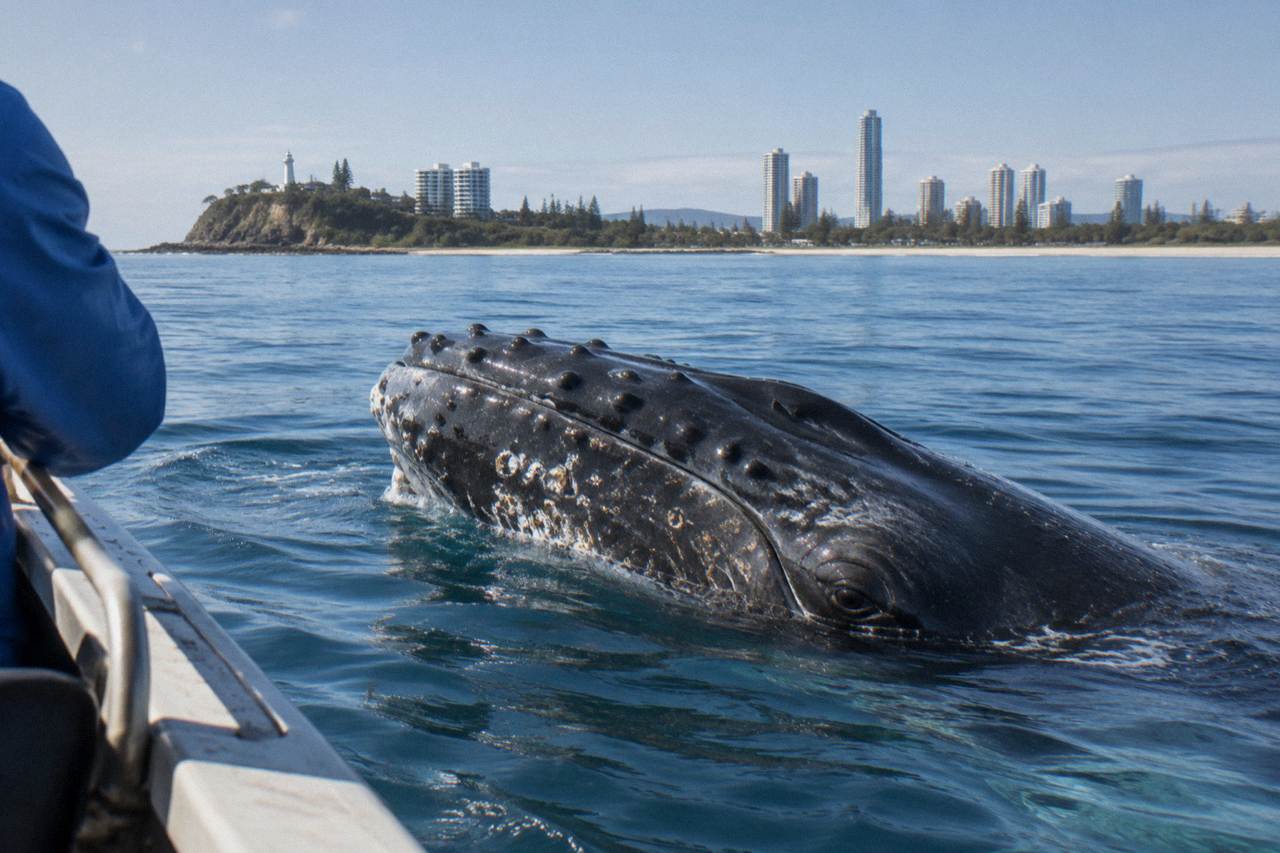
A curious humpback typically lifts its head clear of the water to look at the boat, a behaviour called spy hopping, circles the stationary hull, rolls onto its side or back to expose an eye, and sometimes drifts directly beneath the keel. Juveniles are the most likely to do this. The crew's role is to sit in neutral and let the animal set every term of the encounter.
None of that is trained, coaxed or baited. It is genuine curiosity from an animal with a brain large enough, and a social life complex enough, that researchers treat it as deliberate inspection. The humpbacks passing the Gold Coast are mostly travelling the east coast migration, northbound to breeding grounds and southbound with calves, and the young animals that lead the migration, typically the juveniles and young adults on the early leg, are the ones most inclined to burn energy on a stationary object in their path. Pregnant cows and mothers with calves, travelling at the rear of the migration, are far warier, and crews give them the widest possible berth.
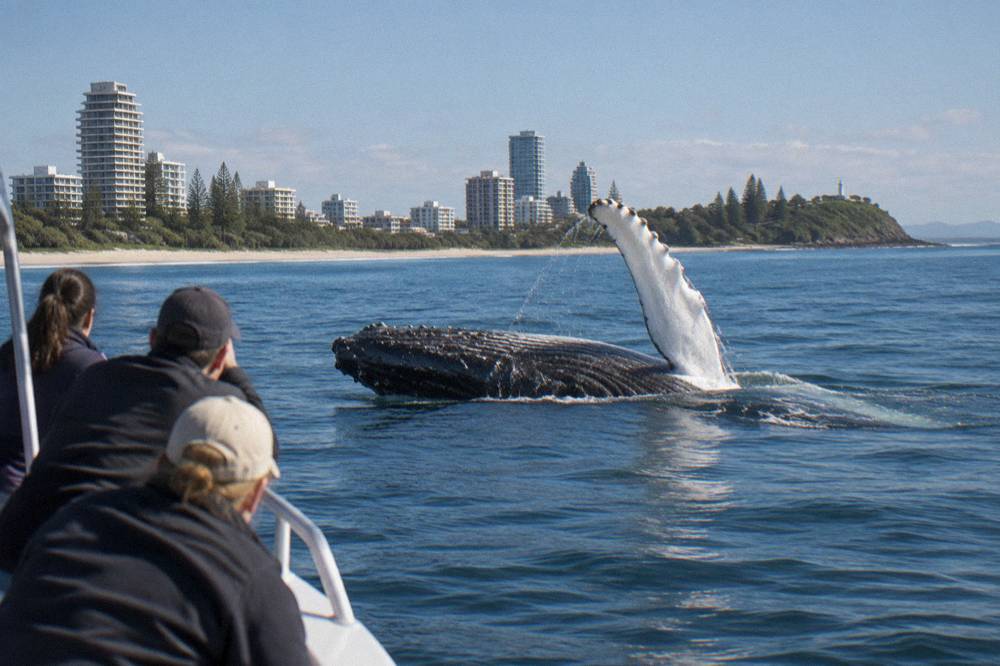
The behaviours have names because whale researchers have watched them for decades. Spy hopping, the head rise, gives the whale a look above the surface at the boat. Lobtailing, slapping the fluke on the water, and pec-slapping, slapping a long white flipper, are loud and visible and common through the whole season. Breaching, the full-body leap, is the one every passenger wants, and the honest answer is that nobody can schedule it. A breach is most often reported on the southbound leg, when mothers with calves linger and play, which on this coast means September and October.
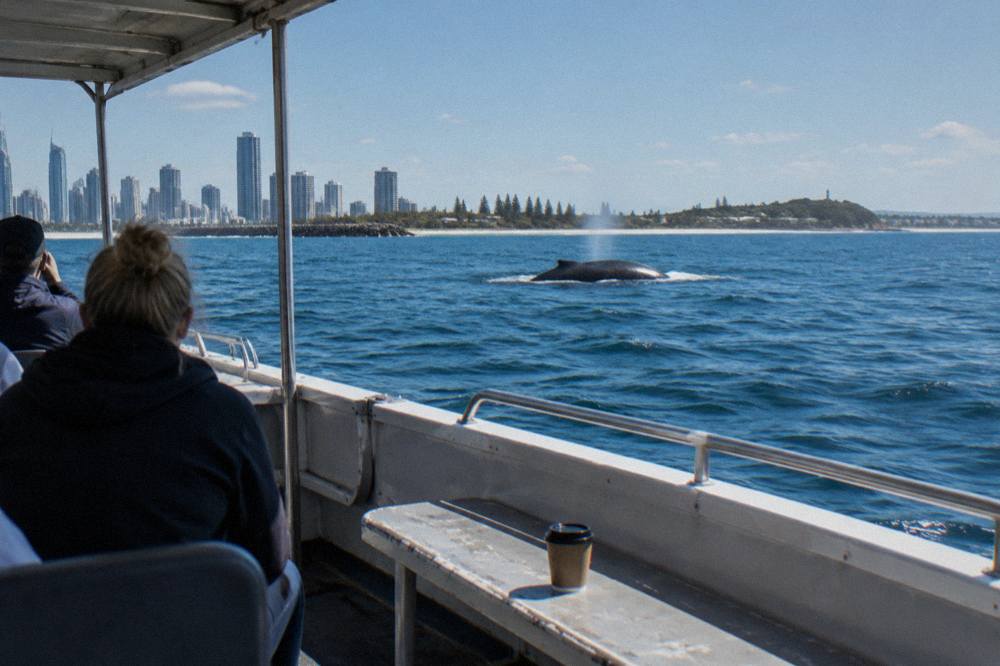
What the rules cannot stop is the whale's own approach, and this is the heart of the answer to the question this article asks. A boat holding position 100 metres out is not invisible to a humpback; the animal's hearing works across kilometres of water and it knows the hull is there. If it swims over, the crew does not reverse away in a panic, because fleeing would be its own kind of interference. The standard practice is engines off or in neutral, silence on the deck, and patience. Encounters like this run from a minute or two to a quarter of an hour, and the whale leaves when it is finished.
The other marine life on the trip plays by the same rules in reverse. Dolphins, which the Gold Coast cruises report on many trips, are the animals most likely to ride a boat's bow voluntarily, and the dolphin caution zone is tighter than the whale's at 150 metres, though a dolphin that chooses to bow-ride is again acting on its own. Turtles and seabirds round out the sightings. The full picture of what a trip holds, calm days included, is laid out in the guide to what to expect on a Gold Coast whale watching cruise, and the species story behind these behaviours is in the guide to humpback whales on the Gold Coast.
The question of whether a whale will come close enough to touch is worth answering plainly: no, and you should not try. Every listing on this roster operates under the approach rules, and a passenger reaching out from a rail is the same offence as a driver closing the distance. The best close encounters end with the whale an arm's length from the hull and every human hand exactly where it belongs.
Do The Small Tweed-Side Boats Get Closer Encounters?
The two Tweed-side small boats, Blue Seafaris from Tweed Heads South and Cooly Eco Adventures from Chinderah, are widely described as offering closer-feeling encounters than the big Gold Coast catamarans, and the reason is geometry rather than law. The 100-metre rule binds every vessel equally, but a 21-guest or 12-guest boat sits low, exposes passengers at eye level, and presents a far smaller, quieter profile for a curious whale to inspect.
Neither boat departs from the Gold Coast itself, and it is worth being precise about that. Blue Seafaris departs from 1A Minjungbal Drive, Tweed Heads South, and Cooly Eco Adventures departs from Chinderah Bay Drive, Chinderah, both on the New South Wales side of the border, and both trips cover the Coolangatta and Gold Coast waters per their listings. The crossing is minutes from the Queensland line, and the whale grounds they work are the same water the Main Beach and Southport cruises reach, but the departure point matters if you are staying in Surfers Paradise and do not want the drive south.
The Cooly Eco Adventures listing describes a custom-built safari-style vessel seating 12, with spray jackets supplied and a marine naturalist on board. Its rating is 4.9 from 68 reviews, from $105.31 per person, about 2.5 hours. The listing states no sighting guarantee, so the honest framing is that the crew works hard and the whales are wild. What the small boat buys you is the water-level view: a humpback rising beside a low freeboard puts its eye level with yours, and when one chooses to circle, there is no upper deck between you and it.
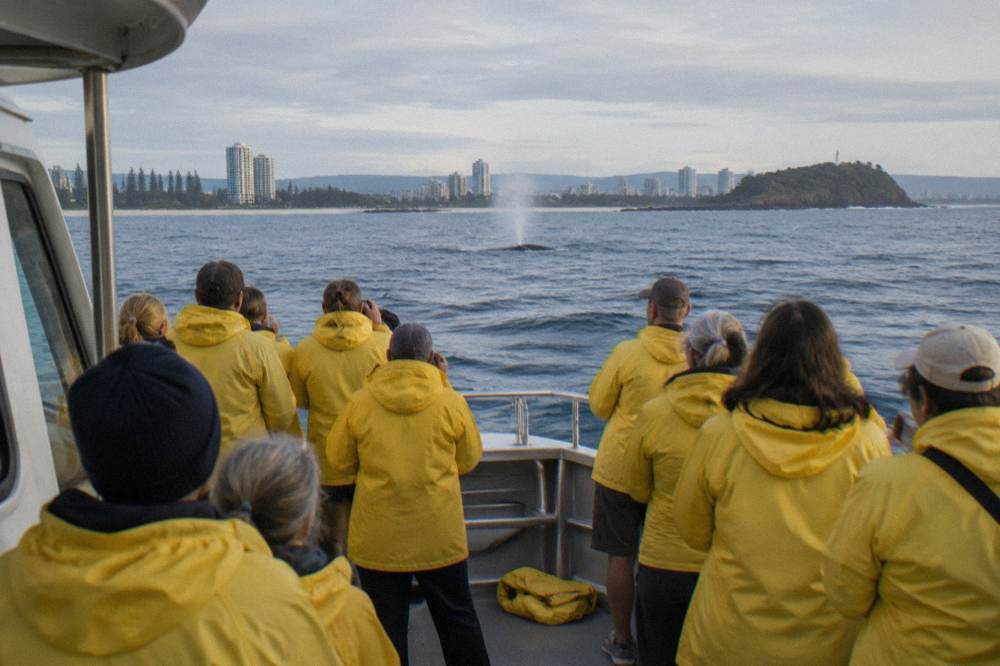
Blue Seafaris runs a similar formula with a marine biologist on board and a small boat, food and drinks excluded from the ticket, 4.9 from 48 reviews, about 2.5 hours. Its listing states a free tour on the next available slot if no whales are sighted, which is the operator's own policy and worth reading as such. It also carries a real "Likely to sell out" badge, as does the Sea World Cruises premium cruise, and no other listing on the roster gets an urgency line. Small-boat berths are genuinely finite, 12 and around 21 seats against hundreds on the big cats, so the badge reflects arithmetic more than marketing.
The comparison with the big boats is not a ranking, it is a trade-off, and the honest version looks like this:
| Vessel | Capacity | Departure point | Eye-level view | Rating and reviews | From, per person |
|---|---|---|---|---|---|
| Cooly Eco safari boat | 12 | Chinderah, NSW | Yes, water level | 4.9 from 68 | $105.31 |
| Blue Seafaris small boat | About 21 | Tweed Heads South, NSW | Yes, low freeboard | 4.9 from 48 | $87 |
| Kokomo cruise | 47 cap | Marina Mirage, Main Beach | Close, small purpose-built vessel | 4.9 from 381 | $62.19 |
| Spirit of Gold Coast catamaran | Large, two decks | Southport | Upper and lower decks | 4.6 from 920 | $52.30 |
| Sea World Cruises premium cruise | Large | Main Beach | Multiple viewing decks | 4.6 from 655 | $55 |
Read the capacity column as the encounter column. A whale that approaches a 12-guest boat is approaching 12 people. The same whale beside a large catamaran is sharing itself across two decks and hundreds of rail positions, and the view from up top, wide and panoramic, is a different experience from the water-level one. Neither is wrong. The question of which suits you is exactly what the best Gold Coast whale watching cruise guide works through, boat by boat.
Which Gold Coast Cruise Gives You The Best Close-Up Odds?
Among the Gold Coast departures, the Kokomo cruise from Marina Mirage is the listing most oriented to close viewing: a smaller purpose-built vessel capped at 47 travellers, 4.9 from 381 reviews, from $62.19 per person, about 2.5 hours, with an underwater camera on board. The Boattime superyacht takes a different route to the same goal, a low luxury yacht with a marine biologist, from $52 per person, 3.7 from 138 reviews, about 2.5 hours.
The Kokomo boat's card name on the listing is "47-Guest Cap Cruise", and that cap is the product. Fewer people at the rail means the boat can rotate everyone through the best positions as a whale works around the hull, and a smaller, nimbler vessel can hold a tidy station when a curious animal decides to inspect it. The listing states no sighting guarantee, which is consistent with how this site reports it: no guarantee, no promise, a crew that positions well and whales that decide for themselves. Free cancellation runs up to 24 hours ahead.
The Boattime superyacht is the wildcard on the roster and the honest read of its numbers is part of this site's job. It is the cheapest listed boat trip at from $52 per person, with light refreshments on arrival and a marine biologist on board, and it is also the lowest rated listing on the roster at 3.7 from 138 reviews. Both facts are real and both belong in a fair comparison. What the yacht offers for closeness is a low, stable platform and a small passenger group on a luxury hull, and what the rating suggests is that the experience has not landed the same way for every guest. The listing states a 100 percent whale sightings guarantee, its own policy, with a free return cruise implied by that wording.
The two big-cat options deserve their own word, because closeness is not the only version of a good whale trip. The Spirit of Gold Coast trip, 4.6 from 920 reviews, the deepest review pool on the roster, runs a 24-metre power catamaran with 360-degree views and a marine biologist guide, from $52.30 per person, about 2 hours 50 minutes, with morning tea included and a humpback sighting guarantee from June to November or a complimentary second cruise, stated as the listing's policy. No hotel pickup: guests make their own way to the departure point. The Sea World Cruises premium cruise, rated 4.6 from 655 reviews, runs about 2.25 to 2.5 hours from the Sea World Cruises Terminal at Main Beach. Hotel pickup is not included, so you make your own way to the terminal, though food and drinks are available to purchase on board. The listing states a 100 percent whale sighting guarantee with a free return cruise. The operator's own site names the Spirit of Migaloo II, a purpose-built catamaran with multiple viewing decks, an underwater camera and a hydrophone, as its newest vessel.
The underwater camera and the hydrophone are worth a pause, because they change what "close" means. A hydrophone lets the whole deck listen to a singing whale that may be hundreds of metres away, and an underwater camera puts a face on an animal that never breaks the surface. On a big catamaran those tools are how the crew closes the sensory distance the law keeps open. On a 12-guest safari boat the tool is the boat itself. Both work, and the choice between them is the choice between panorama and eye level.
What If No Whale Comes Close On The Day?
No operator can change a quiet day, so treat it as a real possibility on every trip here. If that worry matters to you, pick a listing with cover: Sea World Cruises, Spirit of Gold Coast and Boattime each state a free return or second cruise if no whale is seen, Blue Seafaris states a free repeat tour, while Kokomo and the Cooly Eco boat trip state no guarantee at all.
The population numbers make a quiet day less likely than it was a generation ago, which is the quiet good news of this coast. More than 50,000 eastern Australian humpbacks were estimated in 2024, a preliminary figure, up from about 8,000 in 2006 and from a little over 100 when whaling ended in 1963, and the recovery is why a two-and-a-half-hour trip out of Main Beach or Chinderah can be built at all. The first 2026 arrivals were reported off the Gold Coast Seaway on 2 June 2026, a mother and calf, unusually early, and the season runs to early November with peak numbers in July and August.
What a quiet day actually looks like is covered in full in the post on what happens if you do not see a whale on a Gold Coast cruise, including how the return-cruise policies work in practice. The short version for this question: a whale that never comes close is not a failed trip, it is a wild animal day, and the crews that work the coast every morning treat it that way. The official tourism page puts the season at June to November with July and August as peak, and every operator's schedule tracks that window.
If closeness is the priority, book early in the season for the curious juveniles or late for the mothers and calves, choose the smallest boat you can afford, and go in the morning before the wind picks up, which the Queensland Government itself notes is the best spotting window from shore and holds true on the water. Then let the whale decide the rest.
Common Questions About Whales Approaching Boats
Do Whales Come Close To The Boat On The Gold Coast?
Yes, regularly, but on the whale's terms. Queensland law keeps every boat at least 100 metres from a humpback, so a cruise never closes the gap itself. Curious whales, especially juveniles, do swim over to inspect a stationary boat, and the low, small vessels such as the 12-guest Cooly Eco safari boat and the 21-guest Blue Seafaris boat are where those approaches feel closest.
How Close Can A Whale Watching Boat Legally Get To A Whale?
In Queensland, 100 metres from a whale and 300 metres in front of or behind it, with a maximum of 6 knots inside a 300-metre caution zone and no more than three boats in one whale's caution zone. In NSW waters, where the Tweed-side boats work, the boat distance is also 100 metres, and a swimmer must enter the water at least 100 metres away and keep 30 metres clear.
Can A Whale Touch The Boat?
A whale can choose to come alongside or beneath a stationary hull, and crews respond by going into neutral and holding still. The rules govern what the boat does, not what the whale does. Passengers must keep hands and cameras inside the rails, and reaching out toward a whale is an offence in both Queensland and NSW waters.
Do The Small Tweed-Side Boats Get Closer Encounters Than The Gold Coast Catamarans?
They get closer-feeling encounters, because the same 100-metre rule applies to every vessel but a 12 or 21-guest boat sits low, quiet and at eye level. Blue Seafaris departs Tweed Heads South and Cooly Eco Adventures departs Chinderah, both in New South Wales, and both trips cover the Coolangatta and Gold Coast waters per their listings.
Which Whales Are Most Likely To Approach A Boat?
Juveniles and young adults, which lead the northbound migration in June and July, are the most curious and most likely to inspect a stationary vessel. Mothers with calves, travelling at the rear of the migration from August to October, are warier, and crews give them the widest possible berth in line with the approach rules.
Is A Close Encounter Guaranteed If I Book A Whale Cruise?
No. Whales are wild and no operator can promise an approach or even a sighting. Three listings state their own sighting guarantees with a free or second cruise attached, Sea World Cruises, Spirit of Gold Coast and Boattime, and Blue Seafaris states a free repeat tour. Kokomo and the Cooly Eco boat trip state no guarantee at all, and every listing on this roster offers free cancellation.