Humpback Whales Of The Gold Coast: A Species Guide For Cruise Visitors
Every whale that passes the Gold Coast between late May and early November is a humpback, and every one of them is on a round trip of up to 10,000 kilometres. This guide explains what the species is, when it passes, what its behaviour looks like from a cruise deck, and how a population once hunted to about 100 animals came back to around 50,000.
Short answer
The whales passing the Gold Coast are humpbacks, up to 16 metres long and up to 45 tonnes, migrating north from June to August and south from September to November. Peak numbers fall in July and August; mothers with newborn calves pass closest to shore in September and October. Boat tours run about 2 to 3 hours and cost from $52 to $105.31 per person.
The humpback whale is the only large whale species you will meet on a Gold Coast cruise, and for roughly five months of the year it owns this coastline. The whales that breach off Main Beach, slap their tails off Burleigh and glide past the Sea World Cruises terminal are all Megaptera novaeangliae, the long-finned acrobat of the east Australian migration. Their story is bigger than any single breach: a round trip of up to 10,000 kilometres each year, a population rebuilt from about 100 animals to more than 50,000, and a calendar that decides what you will see from the deck before you even leave the marina.
This guide covers the species itself, for the visitor who wants to understand what they are looking at, not just spot it. It pairs each behaviour with the time of season it appears, sizes the animal honestly, and explains the Queensland rules that keep every licensed boat at a respectful distance. Along the way it points to the actual cruises you can book, including the Spirit of Gold Coast marine biologist trip, the Sea World Cruises premium cruise and the Blue Seafaris small boat from the Tweed. For the practical side of choosing a departure, start with the Gold Coast whale watching tours compared guide.
What Kind Of Whale Passes The Gold Coast?
Every large whale seen off the Gold Coast between June and November is a humpback, identified by its long white pectoral fins, knobbly head and the hump that arches before a dive. Adults reach a maximum length of 16 metres and a weight of up to 45 tonnes. The east Australian population passing here is one of the strongest humpback recoveries in the world, estimated at more than 50,000 animals.
Humpbacks are baleen whales: they filter-feed on krill and small fish in the cold southern waters where they spend summer, then fast for months while breeding in the tropics. The Australian Government's species page describes the eastern migration as an annual journey of up to 10,000 kilometres, with the majority of animals moving north from June to August and returning toward the Southern Ocean from September to November. Groups of young males typically lead the migration, while pregnant cows and cow-calf pairs bring up the rear, which is why the Gold Coast's September and October waters hold so many mothers with newborns.
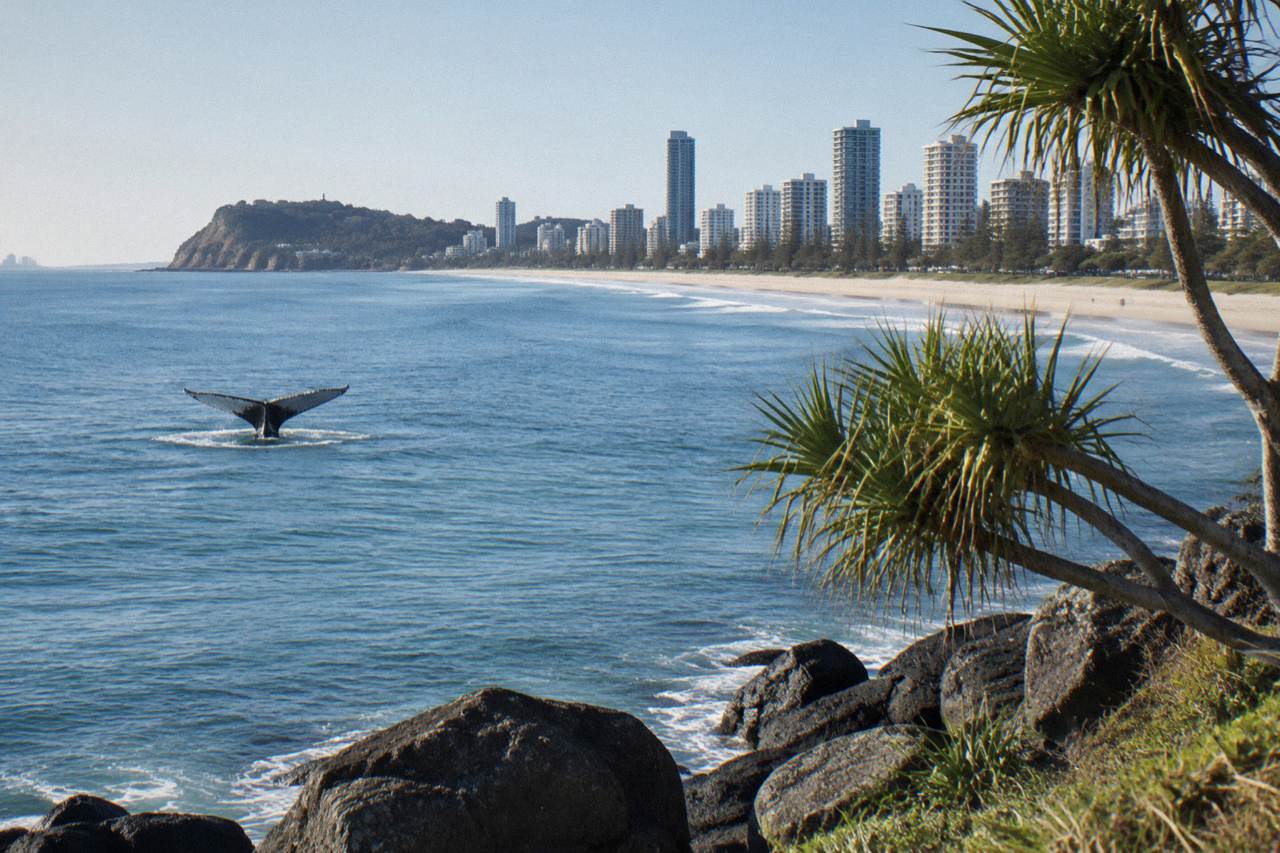
Two features make them the perfect whale for a watching cruise. The pectoral fins, the longest of any whale relative to body size, are visible from hundreds of metres away when they are slapped on the surface or held out of the water. And the fluke, raised high before a deep dive, is individually patterned: the black and white underside works like a fingerprint, which is how researchers track individual animals along this coast.
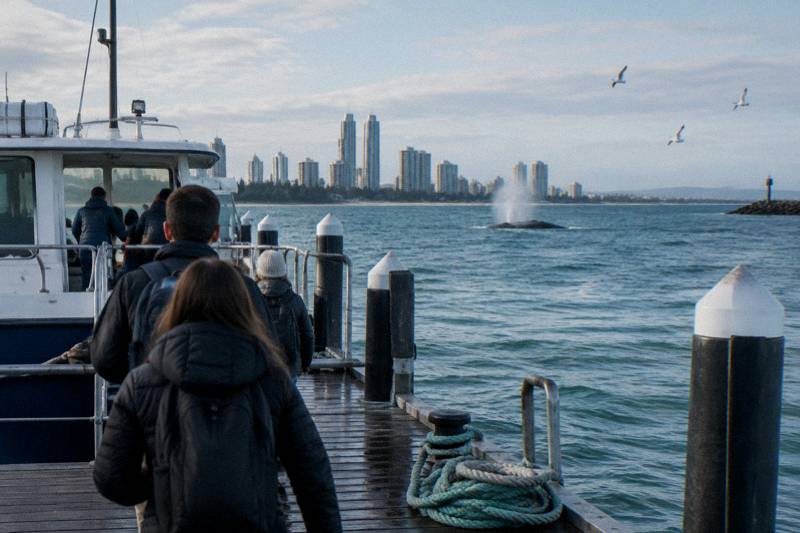
From a deck, the sequence of tells is consistent. A blow first, a tall bushy spout as the whale exhales. Then the back rolls through the surface, and if the tail lifts you are watching a dive rather than a breath. A cruise that finds a resting pod can sit with animals at the legal distance for many minutes, and the Spirit of Gold Coast trip's lower and upper decks are built exactly for that kind of extended viewing.
When Do Humpbacks Pass The Gold Coast?
The season runs from late May or early June to early November, with peak numbers in July and August on the northbound leg and mothers with newborn calves passing from August to October on the southbound. The first humpbacks of 2026 were reported off the Gold Coast Seaway on 2 June 2026, a mother and newborn calf, noted by researchers as very early.
The calendar splits into two distinct halves, and which half you book into changes what you see. Northbound whales, heading to the breeding grounds from June through July, include the juveniles and young adults that travel first, followed by adults and competitive pods. These are the weeks of high energy: breaching, tail slapping and the surface chases of males competing around a female. Southbound whales, from August to October, are the family traffic. Mothers with newborn calves travel slower and closer to shore, and the tourism board's own guidance names September and October as the best months to see mothers and calves.
| Part of the season | Months | Who is passing | What you are most likely to see |
|---|---|---|---|
| Early northbound | Late May to June | Juveniles and young adults first | First breaches of the season, fast travel |
| Peak northbound | July to August | Adults, competitive pods | Highest numbers, surface activity, chases |
| Early southbound | August to September | Mothers with newborn calves | Close-to-shore travel, calf practice breaches |
| Late southbound | October to early November | Stragglers, late mothers and calves | Long resting encounters, tail dives |
The practical read of that table: if your priority is raw action, book July or August. If it is a mother and calf pair, book September or October and accept a slower, quieter encounter. The which month is best for whale watching on the Gold Coast post works through this trade-off in detail, and the Gold Coast whale watching season guide covers the departure calendar.
The cruises that put you in front of this migration are all about the same length: about 2 to 3 hours, from $52 to $105.31 per person for boat-based watching. The Spirit of Gold Coast whale watching trip runs about 2 hours 50 minutes from Aqua Adventures at Southport, from $52.30 per person, with a marine biologist guide on board. The Sea World Cruises premium whale watching cruise runs about 2.25 to 2.5 hours from the Sea World Cruises Terminal at Main Beach, with the price shown on the live booking page. Hotel pickup is not included, so make your own way to the terminal. The Blue Seafaris marine biologist trip, a small boat departing the Coolangatta and Tweed Heads end of the coast, runs about 2.5 hours, and food and drinks are not part of the ticket.
How Big Is A Humpback Whale, Really?
A fully grown east Australian humpback reaches a maximum length of about 16 metres and weighs up to 45 tonnes, with newborn calves born at around a tonne or more after an eleven to twelve month gestation, then staying with their mothers for 11 to 12 months. On a 24 metre catamaran like the Spirit of Gold Coast, an adult alongside is roughly two thirds the length of the boat you are standing on.
Numbers this large are hard to feel, so put them against the boat. The Spirit of Gold Coast cruise runs about 2 hours 50 minutes; a fully grown humpback alongside can reach 16 metres and weigh up to 45 tonnes. The Sea World Cruises operation names the Spirit of Migaloo II, a purpose-built catamaran with multiple viewing decks, an underwater camera and a hydrophone, as its newest whale watching vessel. The Kokomo boat is smaller by design, capped at 47 travellers, which is why its 4.9 rating from 381 reviews tends to describe close, unobstructed encounters.
| Measurement | Adult humpback | How it reads from a deck |
|---|---|---|
| Maximum length | 16 metres | About two thirds of a 24 m catamaran |
| Maximum weight | Up to 45 tonnes | Heavier than a loaded semi-trailer |
| Pectoral fin | Roughly a third of body length | Unmistakable white slaps visible far off |
| Calf at birth | Around a tonne or more | Already the size of a small car |
| Time with mother | 11 to 12 months | Calves seen in Sep-Oct were born last winter |
Weight is the figure that surprises people. Forty-five tonnes is heavier than a loaded semi-trailer, moving through water with the acceleration of a breaching launch. When a whale that size clears the surface, the sound of the re-entry carries across a kilometre of calm water, and every cruise in the fleet will stop for it.
What Does Each Behaviour Look Like From A Cruise Deck?
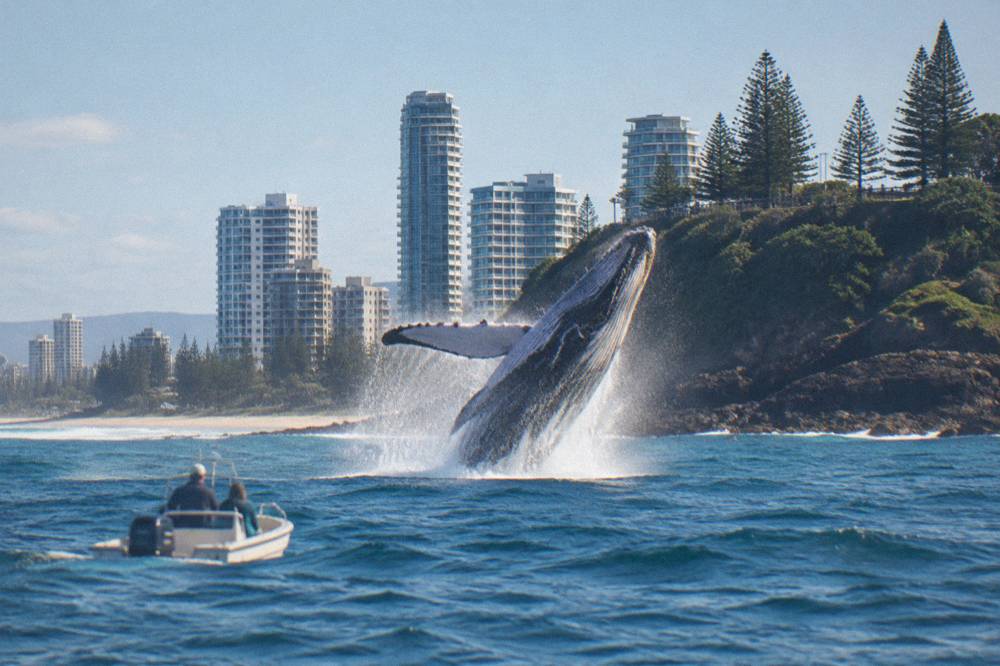
Breaching is a full or partial clear of the surface, landing in a white splash visible a kilometre away; a tail slap is the fluke hammered down repeatedly; a pectoral slap is a long white fin clapped onto the water; a fluke-up dive is the tail raised high before a deep descent. The marine biologist on the Spirit of Gold Coast trip will usually name each behaviour as it happens.
Surface behaviour is the language of the species, and each act has a signature. A breach begins with a steep upward rush, the whale sometimes clearing fully before crashing onto its back or side. The splash is the tell: tall, white and wide, visible far beyond the animal itself. Researchers treat repeated breaching as likely social signalling, possibly to other whales, possibly to do with parasites or simply exuberance; nobody has fully settled it, and a good guide will say so honestly.
The tail slap is the percussion instrument. The whale hangs vertically in the water, tail up, then slams the fluke down again and again, each hit a flat crack across the calm. Researchers often read repeated tail slapping as a social signal. Pectoral slapping is gentler and unmistakable: a long white fin, roughly a third of the animal's body length, held out of the water then clapped down on the surface. Spy-hopping, the head rising vertically to look around, is the behaviour that most convinces passengers the whale is watching them back.
| Behaviour | What it looks like | When it is most common |
|---|---|---|
| Breach | Full or partial clear of the surface, huge white splash | Peak northbound, July and August |
| Tail slap | Fluke hammered down repeatedly, loud flat cracks | All season, competitive pods |
| Pectoral slap | Long white fin raised and clapped onto the water | All season, resting animals |
| Spy-hop | Head rises vertically, eyes just above the surface | Calm days, curious animals |
| Fluke-up dive | Tail raised high before a deep dive | Deep-water travel, ending an encounter |
From the deck, position matters more than luck. A whale surfaces on its own schedule, and a boat that holds station at the legal distance gives you the whole horizon to scan. The which side of the boat is best for whale watching post covers this in detail, but the short version is that humpbacks surface unpredictably, so a boat with lower and upper decks, like the Spirit of Gold Coast catamaran, or an eye-level small boat, like the Cooly Eco Adventures safari vessel seating 12 with a marine naturalist aboard, gives you more usable angles than a single-rail view.
The behaviour also explains why the marine-biologist-led trips earn their keep. A guide who can read whether a pod is travelling, resting or socialising will tell you when to keep your camera up and when to sit down, and that difference is the difference between a good hour and a great one.
Mothers And Calves On The Southbound Leg
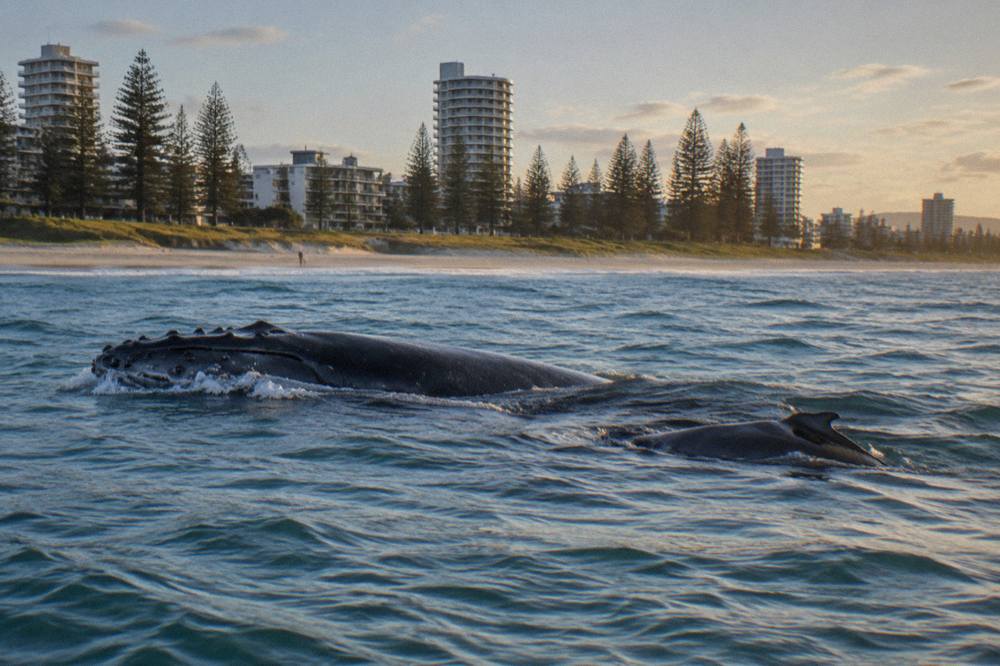
From August to October the southbound traffic is dominated by mothers with newborn calves travelling slower and closer to shore, with the best mother-and-calf sightings in September and October. A calf stays with its mother for 11 to 12 months, so the pairs seen late in the season were born the previous winter and are learning the migration route from her.
The southbound leg is the Gold Coast's quiet advantage over other watching ports. Mothers with calves hug the coast on the way south, and a calf born in the tropical breeding grounds is weeks or months old by the time it passes here. What you see from a deck is tuition: the calf practises breaches it cannot yet land, lifts its small fluke awkwardly, and stays within a body length of the mother, who positions herself between the calf and any boat. The full index of guides sits on Whale Watching On The Gold Coast.
Cruises report these as the most patient encounters of the season. A travelling pod surfaces on a rhythm and moves on; a mother and calf pair resting in shallow water can stay near a stationary boat for a long stretch, and the rules let the watching boat hold its position while the pair decides what to do. Dolphins, turtles and seabirds share these late-season waters too, and cruise crews will usually point them out while the whales rest.
The listing for the Spirit of Gold Coast trip guarantees a humpback sighting from June to November or a complimentary second cruise, which is the operator's own policy rather than a promise about any particular day. That guarantee matters most in the shoulder weeks, when the migration thins: early June, when the first pass is just beginning, and late October, when the last mothers and calves are heading south. For more on the safety net, see what happens if you do not see a whale on a Gold Coast cruise.
The 10,000 Kilometre Migration Explained
The east Australian humpbacks complete an annual migration of up to 10,000 kilometres, feeding in the Southern Ocean in summer, travelling north to tropical breeding grounds from June to August, and returning south with calves from September to November. The Gold Coast sits directly on the corridor, close enough to the breeding grounds that the whales pass in a steady stream rather than a single wave.
The shape of the journey explains the season. Humpbacks feed in the cold, krill-rich waters of the Southern Ocean over summer, building the fat reserves that carry them through a fasting breeding season. Around April the coast starts to come alive, as the federal environment department puts it, and the stream north begins. Young males lead, pregnant cows and mother-calf pairs trail, and the whole population funnels along the east Australian shelf, close enough to shore that a headland with binoculars can watch it pass.
The Gold Coast's position on that corridor is unusually good. The whales pass within sight of the coastline, and the local cruise grounds begin minutes from the marinas at Main Beach and Southport. The Sea World Cruises premium whale watching cruise, from $55 per person, is a short transit from the Seaworld Drive terminal to open water, and its listing states a 100% whale sighting guarantee with a free return cruise, the operator's own policy. The where Gold Coast whale watching cruises depart guide maps every departure point on the roster.
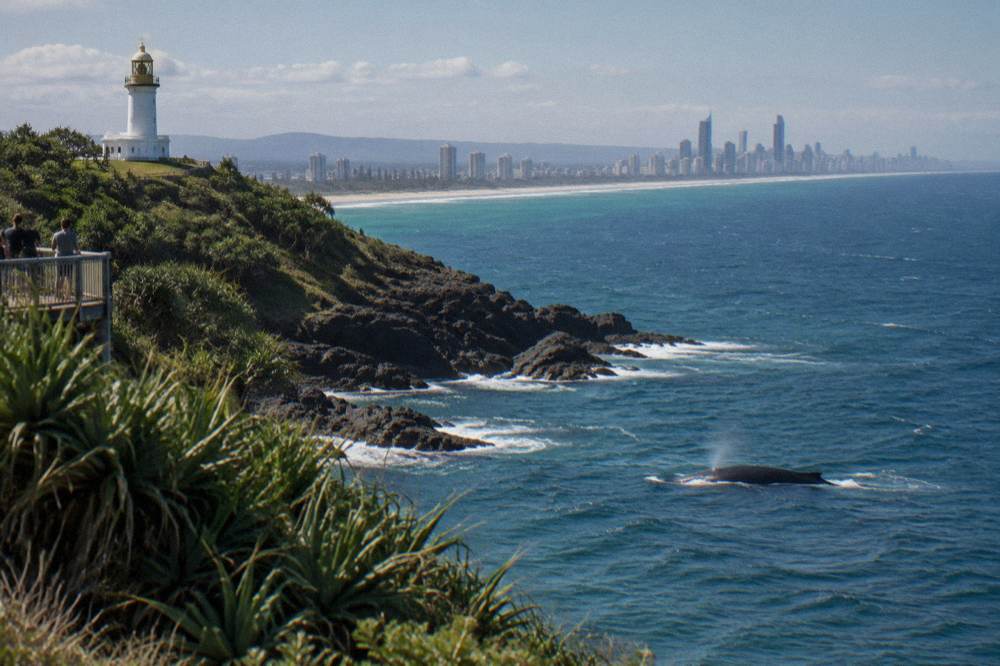
One behaviour worth knowing before you sail: the whales do not eat on the migration. Every breach, slap and chase you see off the Gold Coast is fuelled by reserves built months earlier in Antarctic water. That is why late-season mothers and calves can look thinner than the athletes of July, and why a resting mother is left to rest. A good crew will explain the energetics on the way out, and it changes how you watch a calf practising its breaches.
From 100 Whales To 50,000: The East Coast Recovery
The east Australian humpback population was down to a little over 100 individuals when whaling ended in 1963, was estimated at around 8,000 in 2006, and a preliminary 2024 estimate puts it at more than 50,000, growing around 10 to 11 percent a year. That recovery, about 20,000 more animals than the estimated pre-whaling population of the early 1900s, is why the Gold Coast now has a whale season at all.
This is the part of the story that a first page of search results rarely tells you straight. Commercial whaling took the east coast population from thousands to a little over 100 animals by 1963. Protection followed, and the species rebuilt at around 10 to 11 percent a year: roughly 8,000 by 2006, and more than 50,000 by the 2024 preliminary estimate reported by ABC News, which the report itself notes is not yet peer-reviewed. 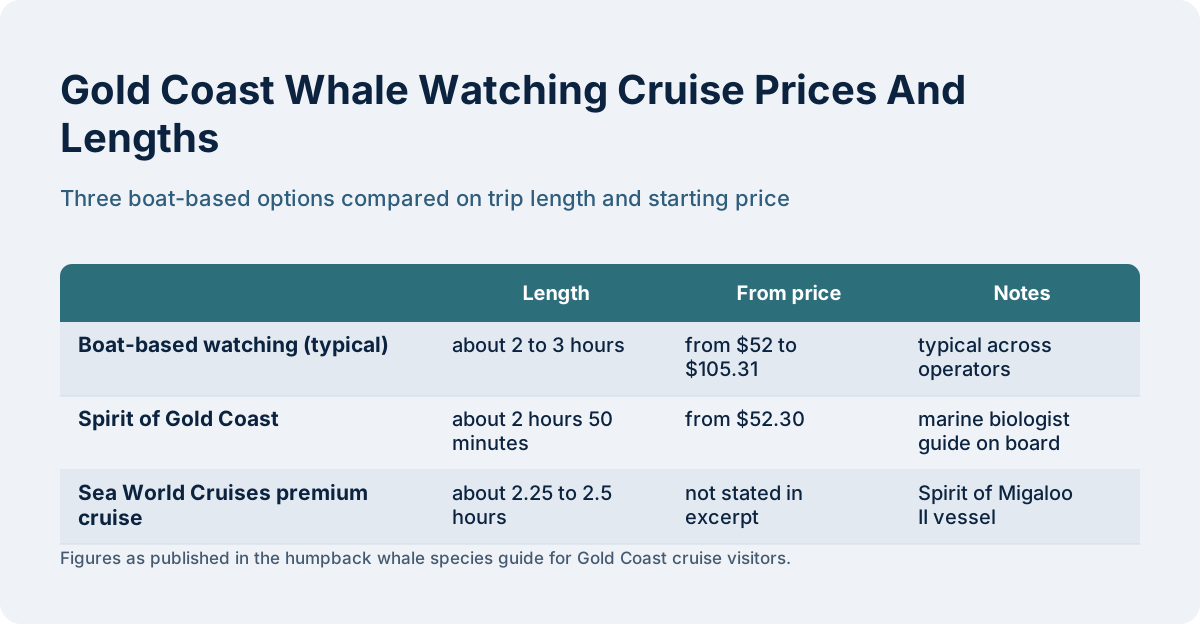
| Year | Estimated east coast population | Source note |
|---|---|---|
| 1963 | A little over 100 | When whaling ended, per federal environment reporting |
| 2006 | Around 8,000 | Federal environment department figure |
| 2024 | More than 50,000 | Preliminary estimate, not yet peer-reviewed |
| Growth rate | Around 10 to 11% a year | Federal environment department |
The recovery is not abstract. It is the reason a mother and calf could be reported off the Gold Coast Seaway in the first week of June 2026, in shallow water just outside the entrance, weeks before the main stream arrived. It is the reason volunteer counts along the Queensland and New South Wales coast log hundreds of whales in a single morning in late June. And it is the reason a species guide like this one is written for cruise passengers rather than historians.
Queensland Rules That Shape Every Cruise
Queensland rules require boats to keep at least 100 metres from a whale and 300 metres in front of and behind it, slow to 6 knots inside the caution zone, and allow no more than three boats in one whale's caution zone. Swimmers must stay 100 metres clear, and boats must keep 500 metres from a predominantly white whale such as Migaloo.
The approach distances are the invisible architecture of every trip you will take. Updated in March 2026, they are the reason every licensed cruise watches from a set distance. When a whale swims toward a stationary boat, and they sometimes do, the engines drop to neutral and the encounter happens on the whale's terms. When a pod is travelling, the boat holds a parallel course at the legal distance and lets the whales come to it. The three-boat rule means a crowded encounter self-limits: once three vessels are inside the caution zone, no fourth may enter, which protects the whale and, incidentally, the quality of your photographs.
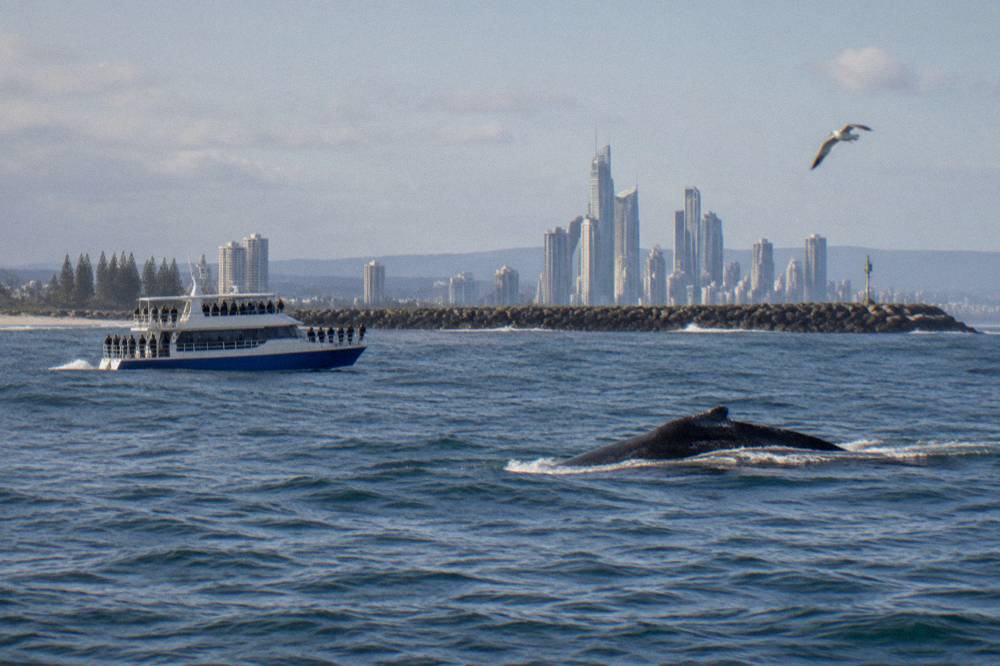
The full rule set, from the Queensland Government's rules for watching marine mammals, also covers the periphery: drones stay 100 metres away, helicopters 500, jet skis 300. The species background in this guide comes from the federal humpback whales of Eastern Australia page, and the population estimate from ABC News reporting on the preliminary 2024 estimate.
The white-whale rule deserves its own sentence, because Migaloo is the one animal that can clear a watching fleet. A predominantly white humpback carries a 500 metre boat exclusion and a 610 metre aircraft exclusion in Queensland waters. The 2026 reports of a white whale off New South Wales were unconfirmed, and no Gold Coast sighting was verified, so no cruise here will claim to have seen him. But every crew knows the rule, and on the unlikely day a white flank shows up, the day changes.
For the Tweed-side trips the rules shift, because those boats work New South Wales water. In NSW a swimmer enters the water at least 100 metres from a whale and then keeps 30 metres clear, which is the framework under which the one swim-with-whales trip in this region operates, departing Chinderah on the Tweed River, south of the Queensland border. No authorised swim-with-whales tour departs the Gold Coast itself; licensed swim operations in Queensland run from Hervey Bay and the Sunshine Coast. The swim with whales guide explains the distinction fully.
Which Cruise Puts You Closest To The Behaviour?
For behaviour-watching, the choice is between the big-deck Gold Coast catamarans and the small eye-level boats from the Tweed. The Spirit of Gold Coast trip, rated 4.6 across 920 reviews, carries a marine biologist; the Sea World Cruises premium cruise, rated 4.6 across 655 reviews, runs with free cancellation; the Blue Seafaris small boat, rated 4.9 across 48 reviews, keeps numbers low. None of the three includes hotel pickup, so guests make their own way to the departure point.
The honest framing is that every boat on this roster watches the same whales under the same rules, so the differences are about angle, crowd and guide. The Spirit of Gold Coast catamaran's lower and upper decks suit photographers who want height and stability. The Sea World Cruises premium cruise suits visitors staying anywhere along the coast, but hotel pickup is not included, so guests make their own way to Main Beach. The Blue Seafaris boat, departing Tweed Heads South in New South Wales and covering Coolangatta and Gold Coast waters per its listing, suits travellers who want a small group, a marine biologist and a meal, from $87 per person with a free repeat tour if no whales are sighted, the listing's own policy.
| Cruise | Boat style | Group size | From (per person) | Rating and reviews | Guide |
|---|---|---|---|---|---|
| Spirit of Gold Coast | 24 m power catamaran, two decks | Standard cruise load | $52.30 | 4.6 from 920 reviews | Marine biologist |
| Sea World Cruises premium | Purpose-built whale watching vessel | Standard cruise load | $55 | 4.6 from 655 reviews | Crew commentary |
| Kokomo Cruises | Smaller purpose-built vessel | Capped at 47 | $62.19 | 4.9 from 381 reviews | Crew commentary |
| Blue Seafaris | Small boat | Around 21 | $87 | 4.9 from 48 reviews | Marine biologist |
Two notes of honesty in that table. The Kokomo boat's 4.9 from 381 reviews is the strongest rating on the Gold Coast side of the roster, but its listing states no sighting guarantee, so no free-return safety net applies. And the Blue Seafaris rating comes from only 48 reviews, a small pool, so read it as what it is rather than as a crowd verdict. The best whale watching cruise guide works through the full comparison, including the Boattime superyacht option, from $52 per person, the cheapest listed price on the roster, with a marine biologist on board and a light tea on arrival.
Whichever boat you choose, the species does not change. A humpback off Main Beach in August is the same animal, doing the same migration, as one off the Tweed in September: up to 16 metres, up to 45 tonnes, part of a population that has come back from about a hundred animals to a preliminary estimate of more than fifty thousand. The cruise is two or three hours. The story you are watching is sixty years of recovery, written on the surface of the water.
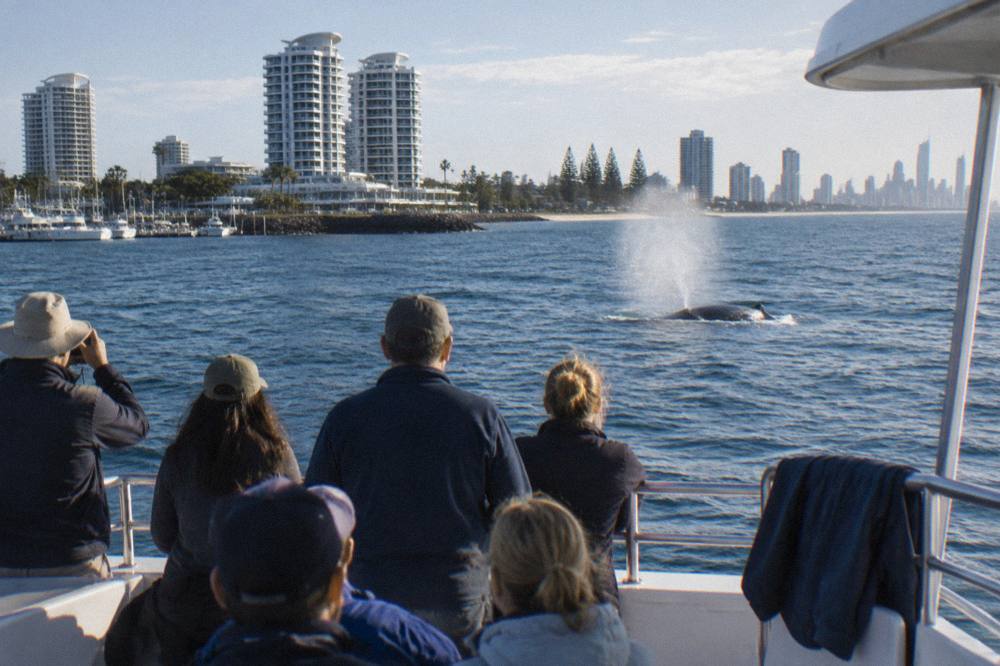
If the small-boat angle appeals but the Tweed departure does not suit your plans, the Kokomo boat splits the difference: a purpose-built vessel capped at 47 travellers, departing Marina Mirage at Main Beach, about 2.5 hours, from $62.19 per person, rated 4.9 from 381 reviews. Its listing states no sighting guarantee, so there is no free-return safety net, but the cap keeps the rail uncrowded on a busy August morning, and free cancellation applies up to 24 hours ahead.
Common Questions About Humpback Whales On The Gold Coast
What Kind Of Whales Come To The Gold Coast?
Humpback whales only. Every large whale seen off the Gold Coast between late May or early June and early November is a humpback, up to 16 metres long and up to 45 tonnes, migrating between the Southern Ocean feeding grounds and tropical breeding waters. Cruises also report dolphins, turtles and seabirds.
How Big Do Gold Coast Humpbacks Get?
A fully grown adult reaches a maximum length of about 16 metres and weighs up to 45 tonnes. Newborn calves are born at around a tonne or more and stay with their mothers for 11 to 12 months, which is why the mother-and-calf pairs seen in September and October were born the previous winter.
When Is The Best Time To See Humpback Whales On The Gold Coast?
Peak numbers fall in July and August on the northbound leg, with the highest surface activity. Mothers with newborn calves pass from August to October, travelling slower and closer to shore, and the tourism board names September and October as the best months for mother-and-calf sightings. The season runs from late May or early June to early November.
Why Do Humpbacks Breach And Slap Their Tails?
Researchers treat breaching and tail slapping as social signalling, though the exact function is not fully settled; repeated breaches are often associated with competitive pods and group activity, while pectoral slapping is common among resting animals. Every behaviour is visible from a cruise deck, and a marine biologist guide will usually name each act as it happens.
How Close Do The Boats Get To The Whales?
Queensland rules require boats to keep at least 100 metres from a whale and 300 metres in front of and behind it, and to slow to 6 knots inside the 300 metre caution zone. No more than three boats may share one whale's caution zone. If a whale approaches a stationary boat, the engines go to neutral and the encounter happens on the whale's terms.
Are Humpback Whales Endangered In Australia?
The east Australian population fell to a little over 100 animals when whaling ended in 1963, was estimated at around 8,000 in 2006, and a preliminary 2024 estimate puts it at more than 50,000, growing around 10 to 11 percent a year. The estimate is noted as not yet peer-reviewed.