Are Humpback Whales Friendly To Humans?
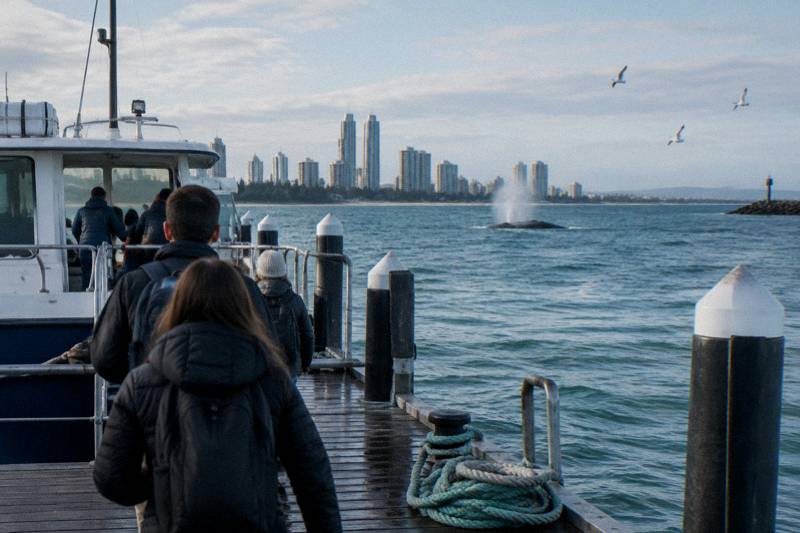
Humpbacks often approach boats out of curiosity, but the law keeps people 100 metres away. Here is what friendly really means on the Gold Coast, and how to watch respectfully.
Are Humpback Whales Friendly To Humans?
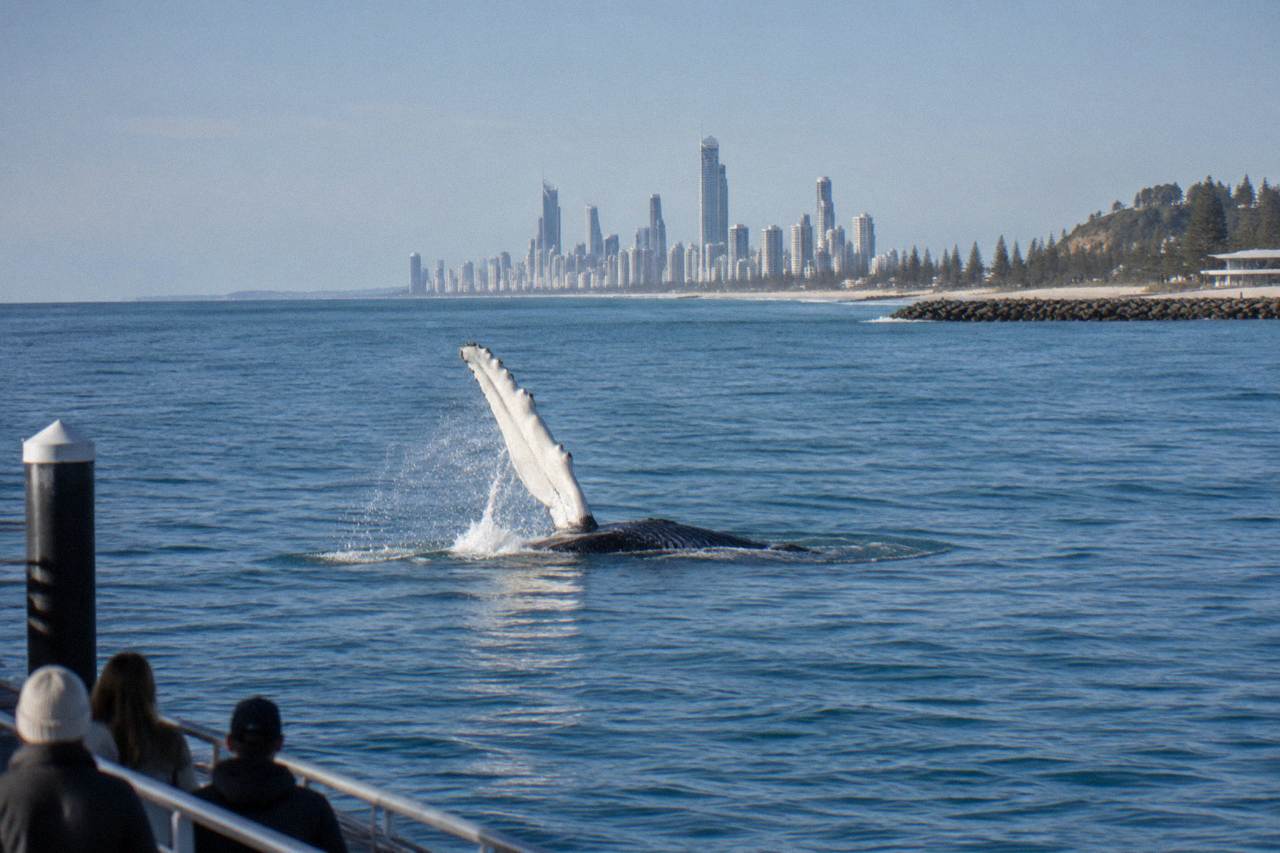
No humpback whale has ever been domesticated, tamed or trained to seek people out, so friendly is the wrong word for what happens on the water. What humpbacks show instead is tolerance and curiosity: they will approach a stationary boat, roll beside the hull and watch the people on deck, entirely on their own terms. Queensland law treats them as wild animals regardless, keeping boats 100 metres away and people out of the water near them.
The question comes up on almost every cruise that leaves Main Beach or Southport in season, usually about ten minutes after the first blow is called off the bow. A whale surfaces close enough that you can see the barnacles on its chin, it hangs there, and someone asks why it came over if it does not like us. The honest answer is that liking us is probably not what is happening at all.
Humpbacks are baleen whales that feed on krill and small fish, so humans have never been prey, competitor or predator in any way their instincts recognise as urgent. The east coast population was hunted to a little over 100 individuals when Australian whaling ended in 1963, and it has since recovered to more than 50,000 animals in a preliminary 2024 estimate, growing around 10 to 11 percent a year for decades. Every living humpback off the Gold Coast was born into a population that has mostly known boats as noisy but harmless things, and the younger whales in particular treat them as something worth investigating. Relaxed around boats does not mean free of danger, though, and the natural enemies that still threaten humpback whales explains which predators target calves and why mothers guard them so fiercely.
That is the curiosity Gold Coast operators see from June to early November. Juveniles and young adults travel north first in June and July, and they are the whales most likely to sidle up to a drifting vessel, spyhop, or lie on their side with one eye above the surface. Adults in competitive pods are busier with each other. Mothers with newborn calves, most common from September to October, are the most protective and the least playful, which is one reason the rules around them are the strictest of all.
The boats that go out to meet them range from the Sea World Cruises purpose-built vessel with its multiple viewing decks to the 12-guest Cooly Eco safari boat that sits low enough for eye-level viewing. What every one of them has in common is that the whale decides the encounter. No Gold Coast crew chases, feeds, calls or touches a humpback, and the ones that come close come close because they chose to. If that kind of chosen encounter sounds appealing, our guide to close whale encounters explains the approach rules and what tends to happen when a curious humpback closes the gap itself.
If you are weighing which trip gives you the best chance of a curious whale lingering at the hull, these three listings cover the spread of formats on the water.
Why Boats Must Stay 100 Metres From Whales
Queensland rules require a boat to keep at least 100 metres from any whale and 300 metres from the space directly in front of and behind it, slowing to 6 knots inside the 300 metre caution zone. No more than three boats may share one whale's caution zone, and a person in the water must stay 100 metres clear. These distances exist because a 45 tonne animal and a small boat cannot safely share the same patch of ocean.
The distance rules are not operator policy or marketing caution, they are the state's Rules for watching marine mammals, updated on 5 March 2026, and every licensed cruise on this coast operates inside them. A whale can weigh up to 45 tonnes and reach 16 metres in length, and a startled animal that flukes hard or breaches without warning displaces an enormous amount of water. The 100 metre no-approach zone gives the whale room to leave, and the 300 metre front-and-back corridor protects boats from an animal that may surface ahead without slowing.
| Who or what | Minimum distance from a whale | Key extra rule |
|---|---|---|
| Boats and paddle craft | 100 m, plus 300 m ahead and behind | 6 knots maximum inside the 300 m caution zone |
| Number of boats | Three per caution zone | A fourth boat must stay outside |
| Jet skis and hovercraft | 300 m | Classified as prohibited vessels |
| Drones | 100 m horizontal and vertical | No low passes over a pod |
| Helicopters | 500 m | No hovering above a whale |
| People in the water | 100 m | Entering the water closer is an offence |
| Predominantly white whales | 500 m for boats | Aircraft must keep 610 m |
The three-boat rule explains a lot of what you see on a busy August morning. When the Sea World Cruises vessel, a Spirit of Gold Coast trip and a small Tweed-side boat all converge on the same pod, the first three into the caution zone hold it and everyone else waits their turn at distance. Crews radio each other, take turns, and the whale gets a say too: if it lifts and travels, the whole arrangement resets around wherever it goes.
Whales do not know the rules, which is why the rules also cover what happens when one approaches you. If a humpback swims into a boat's no-approach zone of its own accord, the correct response is to disengage the engines or withdraw slowly rather than flee. That single provision is what makes the close encounters on this coast legal, and it is why a curious whale can sit beside a stationary hull for half an hour while everyone on deck takes photos. The boat held still, the whale came to it, and no rule was broken. A whale that calm rarely arrives without warning, and the signs that give away a nearby humpback can tip you off long before it drifts alongside the hull.
So where does that leave someone who wants to be near these animals? The honest options are a licensed viewing cruise or a headland with binoculars, and the cruise side of that choice is exactly what the Cooly Eco safari boat and its small-boat rivals exist for.
Do Whales Choose To Come Close To Boats?
Yes, and the choice is entirely theirs. Humpbacks regularly alter course to investigate a drifting or slow-moving vessel, circle it, roll to look up at the deck, and linger for minutes at a time. Crews cannot ask a whale to approach, and the regulations forbid chasing one, so every close encounter on a Gold Coast cruise is a whale exercising its own curiosity. When it has seen enough, it leaves without ceremony.
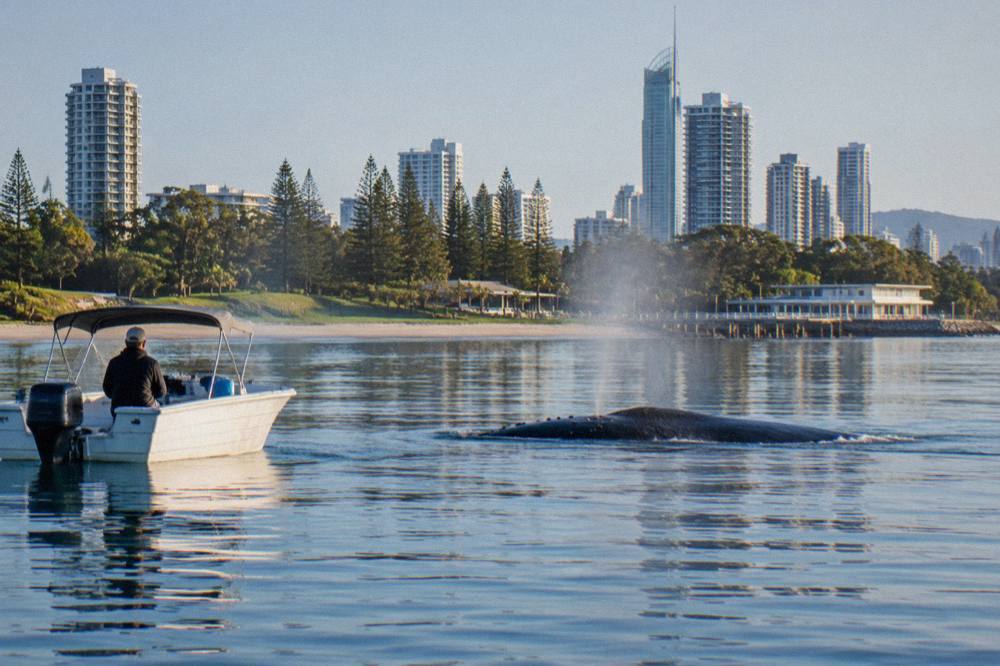
The behaviour has a name in the industry: mugging. A whale mugs a boat when it comes to the vessel and stays, and the correct crew response is always the same, engines off or in neutral, hands inside the rails, voices low. Mugging is most often reported from the smaller boats. The Cooly Eco safari-style vessel from Chinderah sits low and open with a maximum of 12 travellers, and its eye-level deck puts guests close to the waterline where a curious whale's eye is level with theirs. The Blue Seafaris boat out of Tweed Heads South carries around 21 guests with a marine biologist on board and reports the same pattern.
What the whales are actually doing is harder to pin down, and the researchers who study them are careful not to overclaim. One working theory is that boats are simply interesting: a new shape, a new sound, a shadow on the surface. Another is that humpbacks, which have no natural predators as adults beyond orcas and humans, simply never evolved a strong flight response to large slow objects. A third, popular with crews, is that a stationary boat in a busy migration corridor is a good place to pause, the way a traveller pauses at a lookout.
Whatever the mechanism, the pattern holds across the season and across every operator format. The larger Sea World Cruises catamaran with its underwater camera and hydrophone gets its share of close passes, and the Kokomo boat from Marina Mirage, capped at 47 travellers, is marketed around exactly this kind of fast, intimate, unobstructed viewing. None of them can promise it. Some trips the whales pass at regulation distance and keep going north, and a good crew tells you that honestly at the dock.
The distinction matters because it protects the whale as much as the passenger. A humpback that learns boats are safe is a humpback that will keep approaching them, and the population's recovery from a little over 100 animals to more than 50,000 has happened alongside, not despite, a whale watching industry that keeps its distance. If you want a deeper look at how close whales really come and when, the companion piece on whales approaching Gold Coast boats breaks down the encounter patterns by month.
The big-boat experience deserves its own word here, because friendly behaviour looks different from a multi-deck catamaran than from a 12-guest safari rig. This is the Sea World Cruises premium cruise, the Gold Coast's featured listing, in plain terms.
Mothers And Calves Change Everything
Yes, mother humpbacks with calves behave completely differently: they become the most protective and least approachable whales on the coast. A cow nursing a newborn will avoid boats, shield her calf, and stay distant, since the calf cannot yet dive deep or travel fast. During the September and October southbound migration these pairs pass close to shore, and responsible crews give them the widest berth of the season.
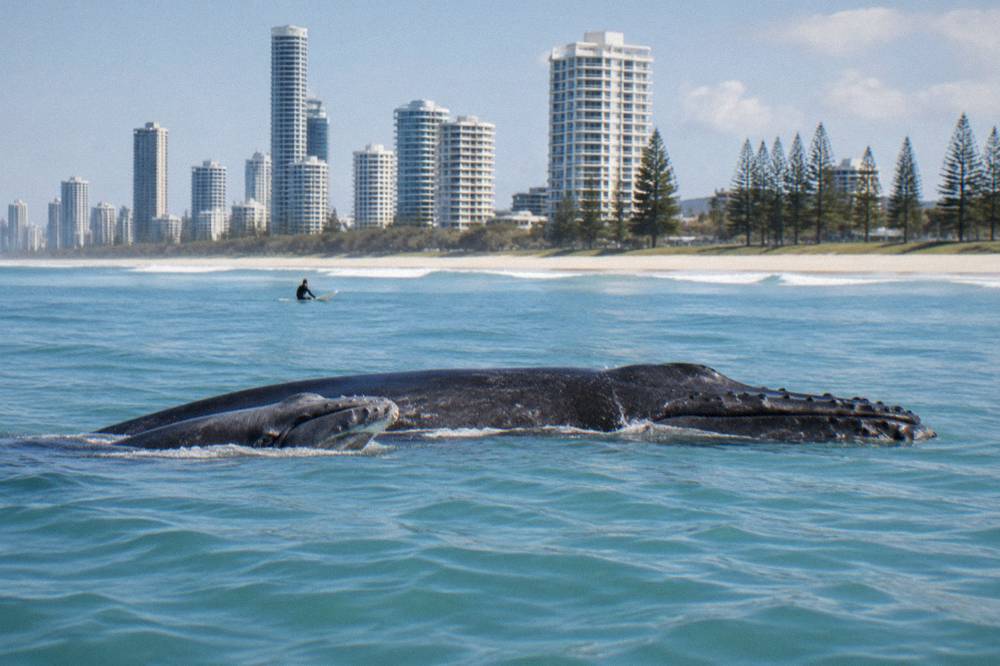
The calf is the reason the question of friendliness has a seasonal answer. In June and July the coast carries mostly juveniles and young adults heading north, and these are the show-offs: breaching, tail-slapping, investigating boats. From late August through October the traffic reverses, and the composition changes. Pregnant cows and cow-calf pairs bring up the rear of the migration, as the federal environment department's species page explains, travelling slower and hugging the coastline where the calf can rest in shallower water.
A mother in this state is not curious about your boat. She positions herself between the calf and anything that approaches, and a calf that is curious about a hull gets shepherded away within seconds. Operators know this and manage for it: the whale watching season page from Tourism and Events Queensland flags September and October as the mother-and-calf months, and crews treat a pod with a calf as a look-don't-linger encounter even when the rules would allow more.
The calf's vulnerability is also why entanglement stories matter. Around 14 September 2026 a roughly 10 metre humpback tangled in shark nets off Currumbin was freed by Sea World Foundation teams, and in mid-July 2026 a tailless humpback, likely scarred by an earlier entanglement, was reported off Cabarita Beach. Neither was a calf, but both are reminders that the threats to this population are ropes, nets and propellers, not spectators on a licensed cruise. The friendliness question, answered properly, is less about whether whales like us and more about whether we behave in ways they can survive.
If a spring trip with calves on the water appeals, the timing guide on the best month for a Gold Coast whale trip weighs the July and August peak against the September and October calf season in detail.
What Friendly Behaviour Actually Looks Like
Friendly humpback behaviour is a repertoire of specific, readable acts: a spyhop that lifts an eye above the surface, a slow roll beside the hull, a pectoral fin raised and held, a whale that circles a stationary boat more than once. None of it is affection and all of it is the whale gathering information. Reading the repertoire correctly is what separates a respectful cruise from a noisy one.
| Behaviour | What it looks like | What it most likely means |
|---|---|---|
| Spyhop | Head lifted vertically, eye above water | Scanning the surface, often at a boat |
| Slow roll | Whale turns on its side and drifts | Resting or observing, common beside hulls |
| Pectoral slap | Long white fin raised and slapped down | Communication, sometimes play near boats |
| Mugging | Whale circles or lingers at a stopped vessel | Active investigation of the boat |
| Tail slap | Flukes beaten on the surface repeatedly | Often a warning, give more space |
| Breach | Full body clear of the water | Signal or display, visible from kilometres |
The table is worth reading twice, because two of those rows point in opposite directions. A whale that rolls beside your boat is relaxed. A whale that starts slapping its tail while a boat is near is telling the boat something, and experienced crews respond by widening the gap rather than closing it. The same animal can be curious at 9am and done with you by 9:15, and the trip that respects the shift is the trip the whale remembers, in whatever way whales remember.
Small-boat guests describe the close passes in strikingly consistent terms across operators, and the review counts back the consistency up. The Cooly Eco safari boat rates 4.9 from 68 reviews, Blue Seafaris rates 4.9 from 48, and the Kokomo boat rates 4.9 from 381, all with free cancellation, and all three trade on proximity rather than scale. The Spirit of Gold Coast marine biologist trip, from $52.30 per person with a guide narrating the behaviour, is the version for travellers who want the repertoire named as it happens, and its 920-review pool is the deepest on the coast.
| Listing | Boat size | From, per person | Rating and reviews | Departure point |
|---|---|---|---|---|
| Cooly Eco safari boat | 12 guests | $105.31 | 4.9 from 68 | Chinderah, Tweed River, NSW |
| Blue Seafaris small boat | About 21 guests | $87 | 4.9 from 48 | Tweed Heads South, NSW |
| Kokomo Cruises | 47-guest cap | $62.19 | 4.9 from 381 | Marina Mirage, Main Beach |
| Spirit of Gold Coast | 24 m power catamaran | $52.30 | 4.6 from 920 | Aqua Adventures, Southport |
Two of those four list a sighting guarantee or free return cruise. Kokomo and Cooly Eco make no such promise. The Sea World Cruises listing states a 100 percent whale sighting guarantee with a free return cruise, and the Spirit of Gold Coast listing guarantees a humpback sighting from June to November or a complimentary second cruise, both stated as those operators' own policies. A guarantee is a commercial promise about a free repeat trip, never a promise about whales, and the listings that skip one are not admitting their whales are worse, only that they would rather not write cheques against the ocean.
The Spirit of Gold Coast trip is the marine-biologist option in that table, and it earns its solo mention here because the behaviour narration is the product.
Are Humpback Whales Ever Dangerous To People?
There is no verified case of a wild humpback deliberately attacking a boat, and the species' record around humans is one of remarkable restraint given its size. The danger is structural, not malicious: a 45 tonne animal that breaches or flukes beside a small craft can injure people without any intent at all. That is why the 100 metre rules exist and why no licensed Gold Coast operation puts passengers in the water near whales.
The scale is worth sitting with. A fully grown humpback weighs up to 45 tonnes and reaches 16 metres, and its pectoral fins alone are up to a third of its body length. An animal that size does not need aggression to be dangerous, it only needs to be surprised, and a breach is a breach whether the whale knew the boat was there or not. The safety arithmetic for humans has nothing to do with conservation status.
The restraint is real, though. Humpbacks feed on krill and small fish, have no reason to treat people as food, and tolerate vessels, swimmers at legal distance and even the noise of a busy port with a docility that orcas, for instance, do not. The rescues tell the same story from the other side: the teams that cut shark net off a whale's head off Currumbin in September 2026 worked close to a distressed 10 metre animal, and the animal's response was to endure it. Distress does not make humpbacks aggressive. It makes them tired.
For people, the practical danger is almost entirely on our side of the equation: private boats travelling too fast through migration corridors, drones flown low over pods, swimmers entering the water inside 100 metres. The licensed cruise industry is the safe way to be near them precisely because its whole operating model is built on the rules that keep everyone intact. The natural-enemy question, orcas and humans aside, is covered in full in what preys on humpback whales, and the answer shapes why an adult humpback has so little instinctive fear of anything on the surface.
Can You Swim With Humpbacks On The Gold Coast?
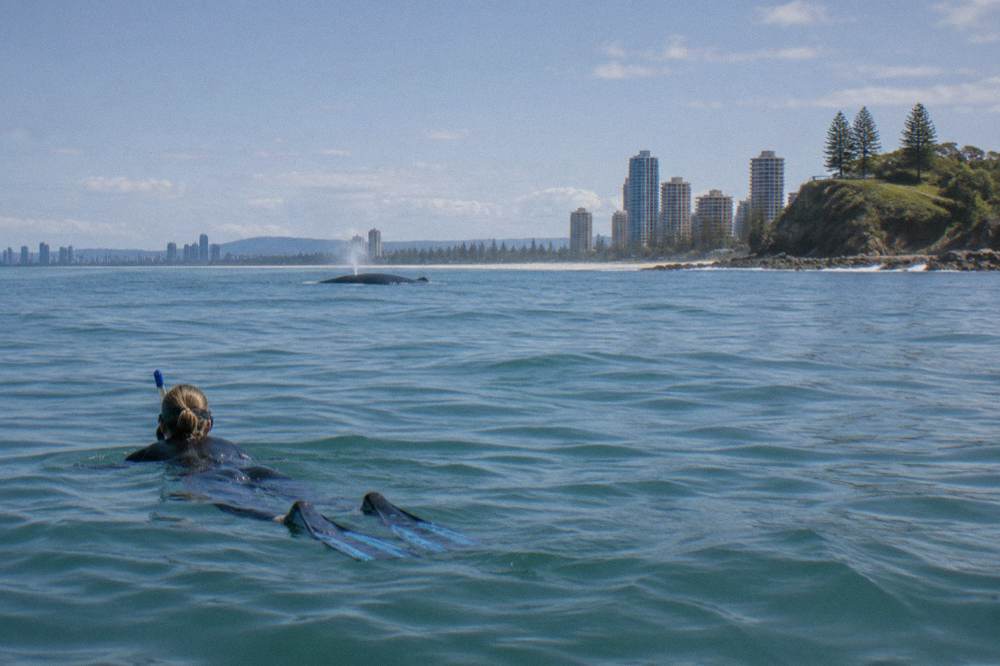
No authorised swim-with-whales tour departs the Gold Coast itself. Queensland rules keep a person in the water at least 100 metres from a whale, and licensed swim operations in Queensland run only at Hervey Bay and the Sunshine Coast. The one swim trip marketed around the Gold Coast, the Cooly Eco Adventures swim experience, departs Chinderah on the Tweed River in New South Wales, where its listing guarantees a sighting but never a swim.
The distinction is the sharpest fact on this page, because it is where the friendly question collides with the law. A humpback may be curious about you, and you may want to be in the water with it, and neither of those things overrides a 100 metre rule that exists because a curious whale is still a wild whale. The Cooly Eco swim trip, from $310.26 per person for about 4 hours with a maximum of 9 travellers, wetsuits and snorkel gear included, is built around that NSW framework: the boat positions legally, the whales decide whether to close the distance themselves, and the listing says plainly that a sighting is guaranteed while a swim is not.
That is the whole philosophy of humpback tourism on this coast in one product. The whale is offered the encounter, never subjected to it, and the trips that work are the ones where the crew treats a declined invitation as a normal outcome. The full picture of the swim option, including what the trip includes and how it differs from Hervey Bay, is in the guide to swimming with whales near the Gold Coast.
How To Be A Guest The Whales Tolerate
Being a good guest on a whale cruise comes down to a handful of behaviours: stay low and quiet when a whale is close, keep every part of you inside the rails, let the crew run the distance decisions, and never fly a drone near a pod. On land, the same instinct means watching from the named lookouts with binoculars and giving any whale near shore plenty of space. The whales will keep being curious whether you behave or not.
The practical version is simple. On the boat, follow the crew, because they are working inside regulations that carry penalties and inside weather that changes fast on the Seaway bar. Keep voices down when a whale is beside the hull, not because sound hurts them at conversational level but because a quiet deck lets everyone hear the blow before they see it. Leave the drone at home: 100 metres horizontal and vertical is the rule, and a whale that reacts to a drone has just been harassed in the legal sense. On shore, the tourism board's named free lookouts, Point Danger at Coolangatta among them, exist precisely so land-based watchers get real sightings without a boat ever needing to leave the marina.
The friendly question, answered once more, plainly: humpbacks are not friendly the way a dog is friendly, they are tolerant and curious the way a very smart wild animal with no reason to fear you can afford to be. Every cruise on this coast, from the 12-guest Cooly Eco safari boat to the Sea World Cruises catamaran, from the Boattime superyacht to the Blue Seafaris biologist trip, is built on that tolerance. The population's comeback from a little over 100 animals to more than 50,000 is the proof it works, and the 100 metre rules are the price of it continuing to work.
Whether you are comparing the small boats against the big catamarans or just deciding whether the trip is worth the fare, the full rundown is in the guide to every Gold Coast whale cruise compared, and the site's Whale Watching On The Gold Coast homepage carries the three-question trip picker if you already know what kind of day you want.
These are the three listings that best cover the range, from the eye-level safari boat to the big-deck cruise to the biologist-led small group.
Common Questions About Humpback Whales And Humans
Are Humpback Whales Friendly To Humans?
Humpbacks are not friendly in the tame, affectionate sense, they are curious and remarkably tolerant. They will approach a stationary boat, roll to look at the deck and linger on their own terms, and Queensland law keeps boats 100 metres away and people out of the water near them regardless. The close encounters on Gold Coast cruises happen because the whale chooses them, not because anyone asked it to.
Do Humpback Whales Like Being Watched?
Nobody can ask a whale what it enjoys, so the honest evidence is behavioural. Humpbacks repeatedly approach boats, circle them and stay for long periods, which is what voluntary curiosity looks like. They also tail-slap and leave when they have had enough, which is what a boundary looks like. Good crews read both signals and give the whale the exit.
Why Do Whales Come So Close To Boats?
The leading explanations are investigation and indifference: a slow or stationary boat is a new object in the whale's world, and humpbacks never evolved a strong flight response to large, slow shapes. The behaviour is most reported from small, low boats like the 12-guest Cooly Eco safari vessel and the 21-guest Blue Seafaris boat, but big catamarans get close passes too. The whale always decides.
Is It Safe To Touch A Humpback Whale?
No, and it is illegal. A person in Queensland waters must stay at least 100 metres from a whale, and in NSW waters swimmers enter at least 100 metres away and keep 30 metres clear. A 45 tonne animal can injure someone without any intent, and touching a wild humpback is an offence under the rules for watching marine mammals. No licensed Gold Coast tour permits it.
Are Humpback Mothers With Calves Dangerous?
A mother with a newborn calf is defensive rather than dangerous, and she is the one whale on the coast that will not be curious about your boat. September and October bring cow-calf pairs close to shore on the southbound leg, and crews give these pods extra distance even when the law allows more. The calf stays with its mother for 11 to 12 months and cannot dive deep or travel fast yet.
Can You Swim With Humpbacks On The Gold Coast?
No authorised swim-with-whales tour departs the Gold Coast itself. Licensed Queensland swim operations run at Hervey Bay and the Sunshine Coast. The one swim trip marketed around the Gold Coast, the Cooly Eco Adventures experience, departs Chinderah on the Tweed River in New South Wales, and its listing guarantees a sighting but never a swim.