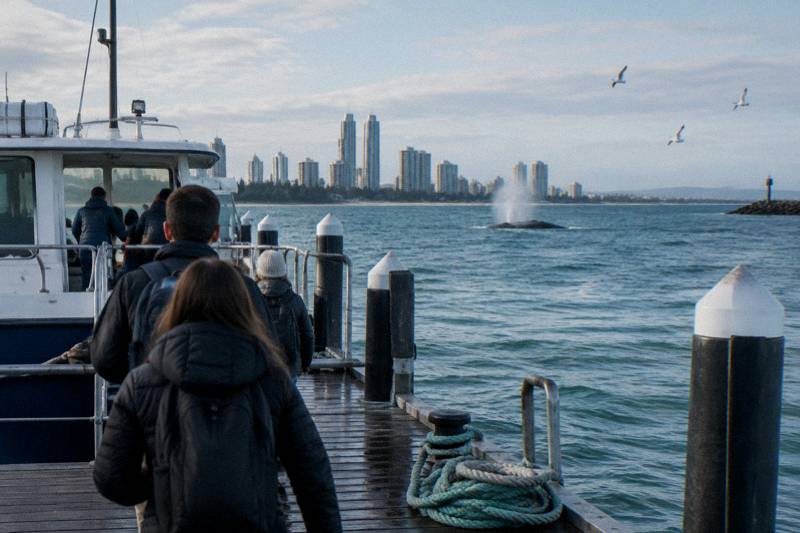
Is A Gold Coast Whale Cruise Worth It?
An honest worth-it verdict on Gold Coast whale watching cruises: what the prices, durations and sighting policies really deliver, the quiet-day risk, and who is better off watching from a headland.
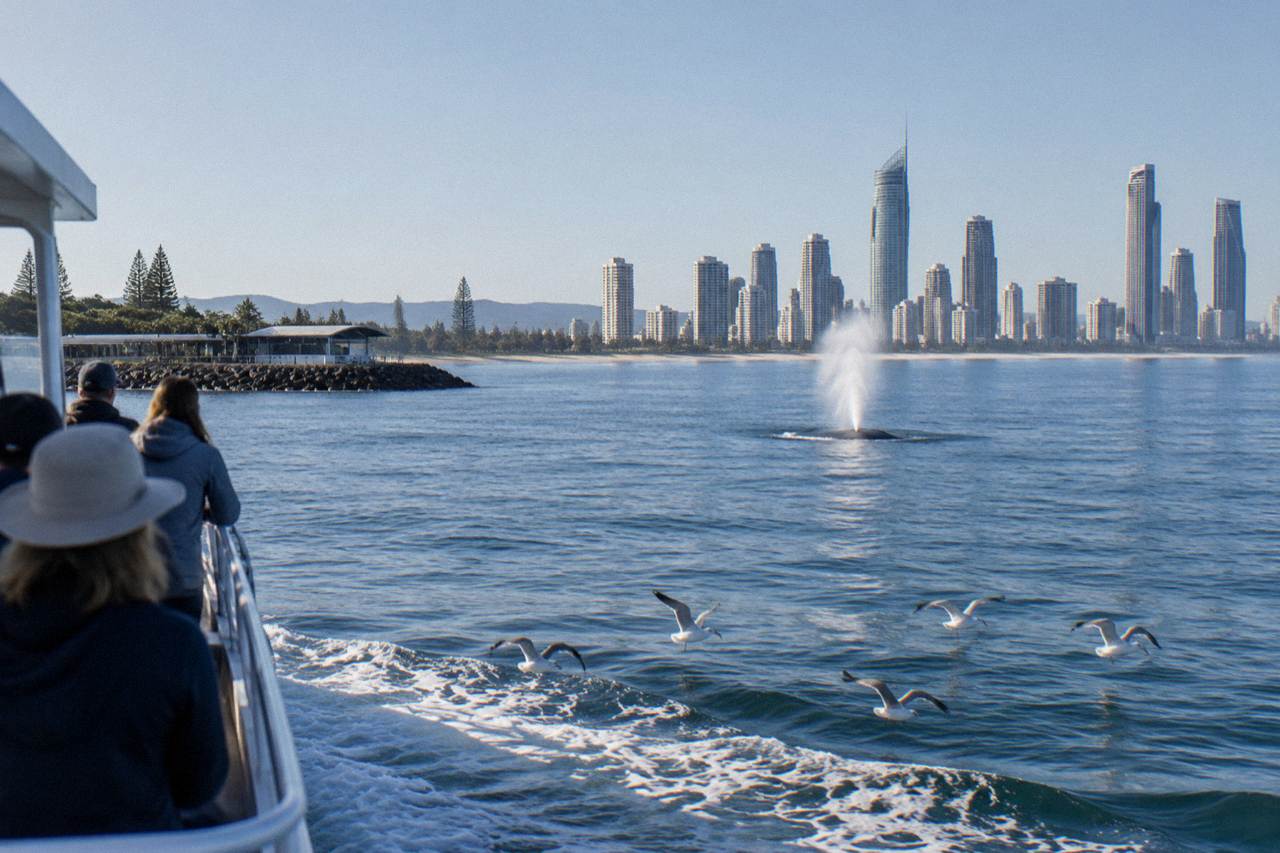
The first humpbacks of the 2026 season were reported off the Gold Coast Seaway on 2 June 2026, a mother and newborn calf in about eight metres of water, weeks earlier than usual. That is the kind of season this coastline is having: an east coast population now estimated at more than 50,000 animals, up from about 8,000 in 2006, pushing past a city that markets itself on water. The question every visitor eventually asks is whether a boat ticket is the right way to spend a morning of it. This page weighs the real prices, the real durations and the real policies, and gives a verdict that does not pretend every trip is a postcard.
The short version: a boat cruise is worth it for most first-time visitors who book in the peak weeks of July to October, choose a listing with a stated free-return policy, and go in knowing a quiet hour is possible. It is not worth it for the strictly budget-minded or the strongly seasickness-prone, who get a genuinely good free show from the headlands. The details below are where that verdict gets earned.
Is A Whale Watching Cruise Worth It?
For most first-time visitors, yes, a Gold Coast whale watching cruise is worth the ticket: boat trips run from $52 to $105.31 per person for roughly two and a half hours on the water, in a season when humpbacks pass this coast in the tens of thousands. The honest caveats are that whales are wild, no operator can promise a breach on your sailing, and a calm headland gives you the same animals for nothing. Once you've decided the cruise is for you, how far ahead to book a Gold Coast whale cruise comes down to which sailings actually sell out and how flexible your travel dates are.
Worth is a comparison, so run it fairly. On one side of the ledger sits the price of a boat trip: from $52 per person for the Boattime superyacht cruise, the cheapest listed price on this roster, up to $105.31 for the Cooly Eco safari-style boat, with the Sea World Cruises premium cruise, the Kokomo boat and the Spirit of Gold Coast trip sitting between them. On the other side sits what the money buys: a purpose-built vessel, a crew who read the water every day, and a viewing angle no headland can match, eye-level with an animal that grows to 16 metres and up to 45 tonnes.
The free alternative is real and should not be dismissed. The tourism board names Point Danger at Coolangatta as its best free whale watching spot, with Burleigh Heads, Miami and Greenmount Point alongside it, and the Queensland Government notes that humpbacks can be seen from headlands and even open beaches with the help of binoculars. What a headland cannot do is hold position beside a pod, follow a competitive group, or put you 100 metres from a tail-slap with a hydrophone feeding the sound through the speakers. That gap is what you are paying for, and for most people in peak weeks it is a gap worth closing once.
The three cruises below are the ones this comparison keeps coming back to: the Sea World Cruises premium cruise as the featured pick, the Spirit of Gold Coast marine biologist trip as the same-family alternative with the deepest review pool, and the Blue Seafaris small boat as the small-group, no-meal contrast.
What Do You Actually Get For The Money?
Every Gold Coast whale cruise on this roster is priced per person, runs between about two and a half and three hours, and includes a dedicated whale watching vessel with crew. Prices span from $52 to $105.31 for boat trips, with the swim trip at $310.26 as the outlier. None of the seven tours includes hotel pickup, so you make your own way to the departure point, and food and guarantee policies also vary listing to listing. Those differences, not the base fare, are what separate the deals from the duds. Since runtimes only tell part of the story, the minute by minute comparison of each cruise's running time helps you plan the rest of your day around whichever trip you pick.
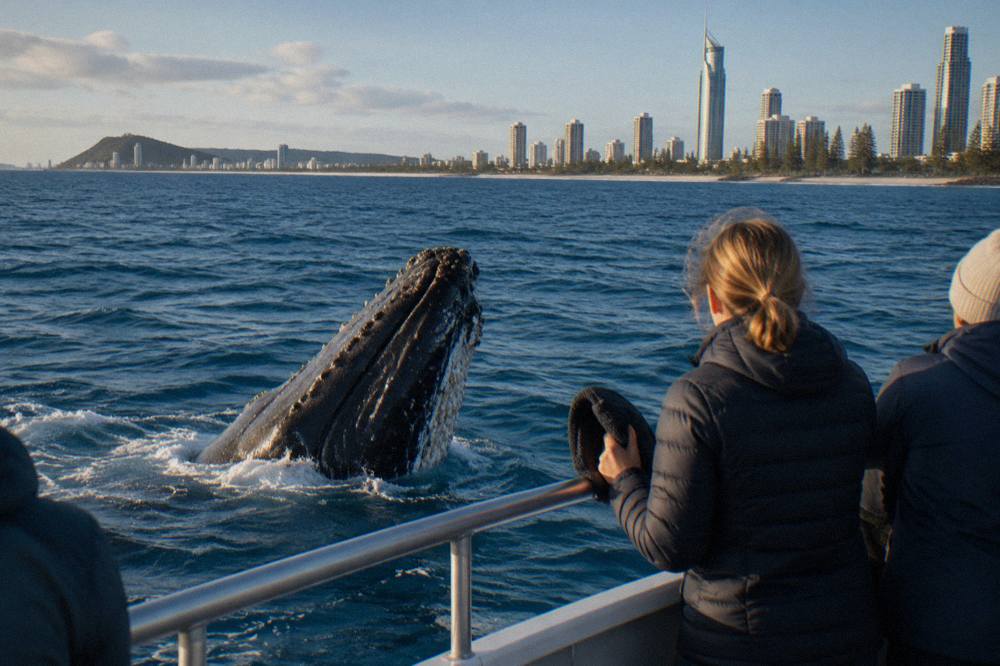
Start with the raw fare table, because it is flatter than most people expect. The cheapest listed price on the roster is the Boattime superyacht at from $52 per person, which is also the trip carrying the lowest rating at 3.7 from 138 reviews. The Sea World Cruises premium cruise, the featured tour on this site, holds a 4.6 rating from 655 reviews and runs 2.25 to 2.5 hours. Guests make their own way to the departure point."Likely to sell out" urgency badge on its listing. Spirit of Gold Coast has the deepest review pool on the roster, 4.6 from 920 reviews, runs about two hours and fifty minutes, allows free cancellation, and includes no hotel pickup: you make your own way to the wharf. Kokomo is from $62.19 per person at 4.9 from 381 reviews, capped at 47 travellers. The two NSW-side small boats cost more: Blue Seafaris from $87 per person at 4.9 from 48 reviews, and the Cooly Eco safari boat from $105.31 per person at 4.9 from 68 reviews. If those fares still sit above your budget, our guide to cheaper ways to see Gold Coast whales covers the free headland lookouts and explains where the pricier small boats actually earn their premium.
| Cruise | From price per person | Rating and reviews | Duration | Pickup |
|---|---|---|---|---|
| Sea World Cruises premium cruise | price on the live booking page | 4.6 from 655 reviews | about 2.25 to 2.5 hours | Hotel pickup not included |
| Spirit of Gold Coast | Price on the live listing | 4.6 from 920 reviews | about 2 hours 50 minutes | No hotel pickup, make your own way |
| Boattime superyacht | $52 | 3.7 from 138 reviews | about 2.5 hours | No pickup |
| Kokomo Cruises | $62.19 | 4.9 from 381 reviews | about 2.5 hours | No pickup |
| Blue Seafaris small boat | $87 | 4.9 from 48 reviews | about 2.5 hours | No pickup |
| Cooly Eco safari boat | $105.31 | 4.9 from 68 reviews | about 2.5 hours | No pickup |
Read that table the way a value decision actually works. Spirit pairs one of the lowest prices with the biggest review pool, but the cheapest ticket, Boattime, draws the fewest reviews, so price and proof of experience sit in tension here. What the fare does not tell you is what surrounds it: the Sea World cruise departs the Sea World Cruises Terminal on Seaworld Drive at Main Beach, with a bar on board that sells food and drinks rather than including them, while Spirit of Gold Coast includes coffee or tea and sells other food and drinks, and the Boattime luxury yacht lists no meal or refreshments in its fare. The Kokomo listing includes no meal, and neither does the Cooly Eco boat trip; the Blue Seafaris listing likewise excludes food and drinks.
No tour on this page includes hotel pickup, so visitors arrange their own way to the departure point. No listing on this roster includes hotel pickup, so every visitor makes their own way to the departure wharf. For everyone else the fare is the fare plus a taxi, and for the two Tweed-side boats the departure point is in New South Wales, at Tweed Heads South for Blue Seafaris and Chinderah on the Tweed River for the Cooly Eco trips, which the listings say cover the Coolangatta and Gold Coast waters. A Surfers Paradise hotel to Marina Mirage hop is trivial; a hotel to Chinderah run is not, and it belongs in the mental price of the ticket.
If the decision is narrowing toward the big-boat end, the featured cruise is the natural place to start, and its live listing carries the current calendar and price for your dates.
What Do The Sighting Guarantees Actually Promise?
Five of the seven listings on this roster state a sighting policy of some kind, and every one of them is the listing's own policy, not a promise of nature. The Sea World, Spirit of Gold Coast and Boattime listings state a 100% sighting guarantee with a free return cruise, Blue Seafaris offers a free tour on the next available slot if no whales are sighted, and the Kokomo and Cooly Eco boat listings state no guarantee at all.
This distinction matters more than any price difference on the page, so it deserves its own table. A "guarantee" on a whale listing is an operator's wager that its own season is reliable enough that the free-return fallback rarely costs it anything. It is a good wager in July and August, when the tourism board's own page puts peak numbers on the Gold Coast, and a thinner one at the season's edges in June and November. The wager is still worth having: a free return cruise converts a bad-luck day into a second attempt rather than a sunk cost.
| Listing | Stated sighting policy (the listing's own words) | What it means for you |
|---|---|---|
| Sea World Cruises premium cruise | 100% whale sighting guarantee, free return cruise | A no-show day earns a free repeat sailing |
| Spirit of Gold Coast | Humpback sighting guaranteed June to November, or a complimentary second cruise | Season-scoped guarantee, attributed to the listing |
| Boattime superyacht | 100% whale sightings guarantee | Free return per the listing's policy |
| Blue Seafaris small boat | Free tour on the next available slot if no whales are sighted | A repeat attempt, not a refund |
| Kokomo Cruises | No sighting guarantee stated | Full price risk on a quiet day |
| Cooly Eco safari boat | No sighting guarantee stated | Full price risk on a quiet day |
| Cooly Eco swim trip | Sighting guaranteed, swim not guaranteed | Two different promises, only one of them firm |
The last two rows are where careless reading costs money. The Kokomo boat is one of the best-rated trips on this coast, 4.9 from 381 reviews, but its listing states no sighting guarantee, so nothing should be assumed from its rating. And the swim trip, the Cooly Eco swim with whales from Chinderah in New South Wales at from $310.26 per person for about four hours, carries a distinction this site repeats wherever it is named: the listing says a whale sighting is guaranteed but a swim is not. You can be taken to the whales with certainty and out of the water with none, and the ticket price is the same either way.
It is also worth being precise about what a guarantee is not. No listing on this roster, guaranteed or otherwise, promises a breach, a close pass or a mother-and-calf encounter, and none could: the Queensland rules for watching marine mammals require boats to keep at least 100 metres from a whale and 300 metres in front of or behind it, slowing to 6 knots inside 300 metres, with no more than three boats in one caution zone. What the whales do inside that envelope is up to them. The Queensland Government's approach distance rules are the real boundary of every "close encounter" you will ever have from a deck.
The Kokomo cruise is the one guaranteed-free listing worth a second look anyway, because a 47-guest cap on a purpose-built vessel with an underwater camera is a different product from a 300-seat cruiser even on a quiet day.
How Long Is The Trip, Really?
Every boat-based whale watching trip on this roster runs between roughly two and a quarter and three hours on the water: about 2.25 to 2.5 hours for the Sea World cruise, about 2.5 hours for the Kokomo, Boattime, Blue Seafaris and Cooly Eco boats, and about 2 hours 50 minutes for Spirit of Gold Coast. The swim trip is the outlier at about four hours.
The tourism board's own page puts the typical tour length at two to three hours, and the roster lands squarely inside that band. The practical reading is that a whale cruise is a half-morning or half-afternoon commitment, not a full day, and the marginal cost of your time is lower than most visitors assume. Add check-in, boarding and the ride out past the Seaway and you are looking at closer to three and a half hours door to water to door, which still leaves the rest of the day for the beach.
That compact length is part of the worth-it case for families, a question this site treats in full elsewhere: a two and a half hour trip with a free return cruise attached is a much easier sell to a restless eight-year-old than a full-day excursion. The same logic favours it over the swim trip for anyone uncertain about their sea legs, since four hours on open water off the Tweed is a different test of commitment than two and a half inside the Broadwater's shelter.
Timing within the day matters less than timing within the season, but it is not nothing. The Queensland Government notes that calm mornings, before the wind picks up, are the best conditions for spotting whales, and morning sailings generally ride that pattern. The trade-off is that afternoon trips are easier to book around and often cheaper on the live listing, so a calm-morning purist and a flexible bargain hunter can both be right.
What Are The Odds Of A Quiet Day?
No operator sighting counts for the 2026 season were found in verified research, so no honest percentage or "X out of Y trips" figure exists, and this site will not invent one. What is known: the east coast population is estimated at more than 50,000 animals, the first 2026 humpbacks were reported off the Gold Coast Seaway on 2 June 2026, and peak numbers pass in July and August.
The absence of a sighting rate is itself information. Operators do not publish per-trip sighting statistics for this coast, which means every "you will definitely see whales" claim you meet in the wild is marketing, not measurement. What can be said with sources behind it is that the population is large and growing, that the migration runs north from June to August and back south from September to November per the federal environment department, and that young males typically lead the migration while pregnant cows and cow-calf pairs bring up the rear. Booking inside that window, in July to October, is the single biggest thing you control.
The 2026 season gave the coast unusually good material to reason from. The first humpbacks were spotted off the Gold Coast Seaway on 2 June 2026, a mother and newborn calf in shallow water, noted as very early against a previous earliest record of 15 June. Around 14 September 2026 a roughly 10 metre humpback entangled in shark nets off Currumbin was freed by Sea World Foundation teams, and in mid-July 2026 a tailless humpback, likely scarred by an earlier entanglement, was reported off Cabarita Beach on the Tweed coast. Those are individual animals, not statistics, but they sketch a coast with whales in it from the first week of June to well into October.
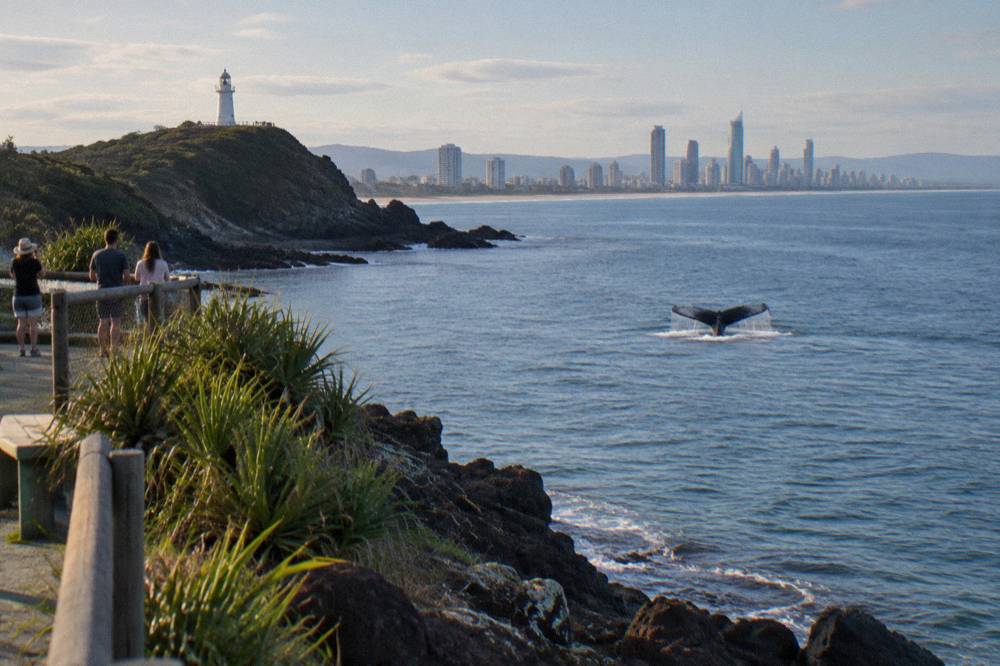
A quiet day, when it happens, is most likely at the season's edges. June sailings catch the juveniles and young adults that lead the northbound leg; September and October catch the southbound mothers and newborns travelling slower and closer to shore, which the verified season research flags as the better weeks for surface activity and close-in encounters. The honest framing is not "you will see whales" but "the odds are strongly with you in peak weeks, weakly with you in the shoulder, and never under your control", which is exactly why the free-return policies in the previous section carry real weight.
Who Should Skip The Boat And Watch From Shore?
Watch from a headland instead if your budget is genuinely fixed, if you are prone to seasickness, or if you only want a chance look at a whale rather than a dedicated encounter: the tourism board names Point Danger at Coolangatta, Burleigh Heads, Miami and Greenmount Point as free whale watching spots, with binoculars and calm early mornings the standard advice.
The free option deserves more respect than the cruise industry gives it. Point Danger sits at Coolangatta on the Queensland and New South Wales border and is the tourism board's own pick for best free spot, overlooking Snapper Rocks and Duranbah Beach, and humpbacks are commonly seen offshore there in season, along with dolphins and turtles year-round. Burleigh Heads offers the headland walk and Tumgun Lookout inside the national park, and local guides add Currumbin's Elephant Rock, Main Beach and The Spit, Kirra Hill and Snapper Rocks via the Point Danger paths as spots with regular season sightings. All of it costs nothing but the walk up.
The trade is distance and patience. From a headland a whale is a spout, a fluke, occasionally a full breach if you are lucky, viewed through the zoom or with binoculars, and the Queensland Government's advice is explicit that calm mornings before wind picks up are when shore spotting works best. From a boat the same animal is a body of water displacement at eye level, with a hydrophone and a crew who have already found the pod before you boarded. Neither is the wrong choice; they are different purchases, and only one of them is free.
There is a middle path that suits the undecided: book a cheap, guaranteed-listing cruise for the morning, and keep a headland in reserve for the afternoon. The Boattime superyacht, at from $52 per person with a stated 100% sightings guarantee and a light tea on arrival, is the roster's cheapest way onto the water with a fallback attached, though its 3.7 from 138 reviews is the lowest rating on the roster and should be weighed plainly rather than hidden.
The shore option also scales better for large families and school-age groups, and the calendar helps: the free Whale and Ocean Festival run by Humpbacks and Highrises at Justins Park, Burleigh Heads, on 4 July 2026 included a guided land-based whale survey from Burleigh Hill, and the group runs Queensland's largest volunteer marine mammal monitoring program. A festival morning on a headland is a genuinely good free whale day, and the festival's own page is the source for the next one.
What About Weather And Cancellations?
Cruises do run in imperfect weather, and operators cancel or reschedule only when conditions are unsafe: Sea World Cruises' own terms give a full refund or reschedule if seas are unsafe, with operator cancellations notified by SMS at least two hours ahead, and Spirit of Gold Coast offers a reschedule or full refund when it cannot sail. No verified cancellation-rate or sea-state statistics exist for this coast, so none are printed here.
The Gold Coast Seaway is a designated coastal bar, and Maritime Safety Queensland warns that conditions there can change quickly, worst on an ebb tide with large swell or strong wind. Whale boats cross it on the way out, which is why the operator terms matter. The pattern across the verified policies is consistent: rough-but-safe seas mean you sail, with a check-in conversation about whether to proceed; unsafe seas mean the operator cancels and you get a reschedule or a full refund, not a fight. Every listing on this roster also offers free cancellation on the platform listing, which covers the change-of-mind side.
The Bureau of Meteorology's winter 2026 outlook, issued 28 May 2026, pointed to below-average winter rainfall and above-average temperatures for the season, with El Nino developing, which reads as a reasonably kind winter for standing on a deck. That is a climate tendency, not a sailing forecast, and the honest advice on rough-day nerves is general: eat lightly, sit mid-boat, keep a steady horizon in view, and take the morning sailing, which the calm-mornings pattern favours anyway. If that paragraph already sounds like your idea of misery, that is the headland talking, and it is free.
The Honest Verdict
A Gold Coast whale watching cruise is worth it for a first-time visitor in the July to October peak who picks a listing with a stated free-return policy and treats the roughly two and a half hours as a bonus morning on the water rather than a guaranteed spectacle. It is not worth it for the fixed-budget or the seasickness-prone, who should take Point Danger or Burleigh Heads and keep the fare.
The strongest version of the case is arithmetic. More than 50,000 humpbacks now migrate past this coast each year, the deepest review pools on the roster run to 920 reviews at 4.6, and the entry price for a boat with a stated guarantee attached is from $52.30 per person. That is a low cost per chance at one of the largest animals on earth, with a free second attempt attached to most of the tickets. The weakest version is the same arithmetic run at the season's edge in early June or late October, on an unguaranteed listing, for a traveller who will only be satisfied by a breach at ten metres, which no policy on any listing promises and no regulation would allow.
If you go, go deliberately. Pick the week before you pick the boat, with July and August for sheer numbers and September and October for mothers and calves closer to shore. Pick a listing whose stated policy you have actually read, from the table above rather than from a billboard. Take the morning sailing if the forecast is calm. And book ahead in the peak weeks, because two of the seven listings on this roster, the Sea World cruise and the Blue Seafaris small boat, carry a genuine "Likely to sell out" badge, and those badges are on the listings because the demand is real. For the full field, the Whale Watching On The Gold Coast homepage comparison and the trip picker lay all seven listings side by side, and the season timing guide covers the calendar question in depth.
The small-boat end of the roster is where the premium money goes furthest, if the premium is what you want. The Cooly Eco safari boat, a custom-built 12-seat vessel with a marine naturalist and spray jackets, departs Chinderah on the Tweed River in New South Wales and is the priciest boat-watching listing at from $105.31 per person, 4.9 from 68 reviews. Twelve seats at eye level is a different animal from a triple-deck catamaran, and the price is the price of that intimacy.
For a fuller weighing of the two ends of the coast, the Hervey Bay versus Gold Coast comparison covers where each stretch of water wins, and the free whale watching spots guide maps the headland option properly. The official tourism board page on Gold Coast whale watching is the primary source for the season and spot claims above, and the federal humpback whale migration pages cover the national pattern.
So: worth it? Yes, once, in the right week, on the right listing, with the free return in your pocket and the headland saved for the morning after. Not worth it as an impulse buy at the season's edge, and never worth it bought on the strength of the word "guaranteed" alone. The fare buys you the best seat on this coast for a wild animal that owes you nothing, and in a season with 50,000 of them passing by, that is usually a seat worth taking.
Common Questions About Whale Cruise Value
Is A Whale Watching Cruise Worth It?
For most first-time visitors in the July to October peak, yes: boat trips run from $52 to $105.31 per person for roughly two and a half hours, most listings carry a stated free-return policy, and the east coast population passing this coast is estimated at more than 50,000 animals. It is not worth it for the strictly budget-minded or the seasickness-prone, who get a good free show from the headlands.
What Happens If You Do Not See A Whale?
It depends on the listing. The Sea World, Spirit of Gold Coast and Boattime listings state a 100% sighting guarantee with a free return cruise, and Blue Seafaris offers a free tour on the next available slot if no whales are sighted. The Kokomo and Cooly Eco boat listings state no guarantee, so a quiet day on those is full price risk. Every policy here is the listing's own, not a promise of nature.
How Much Does A Gold Coast Whale Cruise Cost?
Boat-based whale watching on this roster runs from $52 to $105.31 per person, from the Boattime superyacht at from $52 to the Cooly Eco safari boat at from $105.31. The swim trip, which departs Chinderah in New South Wales rather than the Gold Coast, is from $310.26 per person for about four hours.
How Long Is A Gold Coast Whale Watching Cruise?
Between roughly two and a quarter and three hours on the water: about 2.25 to 2.5 hours for the Sea World cruise, about 2.5 hours for the Kokomo, Boattime, Blue Seafaris and Cooly Eco boats, and about 2 hours 50 minutes for Spirit of Gold Coast. The swim trip runs about four hours.
Is Watching From Shore A Good Alternative?
Yes. The tourism board names Point Danger at Coolangatta, Burleigh Heads, Miami and Greenmount Point as free whale watching spots, with calm early mornings and binoculars the standard advice. You give up proximity and the crew's ability to find pods, but the price is zero and the whales are the same ones.
Do Cruises Cancel For Bad Weather?
Only when conditions are unsafe. Sea World Cruises' terms give a reschedule or full refund if seas are unsafe, with operator cancellations notified by SMS at least two hours ahead, and Spirit of Gold Coast offers a reschedule or a full refund when it cannot sail. Rough-but-safe conditions usually mean the trip proceeds. Every listing on the roster offers free cancellation on the platform listing.