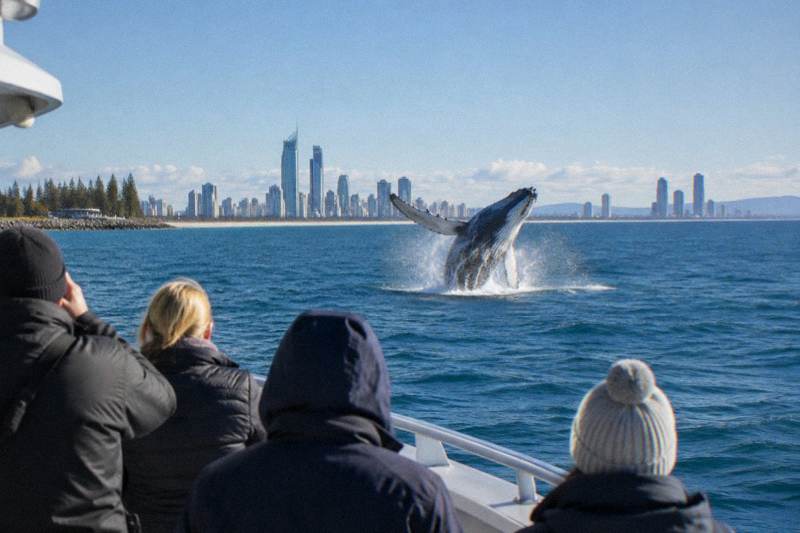
Gold Coast In Winter: Weather, Whales And A Planning Guide
Winter is the season the Gold Coast quietly does best: dry air, clear mornings, empty-ish beaches and humpback whales passing close to shore in the largest numbers of the year.
Short answer
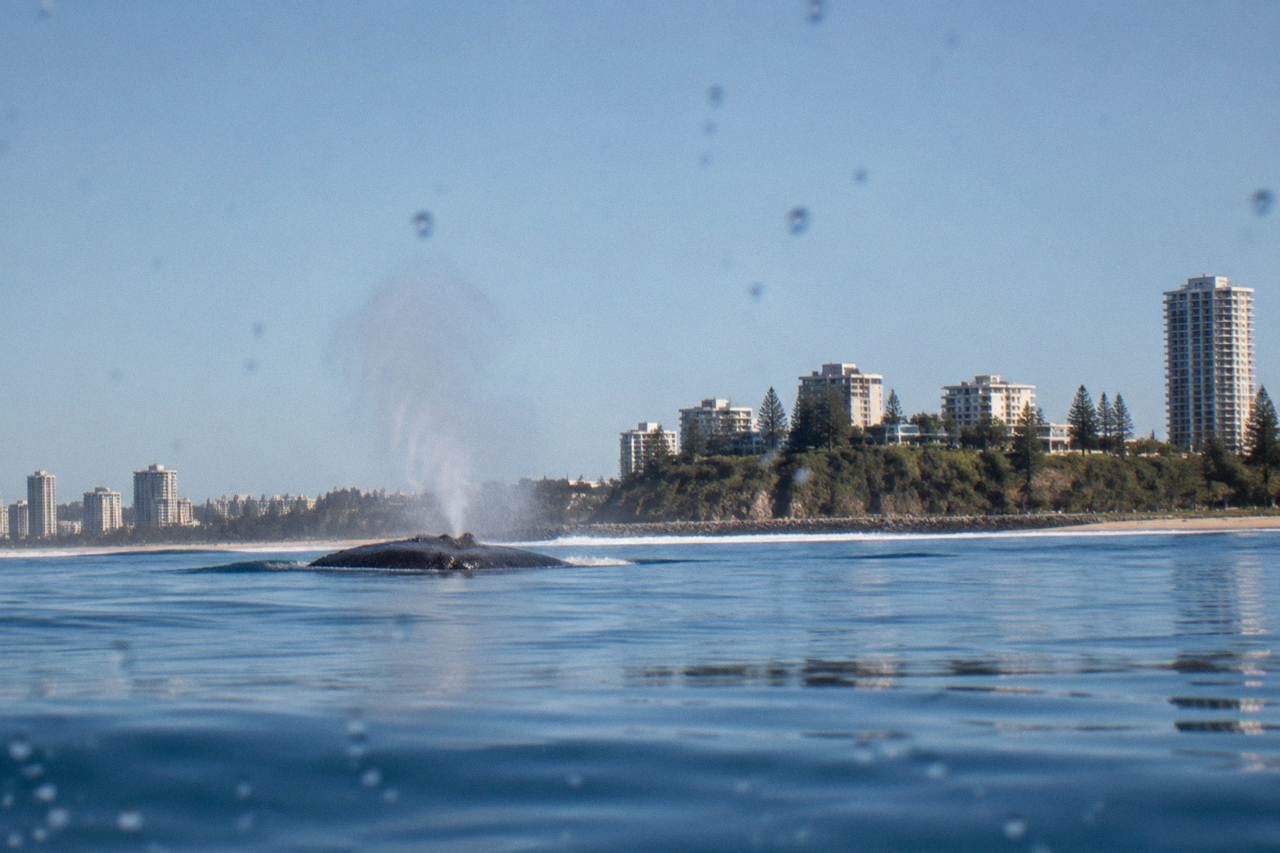
A Gold Coast winter runs June to August with dry, mild conditions and the peak of the humpback migration in July and August. Whale cruises run daily from Main Beach and Southport from about $52.30 per person, free lookouts line the headlands, and the free Whale and Ocean Festival lands in early July.
Winter on the Gold Coast is the season the locals keep to themselves. The humidity drops, the sky clears, the water stays swimmable and the humpback highway running past the coast hits its busiest stretch of the year. While the southern capitals pull on coats, the Gold Coast settles into dry, mild days that are close to perfect for being on or near the water. This guide lays out what a Gold Coast winter actually delivers, month by month, and how the whale cruises fit into it: the Sea World Cruises premium trip from Main Beach, the Spirit of Gold Coast catamaran from Southport, the Kokomo boat from Marina Mirage and the smaller operators working out of the Tweed.
The Bureau of Meteorology's winter outlook, issued 28 May 2026, pointed to below-average rainfall and above-average temperatures across southern Queensland, with El Nino developing. In practical terms: dry, stable, whale-friendly. The first humpbacks of 2026 were reported off the Gold Coast Seaway on 2 June, a mother and newborn calf, unusually early, and the season builds from there into the July and August peak that fills every departing cruise.
What Is Winter Actually Like On The Gold Coast?
Winter on the Gold Coast, June to August, is the city's driest and most stable stretch of the year: low rainfall, clear skies, mild days and cool evenings, with sea conditions usually calmest in the mornings before any wind builds. It is the season locals describe as the coast's best kept secret, and it coincides exactly with the peak of the whale migration.
The Gold Coast sits far enough north that winter never really arrives in the southern-Australian sense. The Bureau of Meteorology's winter long-range forecast frames the season as the dry one: rainfall likely below average, daytime and overnight temperatures likely above average for most of the state. That pattern matters for planning because almost everything worth doing here in winter happens outdoors, on the water or on a headland.
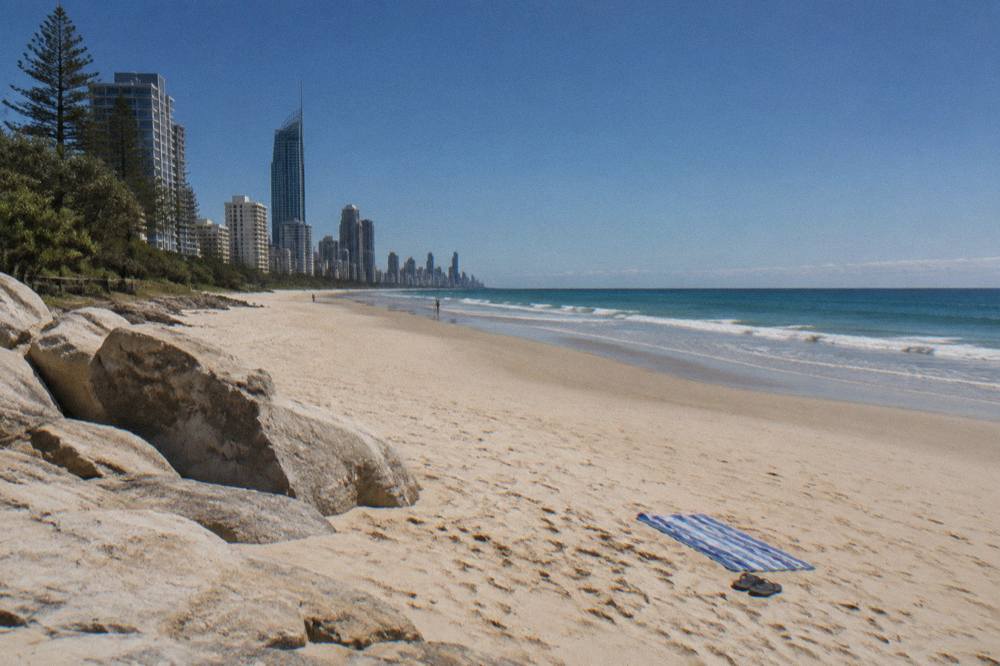
Mornings are the quietest and calmest part of the day, which is why whale spotters, cruise skippers and shore-based watchers all favour them. The Queensland Government's own whale-watching advice says the best spotting conditions from land come in the morning before wind picks up. By afternoon a light breeze often ruffles the inshore water, rarely enough to cancel anything, but enough that photographers and prone-to-seasickness travellers notice the difference. The deeper background on this is in the guide to Gold Coast weather in July and August, which covers the season's conditions in detail.
One honest caveat: the Gold Coast Seaway, the channel every Main Beach and Southport cruise exits through, is a designated coastal bar where conditions can change quickly, worst on an ebb tide with large swell or strong wind. Operators watch it closely and cancel or reschedule when a crossing would be unsafe. Sea World Cruises' own terms promise an SMS at least two hours ahead on an operator cancellation, with a reschedule or a full refund; Spirit of Gold Coast offers a reschedule or a full refund when it cannot rebook you. Winter's general stability makes those cancellations rare, but they are part of the deal on any ocean trip.
| Winter feature | What to expect | Why it matters for planning |
|---|---|---|
| Rainfall | Likely below average for winter | Outdoor plans rarely need a wet-weather backup |
| Temperature | Above average likely | Mild days, cool evenings, pack layers |
| Mornings | Calm, clear, lightest winds | Best window for cruises and shore spotting |
| Afternoons | Light breeze common | Still fine on the water, slightly choppier |
| Sea state | Generally stable, fewer storms | The Seaway bar can still turn on rough days |
Why Winter Is Peak Whale Season On The Coast
The humpback migration puts the biggest crowds of whales past the Gold Coast in July and August, the heart of winter. The season runs from late May or early June to early November, with juveniles leading the northbound leg in June and July, peak numbers in July and August, and mothers with newborns travelling slower and closer to shore from August to October.
Winter is not just pleasant here, it is the whole point. The east Australian humpback population is now estimated at more than 50,000 animals, up from around 8,000 in 2006 and a little over 100 when whaling ended in 1963, one of the strongest recoveries in conservation history. They pass the Gold Coast twice a year, north to the breeding grounds and back south to the Antarctic, and the coast sits close enough to the migratory corridor that whales regularly come within sight of the headlands.
The month-by-month rhythm is worth knowing before you book anything. June belongs to the early runners, juveniles and young adults moving north quickly, often further offshore. July and August bring the peak: the largest volume of whales, competitive pods, breaching and tail-slapping, and the longest encounters because there are simply more animals to stop for. From late August the traffic turns south, and September and October deliver the mother-and-calf pairs that travel slower, rest more and linger closest to shore, though that stretch belongs to spring rather than winter. The official tourism page for Gold Coast whale watching confirms the shape of it: season June to November, peak numbers July and August, mothers and calves September and October.
Every cruise on the coast adjusts to this rhythm rather than fighting it. The Sea World Cruises premium whale watching cruise, the Spirit of Gold Coast marine biologist trip and the Kokomo boat all run daily through the window, and the two NSW-side small boats, Blue Seafaris from Tweed Heads South and the Cooly Eco safari boat from Chinderah, work the same whales from the other side of the border. The one thing no operator can promise is a whale on a given day: whales are wild, and the honest framing is that peak season stacks the odds, it does not hand you a certainty.
| Winter month | Migration phase | What you are most likely to see |
|---|---|---|
| June | Early northbound | Juveniles and young adults, fast-moving, sometimes offshore |
| July | Peak northbound | Highest traffic, competitive pods, breaching, surface activity |
| August | Peak and turn | Peak numbers, then first southbound mothers heading back |
| Late August onward | Early southbound | Mothers with newborns starting to appear, slower travel |
Which Winter Whale Cruise Should You Book?
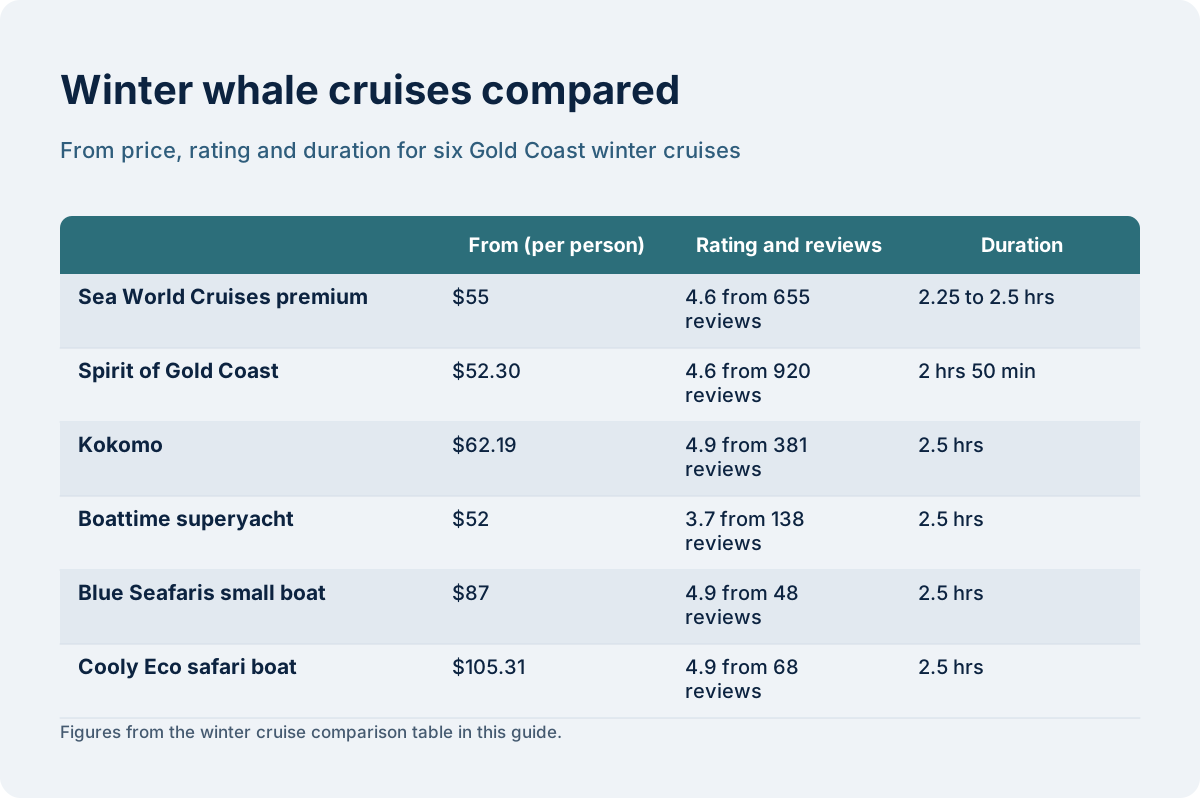
The right winter cruise comes down to boat style, budget and departure point. Boat-based whale watching on this coast runs from $52 to $105.31 per person, from the $52 Boattime superyacht trip to the $105.31 Cooly Eco safari boat, with the Sea World Cruises premium cruise from $55, Spirit of Gold Coast from $52.30 and Kokomo from $62.19. All offer free cancellation.
The featured winter option is the Sea World Cruises premium whale watching cruise, a purpose-built vessel departing the Sea World Cruises Terminal on Seaworld Drive, Main Beach, for about 2.25 to 2.5 hours. It carries a 4.6 rating from 655 reviews, with free cancellation before you sail, and the listing states a 100% whale sighting guarantee with a free return cruise if none appear. It also carries a genuine likely-to-sell-out badge, which in July and August is worth taking seriously: peak-season weekends fill first.
The Spirit of Gold Coast trip is the deep-review-pool alternative: 4.6 from 920 reviews, the largest review pool on the roster, about 2 hours 50 minutes on the water, free cancellation, and a guarantee that runs the full June to November season. A marine biologist guides the trip, morning tea is included, guests make their own way to the departure point, and the listing guarantees a humpback sighting from June to November or a complimentary second cruise. For a family that wants the longest on-water time at the lowest entry price, it is the strongest fit on the coast.
Kokomo sits in the middle: a smaller purpose-built vessel capped at 47 travellers, departing Marina Mirage at Main Beach, about 2.5 hours, from $62.19, with a 4.9 rating from 381 reviews and free cancellation up to 24 hours ahead. The smaller cap and the underwater camera suit travellers who want to be closer to the rail rather than part of a bigger crowd. The listing states no sighting guarantee, which is worth knowing: you are trading that safety net for intimacy and a higher rating.
Between those two, the choice is mostly temperament. Spirit gives you the longest trip and the biggest review pool at the lowest entry price, while Kokomo gives you a quieter deck and the roster's joint-highest rating at a modest premium. Families with young children tend to prefer the extra hour on the water; photographers tend to prefer fewer elbows at the rail. Neither choice is wrong, and both come with free cancellation if your plans shift.
Two more options complete the winter picture. The Boattime superyacht trip is the cheapest listing on the roster at from $52 per person, about 2.5 hours from the Marine Stadium Jetty at Main Beach, a luxury yacht with a marine biologist and light refreshments on arrival; its 3.7 rating from 138 reviews is the lowest on the roster, and an honest comparison says so plainly. And if a small boat appeals more than any big vessel, the two NSW-side operators are covered in the full Gold Coast whale watching tours comparison.
| Cruise | From (per person) | Rating and reviews | Duration | Departs | Listing guarantee |
|---|---|---|---|---|---|
| Sea World Cruises premium | $55 | 4.6 from 655 reviews | 2.25 to 2.5 hrs | Sea World Cruises Terminal, Main Beach | 100% sighting guarantee, free return cruise |
| Spirit of Gold Coast | $52.30 | 4.6 from 920 reviews | 2 hrs 50 min | Aqua Adventures, Southport | Sighting guarantee June to November, free second cruise |
| Kokomo | $62.19 | 4.9 from 381 reviews | 2.5 hrs | Marina Mirage, Main Beach | None stated |
| Boattime superyacht | $52 | 3.7 from 138 reviews | 2.5 hrs | Marine Stadium Jetty, Main Beach | 100% sighting guarantee stated |
| Blue Seafaris small boat | $87 | 4.9 from 48 reviews | 2.5 hrs | Tweed Heads South, NSW | Free tour on next slot if no whales |
| Cooly Eco safari boat | $105.31 | 4.9 from 68 reviews | 2.5 hrs | Chinderah, NSW | None stated |
If you are weighing whether the whole exercise is worth the money, the honest answer is that winter gives you the best value of the year: peak whale traffic, stable weather and the lowest prices of the roster all land in the same window. The deeper walkthrough of what a trip actually feels like, from boarding to the first blow, is in what to expect on a Gold Coast whale watching cruise.
What Else Is On In A Gold Coast Winter?
Beyond the whales, a Gold Coast winter offers free land-based whale spotting from the headlands, the free Whale and Ocean Festival at Burleigh Heads in early July, the annual whale census in late June, and quiet beaches with winter's dry weather. The tourism board names Point Danger, Burleigh Heads, Miami and Greenmount Point as its free whale watching spots.
The festival is the season's anchor event. Humpbacks and Highrises, the volunteer group that runs Queensland's largest marine mammal monitoring program, held the free Gold Coast Whale and Ocean Festival at Justins Park, Burleigh Heads, on 4 July 2026, with stalls, education activities and a guided land-based whale survey from Burleigh Hill. The group also runs research expeditions through the season, and the festival's own page carries the current year's date and program. Late June brings the annual whale census, a volunteer coastal count spanning Queensland to southern NSW, which in 2026 drew record numbers of spotters.
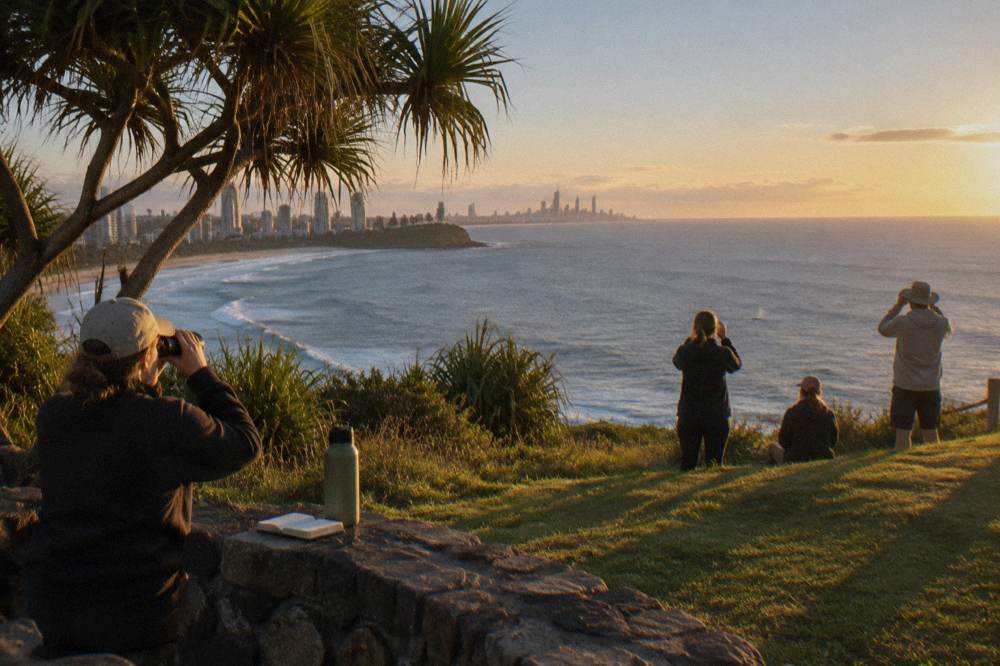
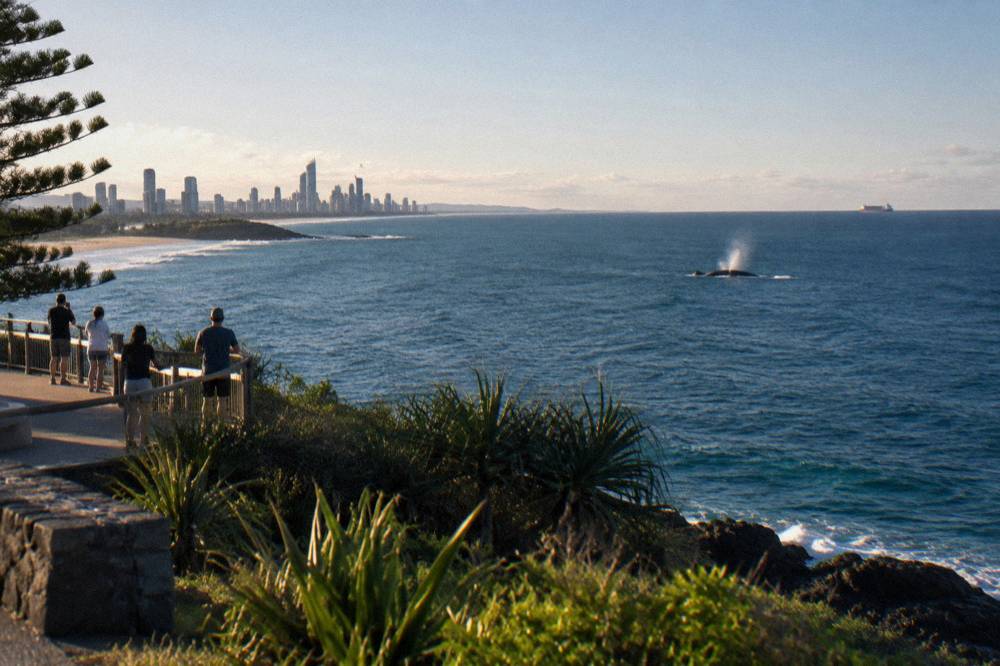
Free whale spotting is the winter activity that costs nothing and often delivers anyway. The tourism board's named lookouts are Point Danger at Coolangatta, its pick for the best free spot, Burleigh Heads headland including Tumgun Lookout, Miami and Greenmount Point. Local guides add Currumbin's Elephant Rock, Main Beach and The Spit, Kirra Hill and Snapper Rocks via Point Danger, described by those guides as regular vantage points rather than official ones. Binoculars help everywhere, and calm early mornings are the best window. The full list, with what each one offers beyond whales, is in the guide to free whale watching spots on the Gold Coast.
| Free lookout | Where | Who names it | Notes |
|---|---|---|---|
| Point Danger | Coolangatta, on the border | Tourism board | Its pick for best free spot, overlooks Snapper Rocks |
| Burleigh Heads headland | Burleigh, including Tumgun Lookout | Tourism board | Elevated trails, festival site nearby at Justins Park |
| Miami | Miami headland | Tourism board | Low-key, close to cafes |
| Greenmount Point | Coolangatta | Tourism board | Paved trails and platforms |
| Elephant Rock | Currumbin | Local guides | Short stair climb to a viewing platform |
| The Spit and Main Beach | North of Main Beach | Local guides | Boardwalk where the Broadwater meets the ocean |
The rest of a Gold Coast winter fills itself. Beaches that are shoulder-to-shoulder in January are walkable and quiet in July. The sand stays firm underfoot, surfers keep the water busy year-round, and the cafe and restaurant strip runs at full pace because winter is when locals actually use their own city. For travellers deciding between this coast and the state's other whale hotspots, the comparisons are worth a read: Hervey Bay versus the Gold Coast and Byron Bay versus the Gold Coast both come down to what kind of whale experience you want.
How Close Do The Boats Actually Get To Whales?
Queensland rules keep boats at least 100 metres from a whale and 300 metres in front of or behind it, with a 6 knot speed limit inside the 300 metre caution zone and no more than three boats in one caution zone. Drones must stay 100 metres away, helicopters 500 metres, and a person in the water 100 metres, which is why no authorised swim-with-whales tour departs the Gold Coast itself.
These distances are not operator politeness, they are law, set out in the Queensland Government's rules for watching marine mammals. Every licensed cruise on the coast works inside them. What makes the rules compatible with great viewing is humpback behaviour: whales frequently approach vessels voluntarily, and when one chooses to come close, the boat holds position and lets it happen. The rule constrains the boat, not the whale.
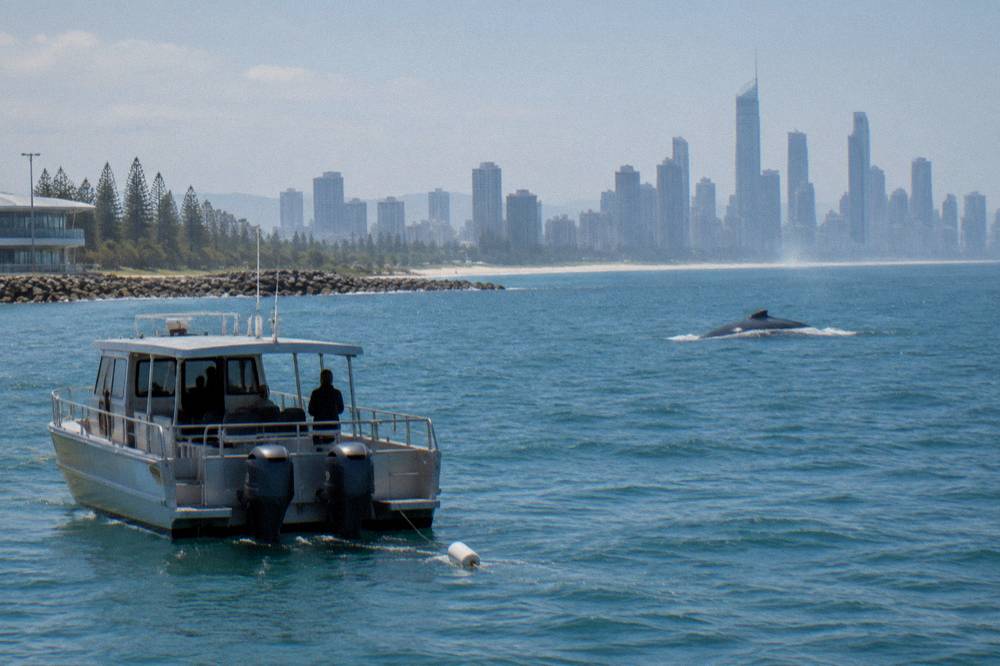
The swim question comes up every winter, and the answer is geographic. No licensed swim-with-whales operation departs the Gold Coast itself; Queensland's permitted swim operations run from Hervey Bay, July to mid-September, and the Sunshine Coast. The one swim trip on this roster, run by Cooly Eco Adventures, departs Chinderah on the Tweed River in New South Wales, just south of the border, and its listing states that a whale sighting is guaranteed but a swim is not. NSW rules require swimmers to enter the water at least 100 metres from a whale and then keep 30 metres clear. The full picture, including what the trip includes, is in the guide to swimming with whales on the Gold Coast side of the border.
| Who or what | Minimum distance from a whale | Rule |
|---|---|---|
| Boats (all vessels) | 100 m, plus 300 m in front of and behind | 6 knots inside the 300 m caution zone |
| Boats sharing one whale | Three-boat maximum | No fourth boat may enter the caution zone |
| Jet skis and hovercraft | 300 m | Prohibited vessels |
| Drones | 100 m | Horizontal and vertical |
| Helicopters | 500 m | No hovering above |
| Swimmers (Queensland) | 100 m | Person in or entering the water |
| Swimmers (NSW) | Enter 100 m away, then keep 30 m clear | Applies to the Chinderah swim trip |
| Predominantly white whales | 500 m for boats | Special protection for Migaloo and similar animals |
One winter footnote on the white whale: Migaloo had only unconfirmed 2026 reports, off NSW, and no confirmed Gold Coast sighting, so no cruise here will promise you one. The 500 metre rule for predominantly white whales exists precisely because the rare animal draws crowds.
How Should You Plan A Gold Coast Winter Trip?
Plan around calm mornings, book the whale cruise early in your stay so a weather reschedule still fits, layer clothing for cool mornings and mild afternoons, and reserve peak-season cruise dates ahead of time. The Sea World Cruises and Blue Seafaris listings both carry real likely-to-sell-out badges, and every listing on the coast offers free cancellation, so early booking carries little risk.
The single best piece of winter planning advice is sequencing. Put the whale cruise in the first half of your trip, not the last day, because an operator weather cancellation then leaves room to rebook. Every listing on this roster offers free cancellation, and Sea World Cruises' terms give you a full refund or a reschedule when the operator calls a trip off, with SMS notice at least two hours ahead. That safety net only helps if you still have days left.
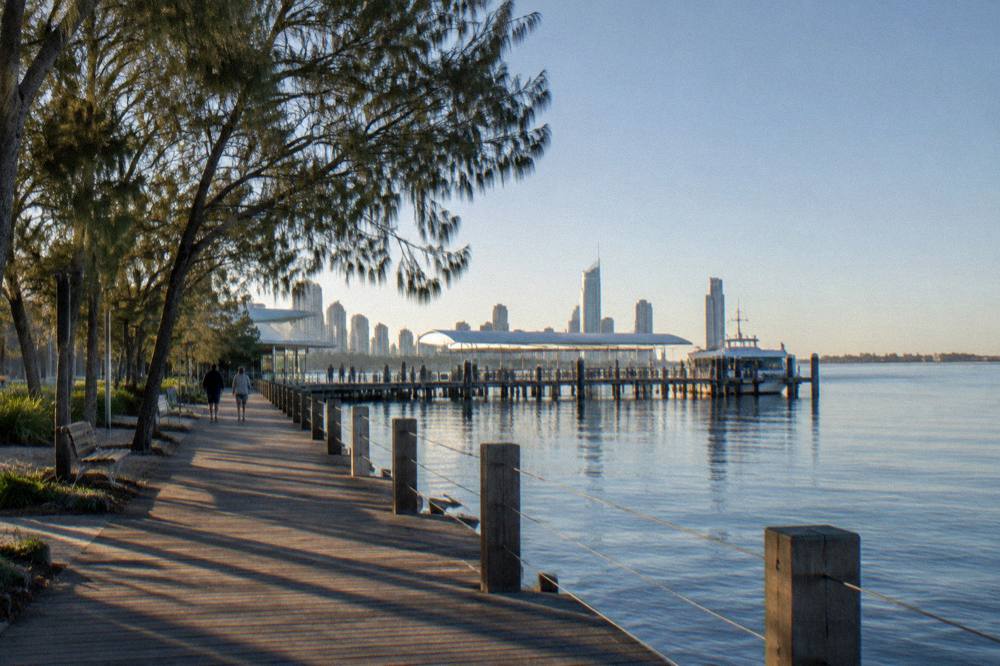
Morning departures are the winter default for a reason, and the question of morning versus afternoon whale watching resolves strongly toward the early slot in winter: calmest water, clearest light, lightest winds. Dress in layers, cool at the dock, mild an hour out, and bring a windproof layer for the boat's motion even on a bright day. General seasickness advice stays general because no listing on the roster prints medication guidance: eat lightly, pick a mid-boat seat, keep your eyes on the steady horizon.
A sensible winter day writes itself. Early walk on a quiet beach, late-morning whale cruise from Main Beach or Southport, lunch on the Broadwater, an afternoon on a headland lookout with binoculars, and the festival or a Burleigh sunset if your dates line up with early July. Travellers weighing the whole idea against the cost can read the honest case in is a whale watching cruise worth it, and anyone deciding how far ahead to commit should check whether to book a Gold Coast whale cruise in advance.
For everything the coast offers across the whole season, not just winter, Whale Watching On The Gold Coast keeps the full comparison, the trip picker and every cruise listing in one place.
Common Questions About A Gold Coast Winter
Is The Gold Coast Worth Visiting In Winter?
Yes, and for many travellers it is the best time. Winter is the driest, most stable part of the year, the beaches are quiet, and the humpback migration peaks in July and August with whales passing close to shore daily.
What Is The Weather Like On The Gold Coast In June, July And August?
Dry and mild. The Bureau of Meteorology's winter outlook pointed to below-average rainfall and above-average temperatures, with cool mornings, mild days and calm conditions most common before midday.
Can You See Whales On The Gold Coast In Winter?
Winter is the peak of whale watching on the Gold Coast. The season runs from late May or early June to early November, with the largest numbers passing in July and August and mothers with calves following from late August into spring.
What Should I Book For A Gold Coast Winter Trip?
A whale cruise is the standout seasonal experience, running from $52 to $105.31 per person for boat-based watching. Book it early in your stay so a weather reschedule still fits, and reserve peak-season dates ahead: the Sea World Cruises and Blue Seafaris listings both carry real likely-to-sell-out badges.
Are There Free Things To Do On The Gold Coast In Winter?
Plenty. The tourism board names Point Danger, Burleigh Heads, Miami and Greenmount Point as free whale watching lookouts, the Whale and Ocean Festival at Burleigh Heads is free in early July, and the beaches themselves are at their quietest and most walkable.
Can You Swim With Whales On The Gold Coast In Winter?
No authorised swim-with-whales tour departs the Gold Coast itself. Queensland's licensed swim operations run from Hervey Bay and the Sunshine Coast; the one swim trip on this roster departs Chinderah on the Tweed River in New South Wales, and its listing states a sighting is guaranteed but a swim is not.