Which Side Of The Boat Is Best For Whale Watching Off The Gold Coast?
An honest answer to which side of the boat is best for whale watching off the Gold Coast, with deck-by-deck positioning for the Spirit of Gold Coast catamaran, the Kokomo small boat and the Cooly Eco safari vessel.
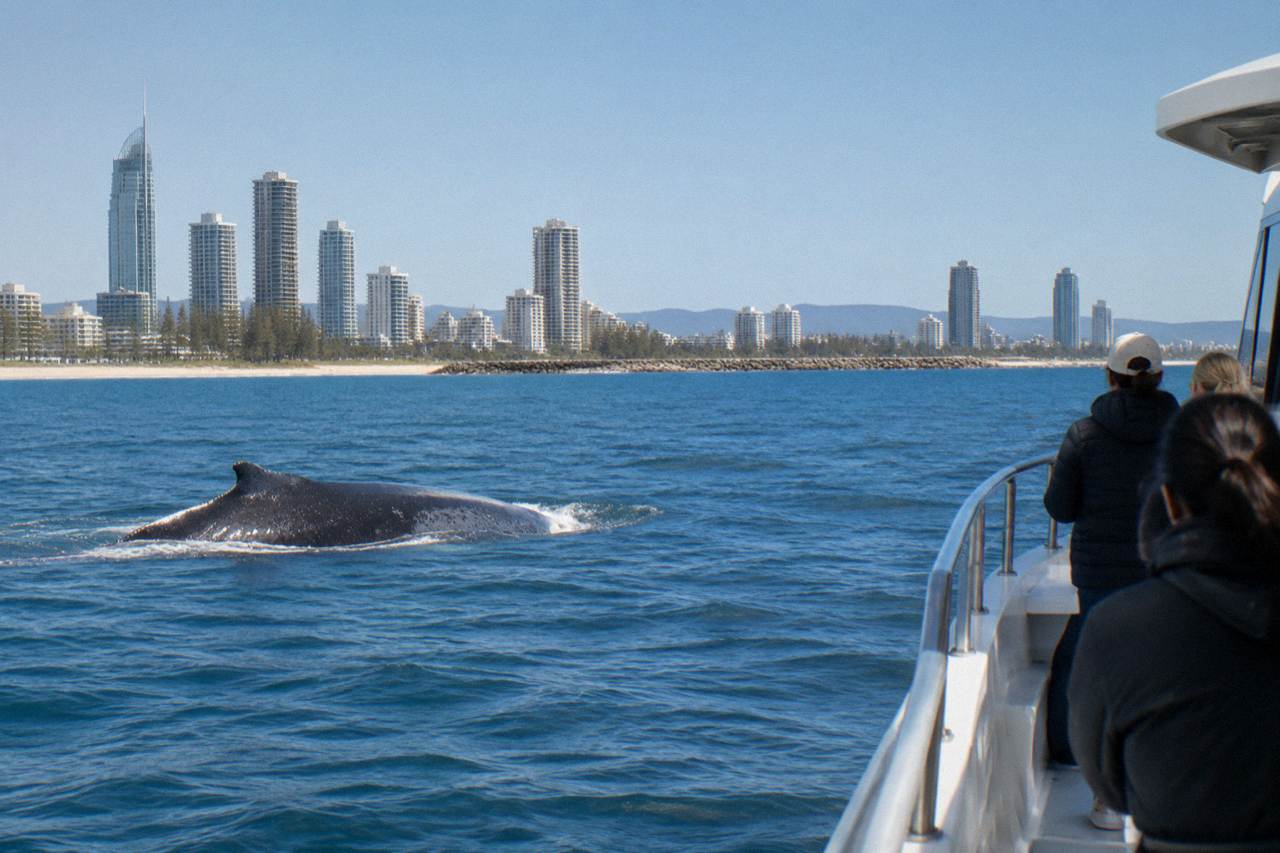
Every whale watching forum thread eventually arrives at the same question, usually asked the night before a cruise: which side of the boat is best for whale watching? The people asking it are hoping for a seat assignment the way you would hope for a good table at a restaurant. The whales have not read the seating plan. A humpback can surface off the port rail, vanish, and reappear two minutes later off the starboard bow, and the boats that work the Gold Coast migration corridor are built around exactly that unpredictability. This article looks at what actually determines where you should stand, from the lower and upper decks of the Spirit of Gold Coast catamaran to the eye-level seating of the Cooly Eco safari boat, and it explains why the crew's callouts matter more than any fixed spot on the rail. For a closer look at the catamaran's deck layout and what each level offers during a trip, our Spirit of Gold Coast whale watching guide walks through the vessel from rail to roof.
Which Side Of The Boat Is Best For Whale Watching Off The Gold Coast?
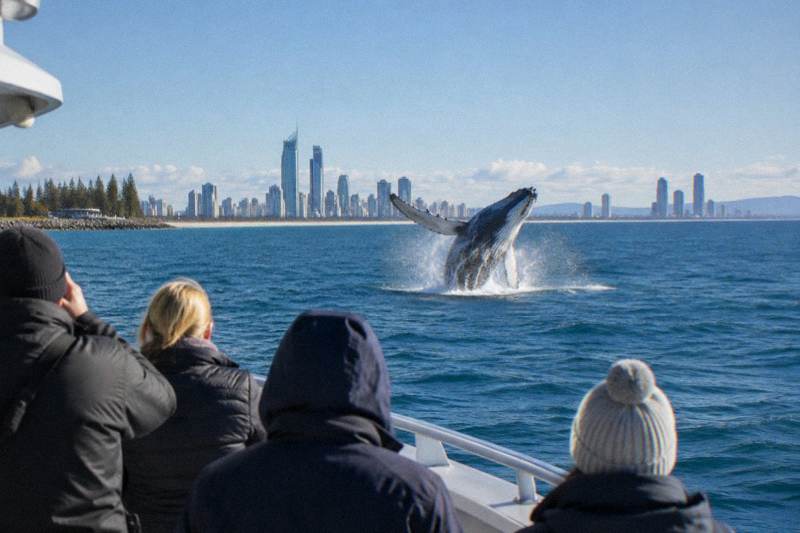
There is no reliably better side. Humpbacks surface on whichever side of the boat they choose, and they change direction without warning, so a fixed seat is a lottery rather than a strategy. The best position is a mobile one: stay near the centre of the boat, keep your eyes moving, and walk to whichever rail the crew calls out. Boats with multiple decks and 360 degree views reward movement more than any single spot.
That answer disappoints people who want a hack, but it is the truthful one, and it is supported by how the boats themselves are designed. The Spirit of Gold Coast whale watch runs a 24 m power catamaran with 360 degree views precisely because whales do not cooperate with a seating chart. Sea World Cruises built its purpose-built whale watching vessel with multiple viewing decks for the same reason. If one side of a boat reliably outperformed the other, operators would simply sell the starboard rail at a premium and the port rail at a discount, and no Gold Coast operator does that. Since where you sit matters more for comfort than views, our seasickness survival guide explains how seat position and sea state change your odds of feeling rough.
What you can control is your readiness to move. On a roughly 2.5 hour cruise, a whale might spend twenty minutes near the boat or thirty seconds near the boat, and the difference between a good photo and a missed one is often the ten seconds it takes to cross the deck. Loose shoes, empty hands and a willingness to relocate beat a claimed seat at the bow every time.
The other controllable factor is the boat you book in the first place. Small vessels put everyone close to the water; big catamarans give you height and shelter. The choice between those formats matters far more than the choice between port and starboard.
Why Whales Surface On Any Side Of The Boat
A whale's track is decided by the animal, not the vessel. Humpbacks follow the migration corridor, their pods and their own curiosity, and they frequently approach or cross under a boat, so the viewing side rotates through a single trip. Queensland rules also shape this: boats must stay at least 100 m from a whale and 300 m in front of or behind it, which means the boat manoeuvres around the whale, not the reverse.
The Gold Coast sits directly on the east Australian humpback migration route, and the population passing it is now large: preliminary estimates put the east coast population at more than 50,000 animals in 2024, up from about 8,000 in 2006. With that many whales moving through the corridor between June and November, a cruise is usually working one pod at a time, and the skipper positions the boat according to the approach distances set out in the Queensland rules for watching marine mammals. Inside the 300 m caution zone the boat slows to 6 knots, and no more than three boats may share one whale's caution zone. The result is a slow, circling dance in which the whale's position relative to the hull changes constantly.
Sometimes a whale approaches the boat voluntarily, which is when the "which side" question dissolves entirely, because the animal may pass directly underneath or along the keel. Curious juveniles are the usual culprits, and the early northbound leg of the migration in June and July tends to carry more of them. A whale that decides to investigate will give everyone on board a look, on every side, at once.
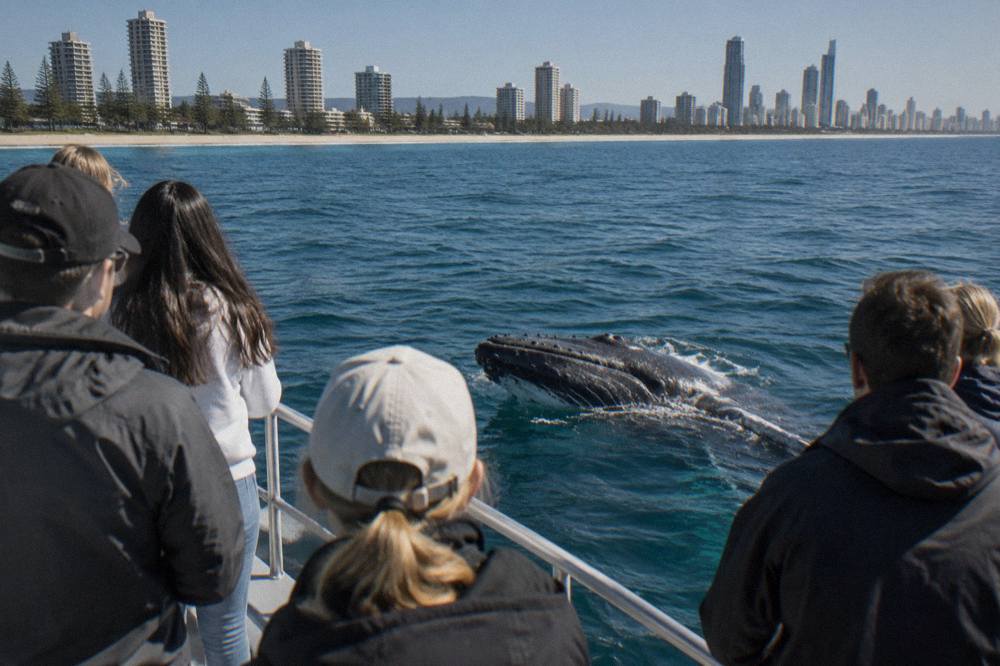
It also helps to understand what the whale is doing. A travelling animal moves in a straight line at steady speed, and the skipper will parallel it at a legal distance, which usually puts it on one side for a while. A resting animal, often a mother with a calf in September or October, sits low and slow, and the boat may hold station at a respectful distance while the pair drifts. A socialising or breaching animal is chaos, and the crew will tell you to spread out and watch everywhere.
| Whale behaviour | Typical boat response | Where the whale tends to appear |
|---|---|---|
| Travelling north or south | Boat parallels at legal distance | One side, changing as the whale zigzags |
| Resting, often mother and calf | Boat holds station at distance | Low profile, one spot, viewable from most rails |
| Curious approach | Engines slowed or disengaged | Under and around the boat, all sides |
| Breaching or tail-slapping | Boat slows, crew calls the splash | Wherever the display happens, sometimes far off |
The honest summary is that the whale decides the side, and the crew decides where the boat sits, and your job is the easy one: be ready to move when the call goes out.
Where To Stand On A Big Catamaran With Multiple Decks
On a multi-deck vessel, height and mobility beat a fixed rail. The lower deck puts you closer to the water for scale and splash views, while the upper deck gives a wider arc and a better view of distant blows and breaches. Start high, spot from the upper deck, then drop down when a whale comes close. The Spirit of Gold Coast boat, with lower and upper decks and 360 degree views, is built for exactly this approach. Spotting from the upper deck gets easier once you know the telltale signs, so check out the cues that reveal a nearby humpback before you climb aboard.
The Spirit of Gold Coast whale watch, departing Aqua Adventures at 95 Marine Parade, Southport, is the clearest example on the roster. The 24 m power catamaran offers 360 degree views from both its decks, and a marine biologist guides the roughly 2 hour 50 minute trip. From the upper deck you can scan the horizon and see the telltale bushy blow of a humpback a kilometre or more away, plus the direction the pod is travelling, which is genuinely useful information for choosing where to stand next. From the lower deck you are close to the waterline, and a whale beside the hull looks enormous: an adult humpback reaches up to 16 m in length and weighs up to 45 tonnes, and those numbers land differently from three metres above the surface than they do from an upper deck.
The same logic applies to Sea World Cruises' purpose-built whale watching vessel, which carries multiple viewing decks, and to the Boattime superyacht, which spreads a much smaller group across a luxury yacht with a marine biologist on board. On all of them, the practical pattern is the same. Spend the transit and the search phase high, where you can see furthest. When the skipper cuts speed and the crew gathers at one rail, come down, because the close pass will happen at water level.
One caution about the upper deck: it moves more. Higher decks amplify the boat's roll, which matters if you are prone to seasickness. The general advice stays general: keep your eyes on the steady horizon, eat lightly before boarding, and sit mid-boat, where the motion is gentlest, if your stomach objects. If that is you, claim a lower-deck mid-ship spot and let the whales come to you rather than chasing them up a companionway.
| Position on a multi-deck boat | Strengths | Trade-offs |
|---|---|---|
| Upper deck | Widest sightlines, first to see distant blows and breaches | More motion, further from the water |
| Lower deck rail | Close waterline views, best sense of scale, shelter from wind | Sightline blocked by the hull on the far side |
| Mid-ship, lower deck | Gentlest motion, comfortable for queasy travellers | Views depend on whales coming close |
| Bow area | Open forward sightline in the travel direction | Often crowded at the first callout, exposed to spray |
What Eye-Level Small Boats Change About Positioning
On a small boat, the side question mostly disappears because everyone is already at eye level and within a few steps of every rail. The Kokomo cruise caps its vessel at 47 travellers and the Cooly Eco safari boat seats just 12, so there is no bad seat, only the question of whether you are on the rail or one step back when a whale surfaces alongside. Small boats trade deck levels and shelter for closeness and immediacy.
The Kokomo whale watching cruise departs Marina Mirage at Main Beach on a smaller purpose-built vessel capped at 47 travellers, running about 2.5 hours with an underwater camera on board. With 47 people rather than several hundred, the crowd thins out quickly after the first sighting, and by the second or third pod most passengers have found a rail spot without jostling. The boat's size also means the skipper can turn it readily, which in practice rotates the whale around the passengers rather than forcing a dash from side to side.
The Cooly Eco safari-style boat goes further: it seats a maximum of 12 on a custom-built safari-style vessel, with spray jackets provided and a marine naturalist on board. It departs Chinderah on the Tweed River in New South Wales, just south of the Queensland border, and covers the Coolangatta and Gold Coast waters on its roughly 2.5 hour trips. On a 12-guest boat, the whole vessel is the front row. Eye-level seating means a humpback beside the hull appears at your own height, and the spray jackets exist because close passes at that level are wet. There is no upper deck to escape to, and no need for one.
The honest trade-off is capacity versus comfort. Small boats expose you to the weather, and the Gold Coast Seaway is a designated coastal bar where conditions can change quickly, worst on an ebb tide with large swell or strong wind, according to Maritime Safety Queensland. Operators monitor conditions and cancel or reschedule when a trip would be unsafe, and every listing on this site's roster offers free cancellation, but a small open boat will always feel the sea more than a 24 m catamaran. If you are booking a small-boat trip for the eye-level view, it is worth reading the guidance in what to expect on a Gold Coast whale cruise so the weather question does not surprise you.
Do Bow, Stern Or Rail Spots Matter At All?
They matter a little, in specific situations rather than as a general rule. The bow gives an open forward sightline, the stern rail is often quieter and looks aft, and a mid-ship rail keeps you one short walk from either end. No spot wins on every trip, so the smart play is to hold a central position and commit to a rail only when the crew calls a sighting.
The bow's reputation comes partly from photography. A whale surfacing ahead of the boat, framed against open water with the Gold Coast skyline behind, is the classic shot, and the bow rail is where you take it. But the bow is also where everyone runs at the first callout, which means the first sighting of a trip is often the most crowded minute of the day. Patient cruisers let that wave pass, hold their mid-ship position, and take the second or third sighting from a rail with space to breathe.
The stern has a quieter logic. Humpbacks frequently surface behind a slowing boat, especially curious animals that have followed the vessel's wake, and the stern rail is where you notice that. It is also where the shelter sits on most catamarans, which matters on a windy July morning when the boat is still searching and there is nothing to photograph yet.
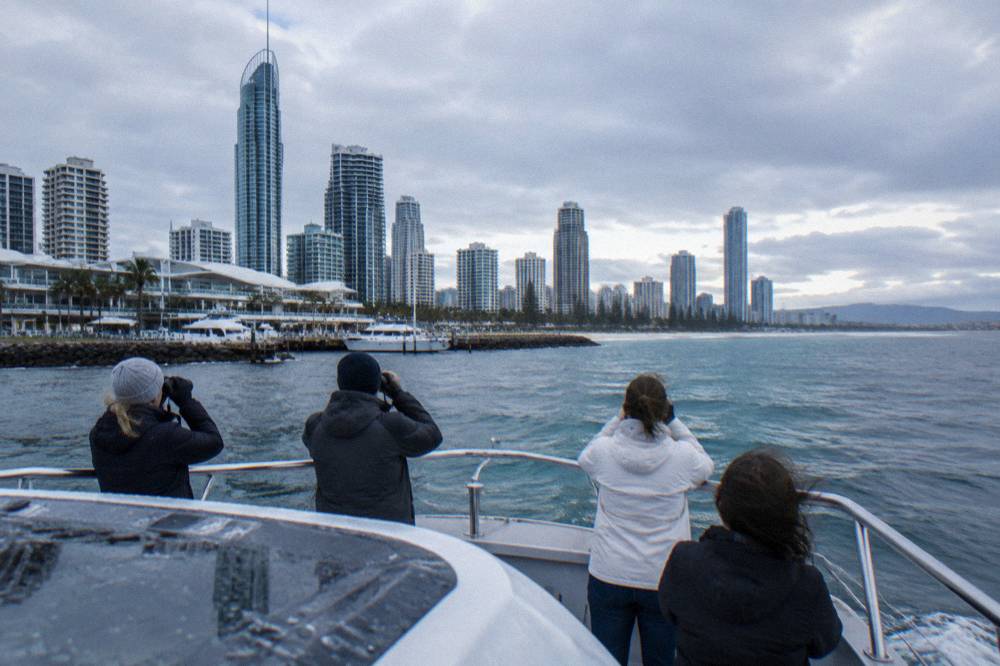
The one genuinely bad strategy is anchoring yourself to a claimed spot for the whole trip. Whales are wild, a quiet day is possible, and the honest pages say so; but on a day with plenty of animals, the people who see the most are the people who moved the most. The crew will announce where the whale is relative to the boat, usually with a clock direction or a simple "port side" call, and the gap between hearing that call and being at the right rail is the whole game.
| Spot on the boat | Best moment to be there | Watch out for |
|---|---|---|
| Bow rail | Whale surfacing ahead, breaching in open water | Crowds at the first callout, spray |
| Stern rail | Curious whales following the wake, shelter while searching | Blocked view when the boat turns |
| Mid-ship rail | Default position between sightings | Neither end is far, but no guaranteed view |
| Upper deck | Search phase, distant blows, breaching far off | More roll, longer descent to the rail |
Morning Or Afternoon, Sun And Spray: Reading The Conditions
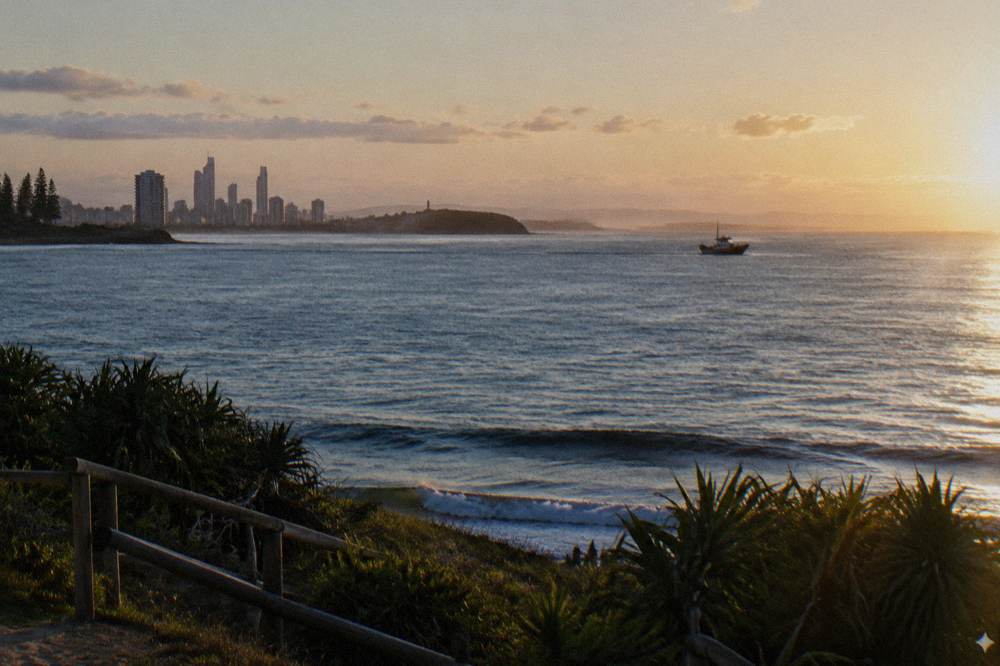
The conditions matter more for viewing quality than any seat. Calm mornings, before the wind picks up, are the best spotting conditions, and the Queensland Government notes the same for shore viewing; low sun can make one side of the boat glare badly, so on early trips the shaded rail is often the comfortable one, and spray direction follows the wind rather than the whale.
There is a real difference between morning and afternoon trips, and it is worth weighing when you book rather than when you board. The general pattern on the Gold Coast is calmer air and flatter water early, with sea breezes building through the day, and the question of morning versus afternoon is examined in detail in the morning or afternoon whale watching comparison. For positioning specifically, the morning calm helps you see distant blows from the upper deck, and the afternoon breeze tends to push spray onto the windward rail, which is exactly where the enthusiastic photographers end up standing.
Sun angle is the underrated factor. On a bright morning heading seaward, the low sun can sit on one side of the boat and turn that half of the ocean into glare, while the other side stays readable. This is the one situation where a side genuinely matters, and it is decided by the trip's direction and the sun's position, not by any permanent property of the boat. Ask the crew at check-in which way the boat will head; they will know, and they answer that question every day.
Weather also decides whether the trip runs at all. The Bureau of Meteorology's winter 2026 outlook, issued 28 May 2026, tipped below-average rainfall and above-average temperatures for the season with El Nino developing, which points to plenty of workable days across the July and August peak. Operators still cancel when conditions are unsafe: Sea World Cruises' own terms let passengers notify at check-in if rough seas are expected and choose to proceed, reschedule or take a full refund, with operator cancellations notified by SMS at least two hours ahead, and Spirit of Gold Coast's terms offer a reschedule or a full refund when it cancels for weather and cannot rebook you.
What The Crew's Callouts Mean For Where You Stand
The crew's announcements are the single most reliable positioning tool on any whale cruise. Skippers and spotters track the pod visually and by hydrophone where the boat carries one, then call the whale's position relative to the boat, and the correct response is to move to the called rail immediately and calmly rather than second-guessing with your own scan. On every Gold Coast listing, the crew does this work all day, every day in season.
Learning to trust the callouts is a skill, and it is quickly learned. A call of "whale at two o'clock, 200 metres, moving right" tells you three things: where to look now, where the animal is heading, and therefore which rail will be the right one in a minute. Passengers who process that and pre-position one rail ahead of the whale's track consistently get the closest views, because they arrive before the crowd. Passengers who wait for the whale to appear before moving arrive with everyone else and see it over shoulders.
The same crew discipline governs what happens when a whale comes to the boat. If a curious animal enters the no-approach zone, the rules require the crew to slow, disengage engines or withdraw slowly, and the best thing a passenger can do at that moment is stay quiet and hold position. A calm boat is a boat a whale stays near. The official tourism page for Gold Coast whale watching describes the season running June to November with peak numbers in July and August, and every operator's crew will be working that corridor daily through those months.
Boat choice shapes how the callouts feel. On the Spirit of Gold Coast catamaran, the marine biologist's commentary runs with the sightings, so the callouts come with context about what the pod is doing. On the Kokomo boat, the 47-guest cap means a callout reaches everyone at once and the crowd disperses along the rail. On the Cooly Eco safari boat, with 12 guests and a marine naturalist, a callout is almost a conversation. The mechanics of where to stand are identical in every case; the size of the crowd racing you to the rail is the only real variable.
For anyone weighing the whole decision, from side to boat to month, the planning basics are gathered in the Gold Coast whale watching season guide, and the full line-up of boats is laid out side by side in the tours compared guide. The short version of all of it, and of this whole article, is that Whale Watching On The Gold Coast rewards the flexible: book the boat whose format suits you, board with loose shoes and an empty bladder strategy, and treat every rail as temporary.
Common Questions About Boat Positioning For Whale Watching
Which Side Of The Boat Is Best For Whale Watching?
There is no best side. Whales surface on any side and change direction without warning, so a fixed seat is a lottery. Stay near the centre of the boat, watch for the crew's callouts, and move to whichever rail they name; mobility beats seat choice on every format from the 24 m Spirit of Gold Coast catamaran to the 12-guest Cooly Eco safari boat.
Is The Front Or Back Of The Boat Better For Seeing Whales?
The bow gives an open forward sightline and the classic photos, but it crowds at the first callout. The stern is quieter and catches whales that follow the wake. Neither wins every trip, so hold a mid-ship position and commit to a rail only when the crew calls a sighting.
Is The Upper Deck Or Lower Deck Better On A Whale Cruise?
Use both. Start high to scan for distant blows and breaches, then drop to the lower deck when a whale comes close, because waterline views give the real sense of scale. If you are prone to seasickness, stay lower and mid-ship, where the motion is gentlest.
Do Whales Come Close To The Boat On The Gold Coast?
They can. Curious whales sometimes approach a slowed or stationary boat and pass alongside or underneath, and Queensland rules require the crew to disengage or withdraw slowly when that happens. A close pass is never promised, which is why several listings state their own sighting guarantees or free return cruise policies.
Does It Matter If You Stand On The Windy Side Of The Boat?
Only for comfort. Spray follows the wind, so the windward rail is the wet one, and low morning sun can make one side glare. Ask the crew at check-in which way the boat heads and where the sun will sit, then choose your default rail accordingly.
Do Small Boats Give Better Whale Views Than Big Catamarans?
Different, not better. Small boats such as the 47-guest Kokomo vessel or the 12-guest Cooly Eco safari boat put everyone at eye level close to the water, while big catamarans such as the Spirit of Gold Coast boat offer height, shelter and 360 degree views from two decks. Choose by comfort and sea conditions, not by expected proximity.