How Do You Tell If A Whale Is Near?
The visible signs that give away a nearby humpback on the Gold Coast: blows, footprints, bird gatherings and boat clusters, plus what the approach rules let you see.
How Do You Tell If A Whale Is Near?
You tell a whale is near by reading the surface: a tall, bushy vertical blow of vapour, a smooth oval patch of flat water amid the chop, a sudden spiral of seabirds dropping to the surface, or a cluster of boats all facing the same way. Whales also leave footprints, oily circles that persist after a dive, and a crew that slows and drifts is usually watching something below. Most of the signs are visible hundreds of metres before any whale shows itself.
A humpback surfacing is not a subtle event, but the ocean is enormous, and the whale you eventually watch was almost always announced minutes earlier by something other than its body. Experienced crews read the water the way a tracker reads ground: shapes, textures and the behaviour of other animals tell the story first. On a Gold Coast cruise this matters, because the boats you ride, the Spirit of Gold Coast catamaran from Southport, the Sea World Cruises vessel from Main Beach, the Kokomo boat from Marina Mirage, all work the same stretch of water, and the crew that spots the signs earliest spends the longest time with whales. Once a crew does find a whale, the next question is usually whether it will come near, and this guide to whether humpback whales are friendly to humans covers what curiosity looks like and why the law keeps everyone at a distance.
The signs break into a handful of families. There is what the whale itself puts into the air: the blow, the splash, the breach. There is what it leaves on the water: the footprints, the smooth patch. And there is what other creatures do about it: the birds, the dolphins, the behaviour of other boats. Each family of signs is worth learning on its own, because on any given trip one will be obvious and another will be invisible.
This article walks through all of them in the order you are likely to meet them on a Gold Coast whale watching morning, and it explains what the Queensland approach rules mean for how close those signs can translate into an actual whale beside your rail. The reporting here draws on the state's marine mammal watching rules, the federal humpback migration pages, and the details of the seven listings on this site's roster. If you want the broader picture of what a trip involves, the guide to what to expect on a Gold Coast whale cruise covers the day from check-in to return.
What Does A Whale Blow Look Like From The Boat?
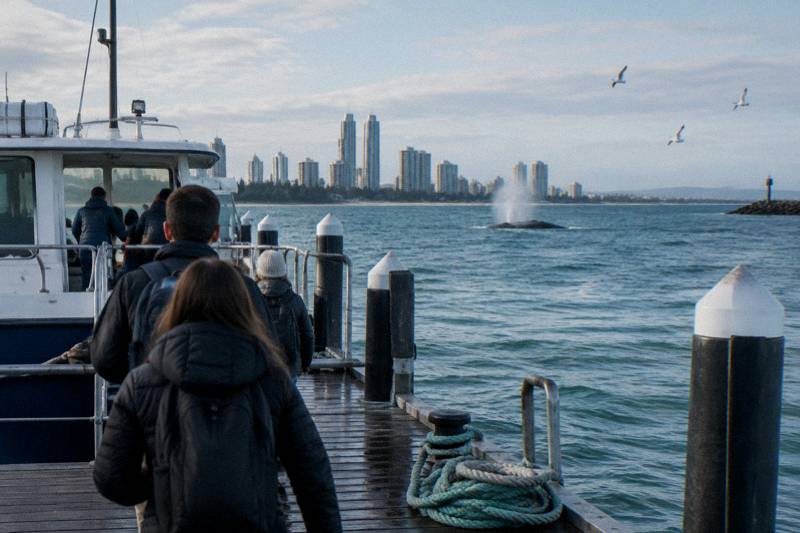
A humpback's blow is a tall, bushy, slightly angled column of vapour that rises 3 metres or more and hangs for a second or two before dispersing; on a windless morning it is visible from a kilometre or more away, and it is usually the first sign a crew calls out. It is exhaled air and moisture, not a water spout, and it appears before any part of the whale shows. On a calm day the blow is the single most reliable long-distance sign on the water.
The blow works hardest early. The Queensland Government's own whale watching guidance notes that calm mornings, before any wind picks up, are the best conditions for spotting whales, and the reason is exactly this: wind smears a blow sideways and flattens its shape within seconds, while still air lets the column stand and linger. That is also why the same calm morning that suits shore-based watchers from the Burleigh Heads headland suits a boat crew scanning from the deck of the Spirit of Gold Coast catamaran.
There is a second, quieter use for blows: counting. Whales in a group surface on slightly offset rhythms, so a pair of blows a few seconds apart, then a smaller third, tells a crew there may be a mother and calf rather than a single animal. Humpbacks can reach 16 metres in length and a fully grown animal weighs up to 45 tonnes, per the federal environment department's species pages, so an adult blow is distinctly taller and heavier-looking than a juvenile's, and a calf's is smaller again. A crew that logs the pattern can position the boat before the animals have finished their dive.
Sound matters too. On a quiet day a blow carries as a soft, low puff across open water, and crews standing near the bow will hear one before anyone at the stern sees it. The Boattime superyacht trip and the Spirit of Gold Coast cruise both carry crew whose whole job at the rail is scanning and listening, and a marine biologist guide, the kind the Spirit of Gold Coast listing and the Blue Seafaris listing both advertise, will usually narrate exactly this sequence as it happens: blow heard, blow seen, flukes up, wait for the rise.
What Are Whale Footprints On Flat Water?
Whale footprints are smooth, glossy, roughly circular patches of flattened water that appear where a whale has swum just beneath the surface; the turbulence from its flukes flattens the surface sheen into an oval that stands out against surrounding chop, and it can persist for a minute or more after the animal has gone. Crews use them both to track a submerged whale and to confirm one passed moments ago.
The physics is simple. A whale cruising a metre or two down pushes a wake upward, and the surface above it loses its fine texture while the water around it keeps rippling. From a deck the contrast is unmistakable: a slick, glassy coin in a field of small waves. On a windless morning a chain of footprints maps a whale's path like a dotted line, and a skipper can idle along that line rather than guess. When the whale finally rises, it often does so at the leading edge of the newest footprint.
Footprints are the sign passengers most often miss, because they do not look like anything until someone points them out. Once pointed out, they become addictive: every flat patch on the water becomes a candidate, and the boat's collective attention sharpens. Guides on small-boat listings, the Cooly Eco safari-style vessel that seats 12, or the Blue Seafaris small boat carrying around 21 guests, get the most value from footprints, because eye-level decks put the surface texture close enough to read in detail.
Footprints also settle a common argument on board: whether a whale is truly near or the boat is just drifting hopefully. A single distant blow proves a whale was somewhere; a fresh footprint beside the hull proves one is close, now, and likely to surface within sight. It is the difference between a sighting and a company, and it is the moment crews start repositioning rather than watching.
Why Do Seabirds And Other Boats Give Away A Whale?
Seabirds, especially gulls and terns, gather where whales feed or where their passage pushes prey toward the surface, so a tight, wheeling flock sitting on or diving at one patch of water is a strong marker of whale activity below; a cluster of boats all stationary and facing the same direction is the human equivalent, and either sign can save a crew ten minutes of searching. On the Gold Coast both signs appear on most mid-season mornings.
The bird sign is the older of the two. Whales do most of their feeding in Antarctic waters, and the humpbacks passing the Gold Coast between June and November are largely fasting, but their movement still stirs the water column, and fish and krill fragments rise where they swim. Birds exploit that. A spiral of birds dropping onto the surface in the middle of otherwise empty water reads, to a spotter, almost like a flare. Crews on the Spirit of Gold Coast whale watch and the Sea World Cruises vessel both work this pattern, and the dolphins that cruises frequently report alongside humpbacks hunt the same stirred-up prey, so a dolphin group moving with purpose is itself worth following.
The boat cluster is the blunter instrument. When three boats sit in a loose arc all facing one point, something is there, and the Queensland three-boat rule, which caps the number of vessels inside one whale's 300-metre caution zone at three, means a fourth boat cannot simply pile in. A skipper arriving fourth will hold off and wait, watching the same water from a legal distance. That is worth knowing as a passenger: if your boat seems to be hanging back from an obvious gathering, it is following the rules, not missing the whale.
| Sign on the water | What it usually means | How reliable it is |
|---|---|---|
| Tight wheeling flock of terns or gulls | Prey stirred toward the surface, often by a whale or dolphins below | Strong when birds are actively diving, weaker when birds are just resting |
| Dolphins moving fast in one direction | Feeding or travelling; may lead to whales nearby | Moderate; worth following briefly |
| Two or three boats stationary in an arc | A whale is in the caution zone they are holding | Strong; the boats are already watching something |
| A single boat circling slowly | A crew working footprints or a submerged whale | Moderate; the whale may have moved on |
| Sudden splash with no blow first | A breach, tail slap or pectoral slap, sometimes first seen as spray | Strong; scan the splash line immediately |
What Do The Queensland Approach Rules Mean For What You See?
Queensland rules keep boats at least 100 metres from a whale and 300 metres in front of or behind it, limit speed to 6 knots inside the 300-metre caution zone, and cap the zone at three boats, so most of what you will watch happens at 100 metres or more, and the close passes that do occur are the whale's choice, not the boat's. The rules shape every sighting on a Gold Coast cruise, and knowing them makes the viewing better, not worse.
The distances come from the Queensland Government's rules for watching marine mammals, updated 5 March 2026. A boat inside the caution zone must slow, must not enter the no-approach zone that surrounds the animal and extends ahead of and behind it, and must withdraw or cut engines if a whale closes the distance itself. Jet skis are prohibited vessels within 300 metres, drones stay 100 metres out, helicopters 500 metres, and a person in the water must keep 100 metres from a whale. White whales carry special protection: boats cannot approach within 500 metres of a predominantly white humpback, a rule written with Migaloo in mind.
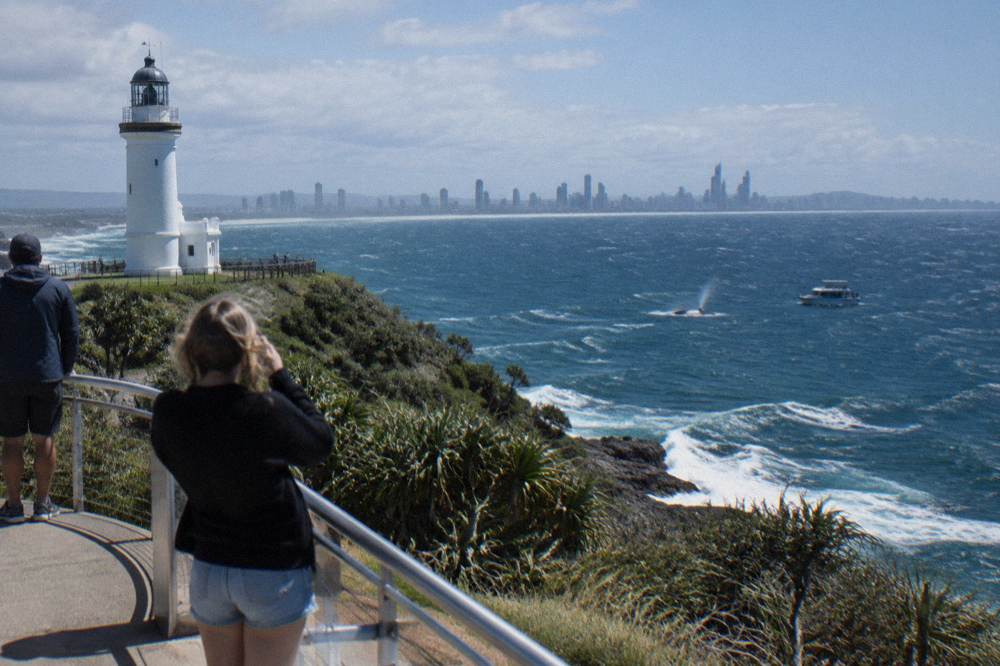
For a passenger this has two practical effects. First, the boat will not chase: when a whale dives, the skipper holds or drifts rather than racing after it, because the animal can travel fast underwater and the rules forbid cutting its path. Second, the best moments are usually approach passes: a curious whale that decides to swim to the boat, inside its own choosing, can pass close enough to fill a camera frame, and that is entirely legal because the whale initiated it. The site's longer piece on whether whales come close to the boat on the Gold Coast works through this in detail.
| Vessel or activity | Minimum distance from a whale | Source rule |
|---|---|---|
| Boat or vessel | 100 m, and 300 m in front of or behind | Queensland caution and no-approach zones |
| Boat speed inside 300 m | 6 knots maximum | Caution zone speed limit |
| Boats in one caution zone | No more than three | Three-boat rule |
| Jet ski or hovercraft | 300 m | Prohibited vessels rule |
| Drone | 100 m horizontal and vertical | Remotely piloted aircraft rule |
| Helicopter | 500 m, no hovering above | Aircraft rule |
| Person in the water | 100 m | In-water approach rule |
| Predominantly white whale | 500 m for boats | Special-interest whale rule |
The NSW side of the border, where the Tweed Heads and Chinderah boats depart, has its own framework, and the Blue Seafaris small boat and the Cooly Eco listings operate under it: a vessel moves no closer than 100 metres to a whale, and a swimmer enters the water at least 100 metres away and then keeps 30 metres clear. The one swim trip on this roster, the Cooly Eco swim experience, departs Chinderah on the Tweed River in New South Wales, not from the Gold Coast itself, and its listing states a whale sighting is guaranteed but a swim is not.
How Do Crews And Marine Biologist Guides Actually Find Whales?
Crews find whales by dividing the horizon into sectors, scanning methodically rather than staring, logging every blow and footprint against a compass heading, and using the migration's own logic: in June and July the northbound animals pass in a broad corridor, and from August to October the southbound mothers and calves travel slower and closer to shore, so the search box shrinks as the season turns. A marine biologist guide adds pattern recognition on top of the scanning.
The sector method sounds mundane and is the difference between a sighting and a morning of squinting. Two or three crew take arcs of the horizon, sweep them slowly, and call out anything that breaks the surface texture: a blow, a splash, a bird drop, a footprint. The call goes out with a heading, and the skipper turns the boat toward it while the rest of the crew keeps scanning, because the first sign is often not the whale you end up watching. On the Spirit of Gold Coast whale watch, the boat that departs Aqua Adventures at Southport with lower and upper decks, a marine biologist guide leads this work and narrates it, which is why guests on that trip frequently leave knowing what a footprint is.
The migration logic does the rest. The federal environment department's humpback pages describe the eastern Australian migration: the majority of animals move north from June to August and return toward the Southern Ocean from September to November, with young males leading and cow-calf pairs bringing up the rear. On the Gold Coast that translates into a simple seasonal search pattern: early season, spread out and further offshore, fast passes; late season, mothers and calves hugging the coastline, slower and longer encounters. Peak numbers come in July and August on the northbound leg, per the state's tourism whale watching pages. If you're wondering why those mother-and-calf pairs hug the shoreline so tightly, the guide to what actually hunts humpback whales explains the threats they're steering clear of.
Small boats sharpen all of it. The Blue Seafaris trip from Tweed Heads South carries around 21 guests with a marine biologist aboard, though food and drinks are not part of the ticket, and the Cooly Eco safari-style vessel seats 12 at eye level with a marine naturalist. On a boat that size, a crew's footprint read becomes a shared experience rather than a distant announcement, and the same sign that would be one shout on a 100-person deck becomes a conversation. The Boattime superyacht trip pairs a marine biologist with a luxury yacht platform, and its listing states a 100 per cent whale sightings guarantee with a free return element, phrased as the listing's own policy.
What Other Signs Give Away A Nearby Whale?
Beyond blows and footprints, look for breaches (a full-body leap and re-entry that can be seen from kilometres away), tail slaps and pectoral slaps that throw white spray high, a whale's back rolling in a slow arc, and the flukes rising before a deep dive; splashes from a distance often appear before any whale shape does, and a persistent splash line in one spot means sustained surface activity. Surface activity runs through the whole season, with mothers and calves reported most in September and October.
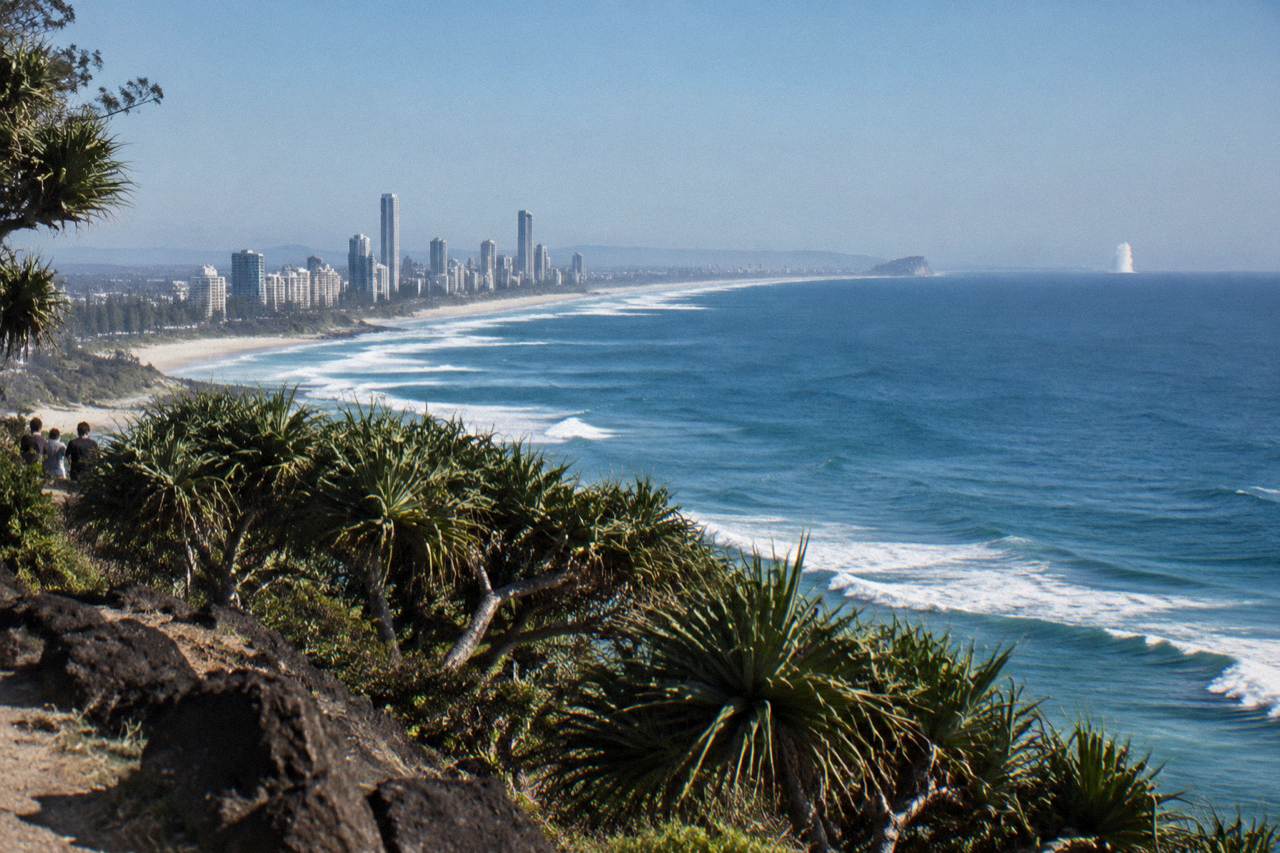
The breach is the loudest sign on the water and the easiest to spot from the farthest away. A 40-tonne animal falling back into the ocean throws a plume visible, on a clear day, from a headland, which is why the free shore lookouts the tourism board names, Point Danger at Coolangatta among them, work so well in peak months. From a boat, a distant breach is an invitation: the crew notes the bearing and closes the distance at the legal speed, and more often than not a breaching whale keeps breaching, because the behaviour comes in runs.
Tail slaps and pectoral slaps are the mid-range signs. A humpback lying on its side and slapping a long pectoral fin throws a distinctive white, flat report of spray, and a tail slap sends a boom across the water that carries further than the splash itself looks like it should. Crews listen for that percussion. Between slaps the whale may simply log at the surface, resting, its back a slow dark shape that is easy to miss and impossible to forget once it exhales.
Then there is the negative sign, the one honest pages have to include: a quiet day. Whales are wild, the ocean is big, and no cruise on this coast promises a sighting in its own voice. Some listings state a guarantee as their own policy: the Sea World Cruises listing states a 100 per cent whale sighting guarantee with a free return cruise, the Spirit of Gold Coast listing guarantees a humpback sighting from June to November or a complimentary second cruise, and Blue Seafaris offers a free tour on the next available slot if no whales are sighted. The Kokomo boat and the Cooly Eco boat trip state no guarantee, and a quiet morning on those trips is simply a quiet morning, with dolphins, turtles and seabirds as the consolation the listings describe.
How Do You Practise Reading The Water Before You Sail?
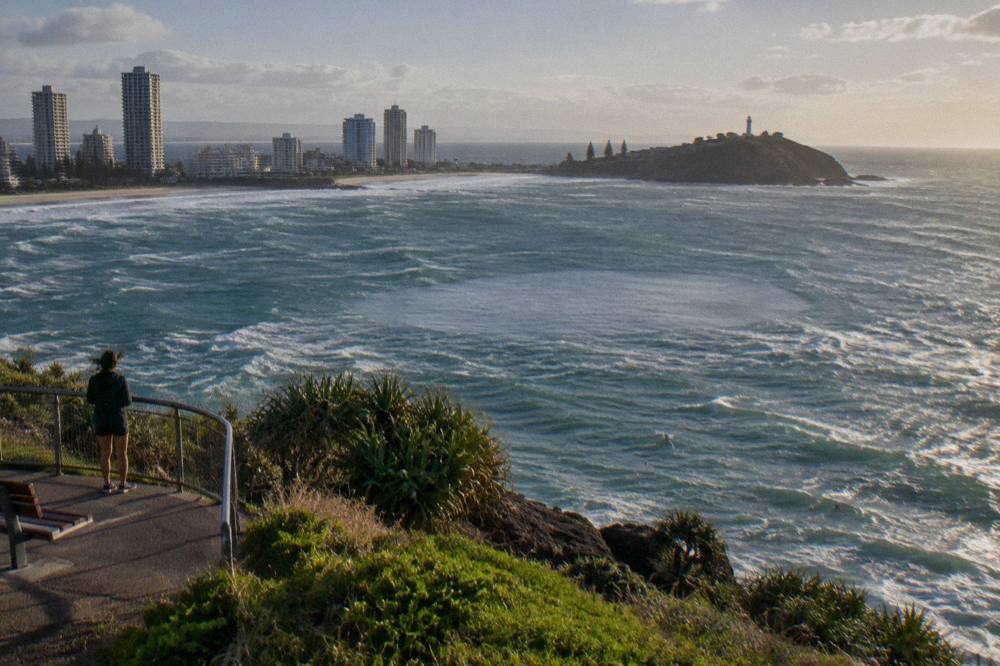
You practise by watching from shore: pick a named lookout such as Point Danger, Burleigh Heads, Miami or Greenmount Point, bring binoculars, go early on a calm morning in July or August, and spend an hour scanning for exactly the same signs a crew scans for, blows, splash lines and bird gatherings, so that by the time you board a cruise the signs are already familiar. Shore watching is free and it is the best training there is.
The tourism board's Gold Coast whale watching page names those four lookouts outright, and Point Danger at Coolangatta is its pick for the best free spot, sitting on the border with views over Snapper Rocks and the open ocean. Local guides add Currumbin's Elephant Rock and the Main Beach and The Spit stretch, described as reported by local writers rather than board-named vantage points. Binoculars help enormously, and the state government's guidance repeats the point that headland watching with optics is a genuine way to see migrating humpbacks, not a consolation prize.
The rhythm of a shore session teaches the same discipline a crew uses. Scan slowly, section by section, and do not fixate on one patch. Watch for the vertical: a blow is vertical, a wave crest is horizontal, and the eye learns the difference within minutes. Watch the birds, and when a flock sits in one spot on otherwise empty water, give that spot a long look. When something breaches far out, note where it was and keep watching that line, because a second breach usually follows within a minute.
Then bring the trained eye to a boat. The step from a headland to a deck is mostly a step of scale: the same blow that was a faint puff from Point Danger is a column you can hear from a deck, and the same footprint that was a glassy speck from the hill is an oval you could almost touch from the rail. Every listing on this roster, from the Sea World Cruises vessel at Main Beach to the Kokomo boat at Marina Mirage, runs about two and a half hours or a little more, which is enough time for a patient reader of water to see the whole vocabulary of signs play out at least once.
The site behind this article, Whale Watching On The Gold Coast, exists to close exactly that gap: between knowing the signs and being on the boat that reads them. The season timing guide covers which weeks match which sign, and the cruise comparison guide matches each boat type to the kind of viewing you want.
Common Questions About Spotting A Nearby Whale
How Do You Tell If A Whale Is Near?
You read the surface: a tall bushy blow of vapour, a smooth oval footprint of flat water among the chop, a tight flock of diving seabirds, or a cluster of boats all facing one point. A whale's presence is usually announced minutes before any part of its body shows, and a crew that slows and drifts is almost always watching something below.
What Does A Whale Blow Look Like From A Distance?
It is a tall, bushy, slightly angled column of vapour that rises several metres and hangs briefly before dispersing. On a calm morning it can be visible from a kilometre or more. It is exhaled air and moisture, not a water spout, and it appears before the whale's body does.
What Are Whale Footprints On The Water?
They are smooth, glossy, roughly circular patches of flattened surface water left where a whale has swum just beneath. The turbulence from the whale's flukes flattens the surface sheen, and the patch stands out against surrounding chop and can persist for a minute or more, letting a crew track a submerged animal.
How Close Can A Whale Watching Boat Get To A Whale?
Queensland rules keep boats at least 100 metres from a whale and 300 metres in front of or behind it, with a 6-knot speed limit inside the 300-metre caution zone and no more than three boats in that zone. Close passes happen when the whale chooses to approach the boat, not the other way around.
Do Birds Really Lead You To Whales?
Frequently, yes. Gulls and terns gather where a whale's passage has stirred prey toward the surface, and a tight, wheeling flock actively diving at one patch of water is a strong marker of whale activity below. Dolphins moving with purpose in one direction point the same way.
What If You See No Signs At All On Your Cruise?
It happens: whales are wild and the ocean is large, and no page should promise otherwise in its own voice. Some listings state a guarantee as their own policy, such as a free return cruise if no whale is sighted, while others state no guarantee at all. A quiet trip still usually delivers dolphins, turtles and seabirds.