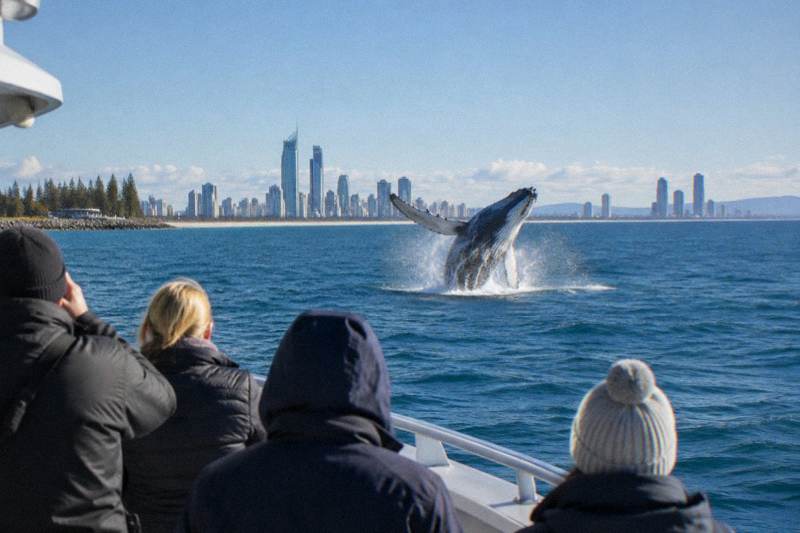
Is July A Good Time To Visit The Gold Coast?
July sits in the peak of the Gold Coast whale season, with the biggest northbound humpback numbers, mild winter weather and the free Whale and Ocean Festival at Burleigh Heads. Here is what a July trip actually looks like.
Is July A Good Time To Visit The Gold Coast?
Yes, July is one of the strongest months on the coast, and the main reason is in the water. It sits inside the peak of the humpback migration, when northbound whale numbers are at their highest, while the winter weather is mild, settled and drier than the storm months of summer. Crowds on the water are thinner than the school-holiday rush of the September and October calf season, and cruise prices hold steady through the month.
The tourism board's own season guide puts peak numbers in July and August, which makes July the first full month where the northbound migration is running at full volume. The whales passing the Gold Coast in July are mostly juveniles, young adults and competitive pods heading for the breeding grounds further north, and they are the energetic part of the population. Breaching, tail-slapping and surface chases are the behaviours this stretch of the migration is known for, and the cruise fleet is out every day to meet it.
July also happens to be the month the coast celebrates the migration rather than just watching it. The free Gold Coast Whale and Ocean Festival ran at Justins Park, Burleigh Heads, on 4 July 2026, with stalls, education activities and a guided land-based whale survey from Burleigh Hill, and the volunteer group behind it, Humpbacks and Highrises, runs Queensland's largest volunteer marine mammal monitoring program between festivals. A winter trip in July can combine a morning on the water with an afternoon on a headland, and both halves of that day are free or close to it.
The practical side favours July too. The Bureau of Meteorology's winter outlook pointed to below-average rainfall and above-average temperatures across the state's south-east, which on the Gold Coast translates into the clear, calm mornings that whale spotters and skippers both prefer. The full cruise roster runs in July, from the Sea World Cruises premium cruise out of Main Beach to the Spirit of Gold Coast catamaran from Southport, so availability is broad even if the most popular departures fill early.
If you are weighing July against other months, the trade-offs are simple. August carries similar whale numbers with the southbound season beginning to mix in, and September and October bring mothers and calves closer to shore, but July wins on raw northbound volume and on the festival calendar. The comparison between the coast and the calmer nursery waters further north is covered in detail in the guide to whale watching in Hervey Bay versus the Gold Coast, which explains why the two regions suit different travellers.
What Is The Gold Coast Weather Like In July?
July is winter on the Gold Coast, and it behaves like it: mild daytime temperatures, cool nights, low rainfall and a higher share of clear, calm mornings than almost any other month. The Bureau of Meteorology's winter outlook for 2026 pointed to below-average rainfall and above-average temperatures, with El Nino likely to develop, which historically means more settled days rather than fewer. It is a dry, gentle winter by Australian east coast standards.
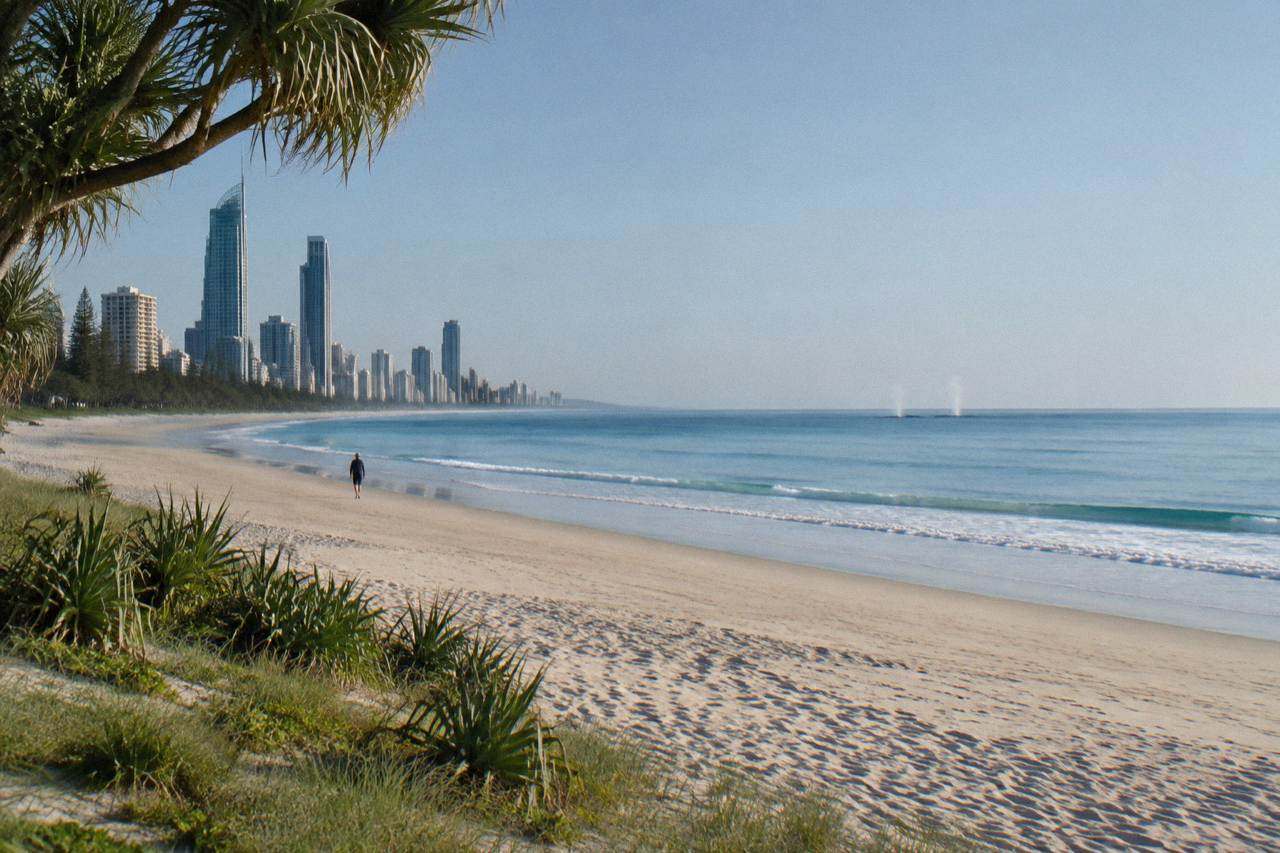
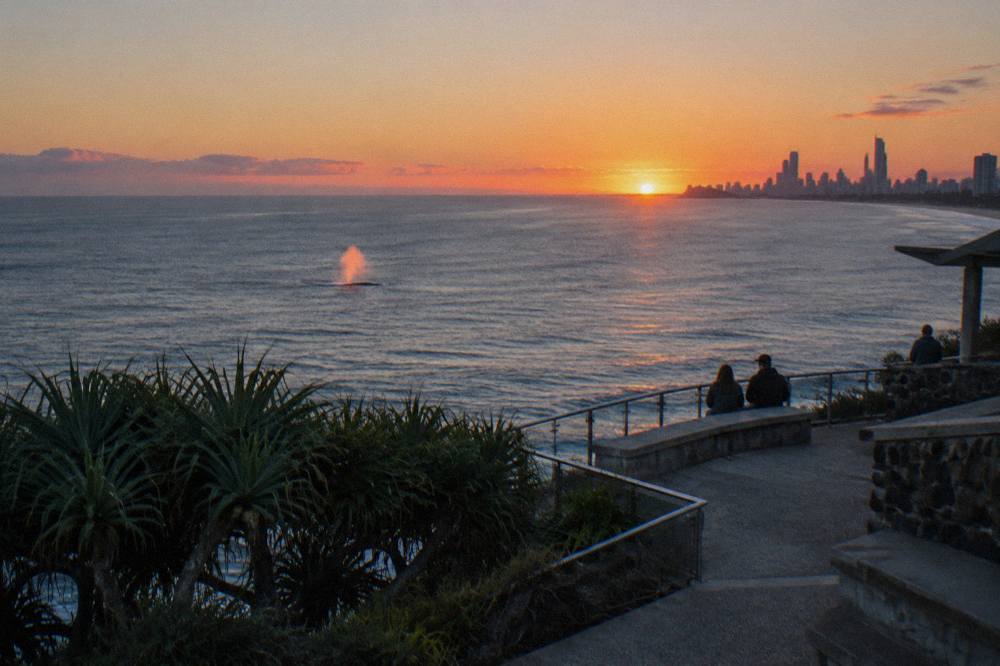
The rainfall signal matters more for a whale trip than the thermometer does. A dry outlook means fewer of the grey, squally days that push operators to reschedule, and the calm-morning pattern the Queensland Government itself recommends for shore-based whale spotting, before any wind picks up, is easier to catch in July than in the storm season. The same page notes that migrating humpbacks can be seen from headlands and open beaches with the help of binoculars or spotting scopes, so a still July morning doubles your chances both on the water and from the shore.
One July-specific caution is worth knowing before you book. The Gold Coast Seaway, the channel the Main Beach and Southport cruises use to reach open water, is a designated coastal bar, and Maritime Safety Queensland warns that conditions on a bar can change quickly, and are at their worst on an ebb tide with large swell or strong wind. Operators monitor this closely and cancel or reschedule when a crossing is unsafe. Sea World Cruises' own terms, for example, let you notify the crew at check-in if rough seas are expected and then choose to proceed, reschedule, or take a full refund if the trip cannot run safely, with operator cancellations notified by SMS at least two hours ahead.
For planning purposes, treat July as a month of two half-days rather than one long one. The mornings are the calm, prime viewing window; the afternoons can freshen up with wind, which matters less if your whale watching is already done and the rest of the day is for the festival, the headlands or a long lunch. The question of timing departures is unpacked further in the blog post on morning versus afternoon whale watching, and the mechanics of rough-weather decisions are covered in whether Gold Coast cruises run in rough weather.
Thinking about locking in a July departure now?
Free cancellation applies across the whole roster, though none of the seven tours includes hotel pickup, so you make your own way to the departure point for a winter morning on the water.
How Many Whales Are In Gold Coast Waters In July?
July is the first of the two peak months. The east coast humpback population is estimated at around 50,000 animals, and the northbound leg that passes the Gold Coast in June and July carries the juveniles and young adults first, followed by adult whales and competitive pods. By July the flow of animals past the coast is steady, and the tourism board names July and August as the months of peak numbers.
The scale of that population is the quiet headline of the modern season. The preliminary estimate of more than 50,000 eastern Australian humpbacks in 2024 compares with about 8,000 in 2006 and barely a hundred individuals when whaling ended in 1963, a recovery rate scientists put at around 10 to 11 percent a year. For a July visitor the practical meaning is simple: the migration corridor off the Gold Coast is no longer a lucky corridor, it is a busy one, and skippers spend their trips choosing which pod to stay with rather than searching for one.
What July whales are doing shapes what you see. The northbound animals are travelling with intent, but humpbacks are not subtle animals, and the species' surface repertoire, breaching, tail-slapping and pectoral slapping, runs through the whole season according to the tourism board's whale pages. Competitive pods, where several males pursue a female, produce the longest and loudest displays of the migration, and those pods are a July and August feature. Mothers with calves are mostly a September and October story, when the southbound leg brings them closer to shore and travelling slower.
The full season, month by month, looks like this:
| Month | Migration leg | What is passing the Gold Coast |
|---|---|---|
| June | Northbound begins | The first humpbacks, led by juveniles and young adults; the 2026 season opened with a mother and newborn calf off the Seaway on 2 June |
| July | Peak northbound | One of the two peak months, with adults and competitive pods joining the flow |
| August | Peak, turning south | Peak numbers continue while the first southbound adults appear |
| September | Southbound builds | Mothers and newborns travelling slower and closer to shore |
| October | Southbound continues | Mother and calf pairs, the most reported stretch for pairs |
| November | Season tail | The season closes in early November as the last whales head south |
No operator publishes sighting counts for 2026, and this site will not invent a number. What the verified record does show is the shape of the month: a steady northbound stream, energetic surface behaviour, and a cruise fleet that also reports dolphins, turtles and seabirds as regular company. The species itself, its size and its habits, is covered in the guide to humpback whales on the Gold Coast, and the full season calendar is laid out in the guide to the Gold Coast whale watching season. For a sense of what any single day on the water might actually deliver, the guide to today's whale sightings on the Gold Coast explains why daily reports can only hint at what you might see.
What Does A July Whale Watching Cruise Look Like?
**A July cruise is a short, busy morning or afternoon on the water: the four Gold Coast listings run from about 2.25 hours to 2 hours 50 minutes, depart from Main Beach or Southport, and vary in price by boat, with current figures on the live listings. Every listing on the roster offers free cancellation, none include hotel pickup so you make your own way to the departure point, and three of the four Gold Coast cruises attach a sighting guarantee or free return cruise to their listing.
The standard shape is the Sea World Cruises premium cruise, which departs the Sea World Cruises Terminal on Seaworld Drive, Main Beach, runs about 2.25 to 2.5 hours, and is listed from $55 per person with a 4.6 rating from 655 reviews. The listing states a 100% whale sighting guarantee with a free return cruise if none appear, and food and drinks are served on board. Hotel pickup is not included, so guests make their own way to the departure point. It also carries a real "Likely to sell out" urgency badge in July, which the peak month makes plausible rather than promotional. The operator's fleet page names the Spirit of Migaloo II, a purpose-built catamaran with multiple viewing decks, an underwater camera and a hydrophone, as its newest whale watching vessel.
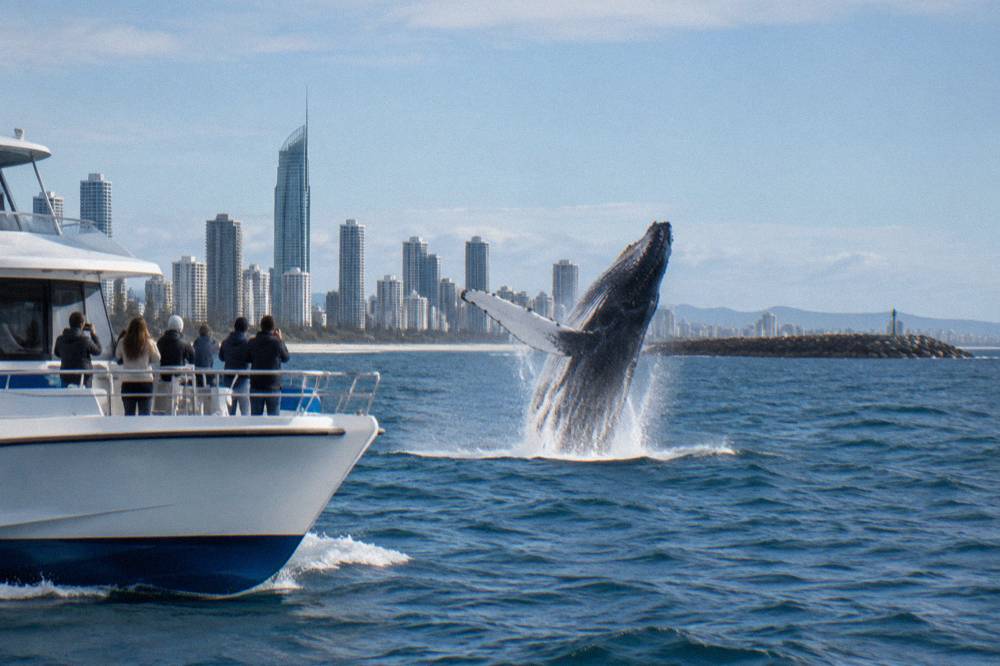
The Spirit of Gold Coast trip runs about 2 hours 50 minutes and carries a 4.6 rating across 920 reviews, the deepest review pool on the roster. The listing includes free cancellation. A marine biologist guides the trip, morning tea is included, and the listing guarantees a humpback sighting from June to November or a complimentary second cruise, which is the listing's own policy rather than a promise any honest page should make in its own voice. No hotel pickup: make your own way. Free cancellation applies. That guarantee lines up with the migration season itself, which our guide to how common humpback sightings are on the Gold Coast breaks down in detail.
For travellers who want a smaller July boat, the Kokomo cruise is the compact option on the Gold Coast side: a purpose-built vessel capped at 47 travellers, departing Marina Mirage at Main Beach, about 2.5 hours, listed from $62.19 per person with a 4.9 rating from 381 reviews. The operator's site describes an underwater camera on board. The listing states no sighting guarantee, so a quiet morning is possible, and the honest answer is that you pay your money and take your chances. Free cancellation applies up to 24 hours ahead.
The Boattime superyacht listing is the wildcard: a luxury yacht with a marine biologist, departing the Marine Stadium jetty at Main Beach, about 2.5 hours, listed from $52 per person, the cheapest price on the roster, with light morning or afternoon tea on arrival. Its 3.7 rating from 138 reviews is the lowest on the roster, and any honest ranking says so plainly. The listing states a 100% whale sightings guarantee with a free return cruise, so the value proposition is comfort plus a second-bite policy rather than polish.
Whales are wild, and the honest framing matters on every one of these boats. The guarantees above are listing policies, not laws of nature, and the two boats that state no guarantee at all, Kokomo and the Cooly Eco safari boat, still run the same waters in the same peak month. The full field, including the two small boats that depart from the New South Wales side of the border, is compared in the guide to Gold Coast whale watching tours compared, and the individual departures are mapped in where Gold Coast whale watching cruises depart.
What Else Is On The Gold Coast In July?
July delivers the coast's clearest whale festival, a set of free headland lookouts that work best in exactly the calm mornings July specialises in, and a winter crowd level that is busy on land but rarely overwhelming on the water. The free Whale and Ocean Festival at Burleigh Heads in early July is the flagship event, and the land-based viewing it celebrates costs nothing for the rest of the month.
The festival is the one date worth building a trip around. The 2026 edition ran on 4 July at Justins Park, Burleigh Heads, from mid-morning to mid-afternoon, with stalls, family activities, education talks and a guided land-based whale survey from Burleigh Hill, run by Humpbacks and Highrises, the volunteer organisation behind Queensland's largest marine mammal monitoring program. The same stretch of headland is one of the tourism board's named free whale watching spots for the rest of the season, so a visitor who likes the idea of the festival can have a version of that day any calm July morning.
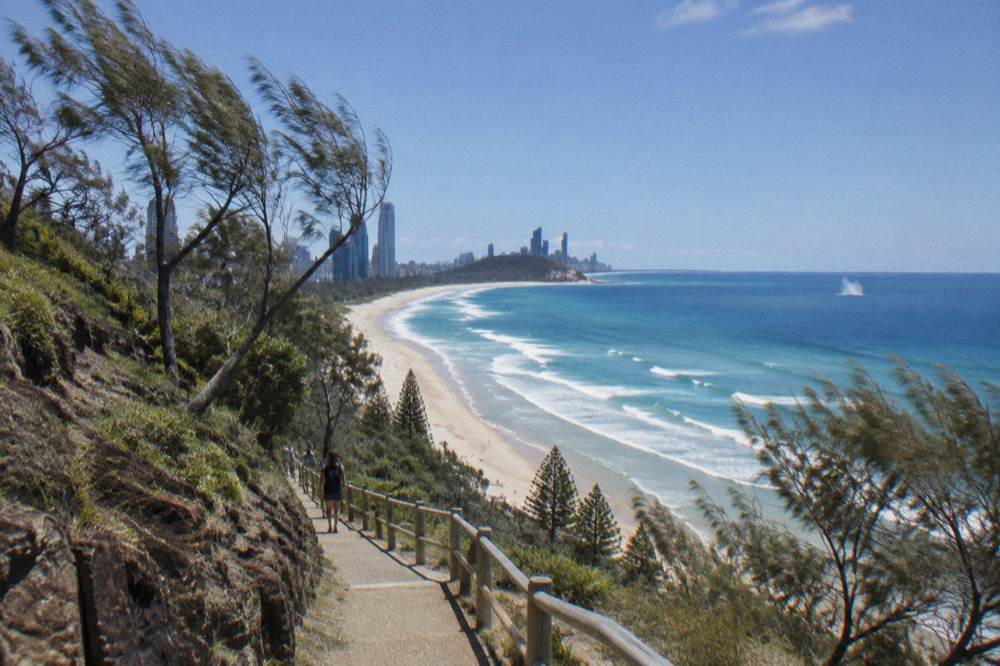
The free lookouts are the July safety net. The tourism board names Point Danger at Coolangatta as its pick of the free spots, along with Burleigh Heads, Miami and Greenmount Point, and local guides add Currumbin's Elephant Rock, Main Beach and The Spit, Kirra Hill and Snapper Rocks via Point Danger. Binoculars help everywhere, and the Queensland Government's advice that calm mornings before the wind picks up are the best shore viewing window matches July's weather pattern neatly. If your cruise morning is blown out or the boat is full, the headlands are the plan B that costs nothing.
The named spots, and who names them:
| Lookout | Area | Who names it |
|---|---|---|
| Point Danger | Coolangatta, on the Queensland and NSW border | Tourism board, its pick for best free spot |
| Burleigh Heads headland, including Tumgun Lookout | Burleigh Head National Park | Tourism board |
| Miami | Miami | Tourism board |
| Greenmount Point | Coolangatta | Tourism board |
| Currumbin, Elephant Rock | Currumbin | Local guides |
| Main Beach and The Spit | Main Beach | Local guides |
| Kirra Hill | Kirra | Local guides |
| Snapper Rocks | Near Point Danger | Local guides |
The rest of the July ledger is ordinary Gold Coast winter life, which is the point: the beaches are walkable, the water is cold for swimming by local standards but the surf still works, and the hinterland behind the coast is green after whatever rain the autumn brought. The crowd picture in July is school holidays for part of the month, so theme parks and restaurants run near full, but whale boats are less affected than land attractions because their capacity is fixed by maritime rules, not by demand. Booking ahead is covered in whether you need to book Gold Coast whale watching in advance, and the free-spot options are listed in full in the guide to free whale watching spots on the Gold Coast.
Which Gold Coast Whale Cruise Suits A July Trip?
Match the boat to what you want from a July morning. For the easiest logistics, the Sea World Cruises premium cruise, 2.25 to 2.5 hours on the water, carries a listing-stated sighting guarantee with a free return cruise; just make your own way to the departure point. For the deepest review pool and a marine biologist, Spirit of Gold Coast runs from $52.30 per person over about 2 hours 50 minutes, with morning tea included.
The comparison below uses the roster's own verified figures, and it is the honest way to pick: price, duration, rating with its review count, and what each listing actually promises.
| Cruise | Listed from | Duration | Rating | Departure point |
|---|---|---|---|---|
| Sea World Cruises premium cruise | $55 pp | about 2.25 to 2.5 hours | 4.6 from 655 reviews | Sea World Cruises Terminal, Main Beach |
| Spirit of Gold Coast | $52.30 pp | about 2 hours 50 minutes | 4.6 from 920 reviews | Aqua Adventures, Southport |
| Kokomo cruise | $62.19 pp | about 2.5 hours | 4.9 from 381 reviews | Marina Mirage, Main Beach |
| Boattime superyacht | $52 pp | about 2.5 hours | 3.7 from 138 reviews | Marine Stadium jetty, Main Beach |
| Blue Seafaris small boat | $87 pp | about 2.5 hours | 4.9 from 48 reviews | Tweed Heads South, NSW |
| Cooly Eco safari boat | $105.31 pp | about 2.5 hours | 4.9 from 68 reviews | Chinderah, NSW |
Two July-specific notes sit behind those numbers. First, the Sea World Cruises and Blue Seafaris listings both carry a genuine "Likely to sell out" badge, and July is the month most likely to make that badge true, so the cheapest strategy is simply to book early rather than hunt for a deal at the wharf. Second, the two New South Wales departures are not Gold Coast departures: Blue Seafaris leaves from Tweed Heads South and the Cooly Eco boats leave from Chinderah on the Tweed River, and the listings describe those trips as covering the Coolangatta and Gold Coast waters. If you are staying around Surfers Paradise or Main Beach, the four Broadwater departures are the practical choice.
The Blue Seafaris small boat is the July pick for travellers who want a quieter, more guided morning. It departs Tweed Heads, runs about 2.5 hours, food and drinks are not included, and current pricing is on the live listing with a 4.9 rating from 48 reviews, a small pool that says nothing about popularity and everything about a young listing. The listing's own policy offers a free tour on the next available slot if no whales are sighted, and it carries the "Likely to sell out" badge, so July dates go early.
One thing no July boat can offer is a swim with whales. Licensed swim-with-whales operations in Queensland run from Hervey Bay and the Sunshine Coast, not the Gold Coast, and the one swim trip on this roster, the Cooly Eco swim experience at from $310.26 per person for about 4 hours with a maximum of 9 travellers, departs Chinderah in New South Wales, just south of the border. Its listing guarantees a whale sighting but not a swim, a distinction worth repeating before anyone books it. The rules and the options are laid out in the guide to swimming with whales on the Gold Coast.
The other thing worth knowing before you board any of them is the law that shapes every encounter. Under the Queensland rules for watching marine mammals, boats keep at least 100 metres from a whale and 300 metres in front of or behind it, slow to 6 knots inside the 300 metre caution zone, and no more than three boats share one whale's caution zone. Skippers work inside those distances, and the whales sometimes ignore them entirely by approaching the boat on their own terms, which is the encounter every July trip is quietly hoping for. The site's own homepage comparison at Whale Watching On The Gold Coast carries the full three-question trip picker if you are still deciding between the boats.
Common Questions About Visiting The Gold Coast In July
Is July A Good Time To Visit The Gold Coast?
Yes. July sits in the peak of the humpback migration, with the tourism board naming July and August as the months of peak whale numbers, while the winter weather is mild, dry and settled. The free Whale and Ocean Festival at Burleigh Heads lands in early July, and the full cruise roster runs daily.
What Is The Weather Like On The Gold Coast In July?
July is winter, with mild days, cool nights and low rainfall. The Bureau of Meteorology's winter outlook pointed to below-average rainfall and above-average temperatures, and calm mornings are the norm before any wind picks up. Operators monitor the Gold Coast Seaway bar and reschedule or refund when a crossing is unsafe.
How Many Whales Are Around The Gold Coast In July?
July is a peak month. The east coast humpback population is estimated at around 50,000 animals, and the northbound leg passing the coast in June and July carries juveniles, young adults and competitive pods. No operator publishes sighting counts, so no honest page can quote a sighting rate.
Are Whale Watching Cruises Guaranteed To See Whales In July?
Whales are wild and no honest page promises a sighting. Three Gold Coast listings state their own sighting guarantee policies: Sea World Cruises, Spirit of Gold Coast and Boattime each attach a free return cruise or second trip to their listings. Kokomo and the Cooly Eco boat trip state no guarantee.
Can You Swim With Whales On The Gold Coast In July?
No licensed swim-with-whales tour departs the Gold Coast itself. Queensland swim operations run from Hervey Bay and the Sunshine Coast. The one swim trip on this roster departs Chinderah on the Tweed River in New South Wales, and its listing guarantees a sighting but not a swim.
What Is The Cheapest Way To Watch Whales On The Gold Coast In July?
Free shore viewing works in July, with Point Danger at Coolangatta named by the tourism board as the best free spot, alongside Burleigh Heads, Miami and Greenmount Point. The cheapest listed cruise is the Boattime superyacht from $52 per person, with boat tours across the roster running from $52 to $105.31 per person.