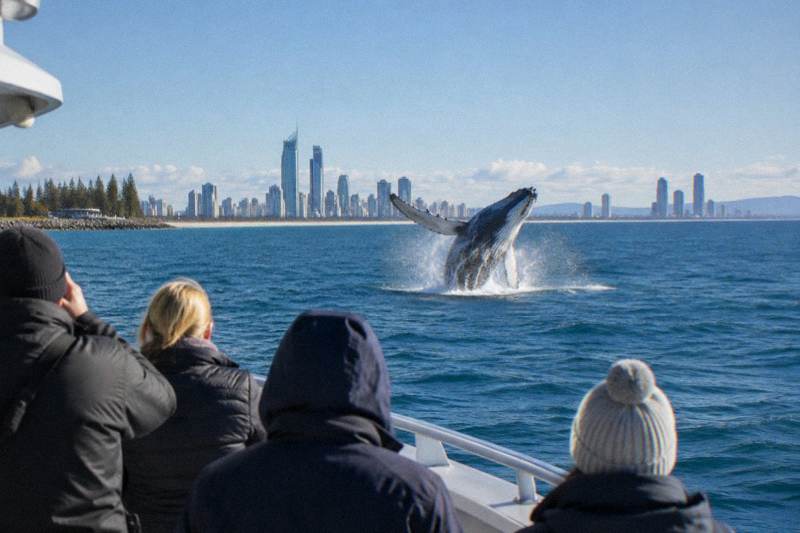
Are There Any Whale Sightings On The Gold Coast Today?
How to read today's Gold Coast whale sighting picture: what the season window, the 2026 opening reports and the shore lookouts actually tell you, and why no page can promise whales on any single day.
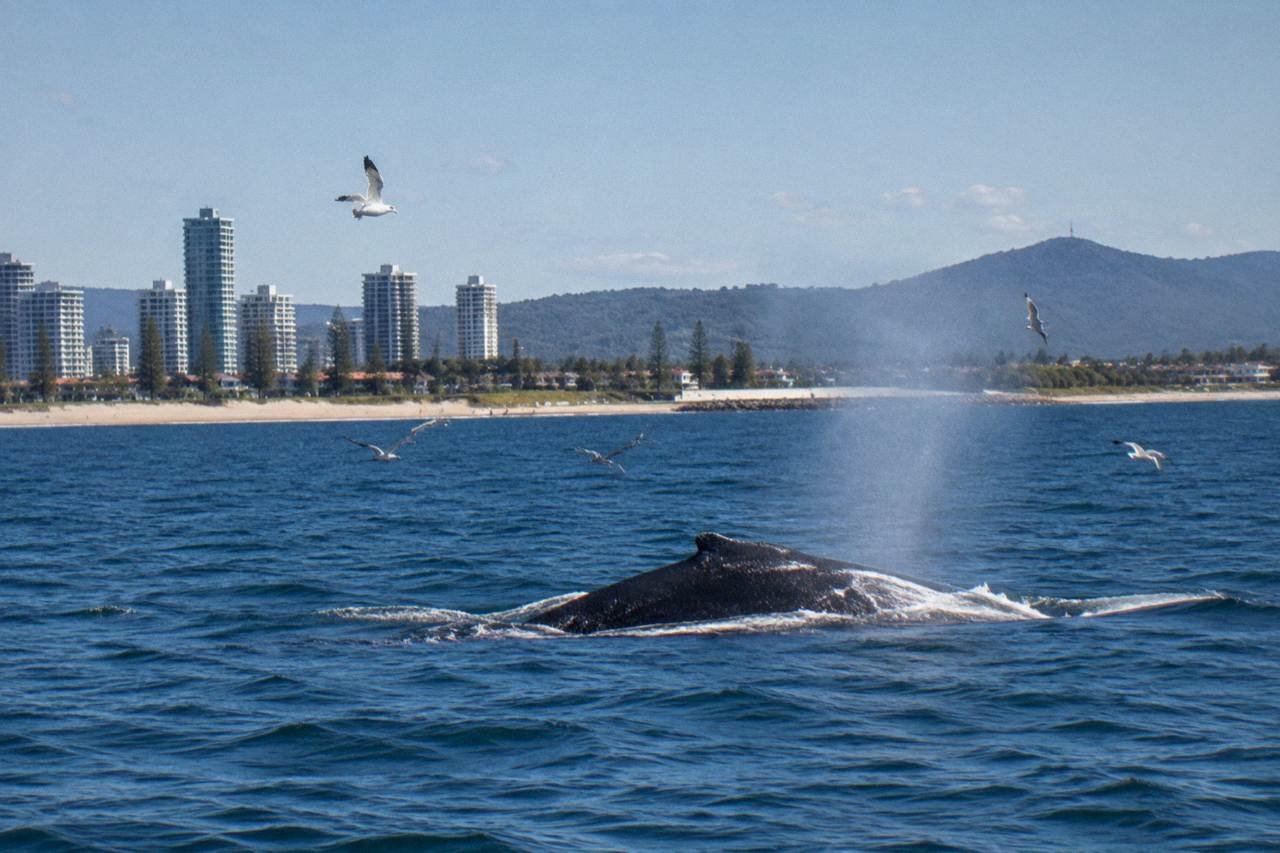
The first humpbacks of the 2026 season were reported off the Gold Coast Seaway on 2 June 2026, a mother and newborn calf in shallow water just outside the bar, noted at the time as remarkably early. That is the kind of report that exists: dated, specific, and already in the past by the time you read it. Nobody publishes a live feed of which whales are off the Gold Coast on any given morning, because no such feed exists. What does exist is a season window that runs from late May or early June to early November, a set of operators who go out every day in that window, a volunteer monitoring program on the headlands, and free lookouts where you can check the water yourself with binoculars. This article walks through how to read all of that, what the 2026 season has actually shown so far, and why any page promising "whales today" is promising something it cannot know. If you're planning a trip around that season window, our guide to what the Gold Coast offers in winter covers the weather, the crowds, and what else is happening on the water while you wait for whales.
Are There Any Whale Sightings On The Gold Coast Today?
The honest answer is that nobody can tell you from a desk. Whales are wild animals moving through open ocean, no live Gold Coast sighting feed exists, and no operator publishes same-day counts. What you can do is check whether today falls inside the June to November season window, look at where reports come from, the cruises, the shore lookouts and the volunteer surveys, and give yourself the best odds of a day on the water.
The question people actually type into a search box is usually the wrong question, or at least an incomplete one. "Today" is a fixed 24 hours, and the whales do not read the calendar the way the tourism industry does. A better version of the question is: is it whale season, are the boats running, and where would I stand or sail to give myself the best chance?
Inside the season, the answer is generally encouraging. The east coast humpback population is estimated at around 50,000 animals in a preliminary 2025 report, up from about 8,000 in 2006, and the migration passes the Gold Coast twice a year, northbound around June and July, southbound from August to October. Roughly 2,260 traveller reviews sit across the seven whale watching listings this site covers, and reviews dated September and early October 2026 describe whales on trip after trip. That is not a guarantee for your Tuesday, but it is the shape of a normal season. If you're wondering whether that counts as lucky, our guide to how common humpback encounters are on the Gold Coast explains just how ordinary these sightings have become.
If you want the strongest single move you can make today, it is a seat on a cruise. The Sea World Cruises premium whale watching cruise from Main Beach, from $55 per person and rated 4.6 from 655 reviews, carries a listing-stated 100% sighting guarantee with a free return cruise if no whales appear, and the Spirit of Gold Coast marine biologist trip from Southport, from $52.30 per person, guarantees a humpback sighting from June to November on the same terms. The Kokomo boat caps its trips at 47 guests from Marina Mirage. All three go looking for the same animals in the same stretch of water.
How To Read The Season Status Before You Leave
Start with the calendar, not the water. The Gold Coast whale season runs from late May or early June to early November, with peak numbers in July and August on the northbound leg and mothers with calves most reported in September and October on the way south. If today sits inside that window, sightings are a matter of odds and patience. Outside it, from roughly December to April, there are effectively no humpbacks passing the Gold Coast at all.
The season is not one event but two overlapping migrations. First come the juveniles and young adults, heading north early and fast, generally in June and July. Then the adult males and competitive groups follow. The southbound leg starts overlapping from August: mothers with newborn calves travel slower, closer to shore, and are the stars of September and October. The practical effect is that almost any date between June and late October has whales somewhere off this coast, but what you see, and how close it comes, changes through the season.
| Month | Who Is Passing The Gold Coast | What The Reports Typically Show |
|---|---|---|
| June | First northbound juveniles and young adults | Season opens, early trips, thin but building numbers |
| July | Peak northbound traffic, adults and competitive pods | Highest volume of the year on most accounts |
| August | Northbound tail end plus first southbound mothers | Peak numbers overall, long encounters |
| September | Southbound mothers with newborn calves | Slower, closer-to-shore whales, more surface activity |
| October | Late southbound pairs, season winding down | Calf sightings, breaching and tail-slapping reports |
| November to May | Migration effectively finished | No meaningful humpback passage of the Gold Coast |
One dated example of how the season actually opens: the 2026 season's first Gold Coast report was that mother and calf pair off the Seaway on 2 June 2026, in roughly eight metres of water, described at the time as very early, with the previous earliest known arrival around 15 June. Operators began their schedules around the same date, and the tourism authority's own framing is that the season runs June to November with July and August bringing peak numbers, per Tourism and Events Queensland's Gold Coast whale watching page.
So when you are asking about today, the first check is free and takes ten seconds: what month is it? If the answer is July, August, September or October, you are inside the corridor and the odds are about as good as whale watching gets anywhere in Australia (see Gold Coast In July). If it is June, you are early but very much in the game. If it is January, no cruise, lookout or luck will put humpbacks off the Gold Coast for you, and the honest page says so.
Where Today's Whale Reports Actually Come From
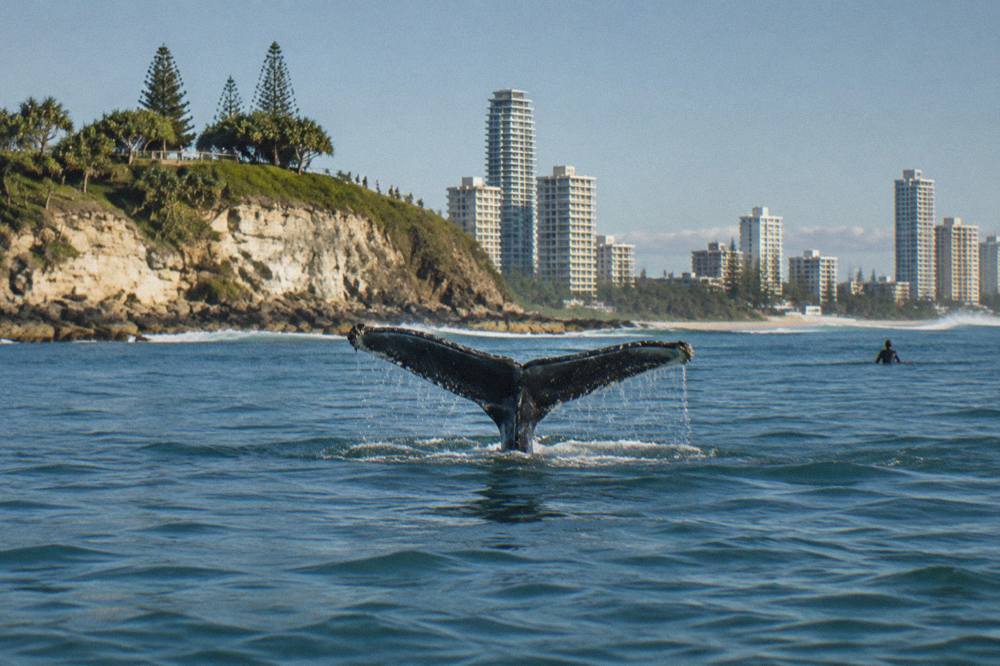
Three sources produce nearly everything worth reading about Gold Coast whale sightings: the cruise operators, who are on the water daily through the season; the Humpbacks and Highrises volunteer program, which runs land-based surveys from the headlands; and the free public lookouts named by the tourism board, Point Danger, Burleigh Heads, Miami and Greenmount Point. None of them is a live feed, and all of them are a day or more behind the present.
The operators are the closest thing to a daily sighting service. Sea World Cruises, Spirit of Gold Coast, Kokomo Cruises, the Boattime superyacht and the two Tweed-side small boats, Blue Seafaris and Cooly Eco Adventures, all run scheduled trips through the season, and their crews know by mid-morning whether it is a three-whale day or a quiet one. Reviews on the live listings, dated and specific, are the public trace of those days: September and early October 2026 reviews across this roster describe whales on essentially every trip. What the operators do not publish is a count, a sighting rate, or a public log, and no source this site has verified provides one for 2026, so any percentage you see quoted anywhere should be treated as invented.
The second source is closer to citizen science. Humpbacks and Highrises, a Gold Coast community group, runs what it describes as Queensland's largest volunteer marine mammal monitoring program, with land-based surveys from spots including Burleigh Heads. In 2026 it ran a free Whale and Ocean Festival at Justins Park, Burleigh Heads, on 4 July, with a guided land-based whale survey from Burleigh Hill as part of the day, and it lists research expeditions through the season on its own site at hhr.org.au. The annual whale census, a volunteer coastal count across Queensland and into southern NSW, happens in late June, and the 2026 count reported over 500 humpbacks spotted in two hours across its sites. That is a snapshot of one winter weekend, not a running tally, but it tells you the corridor is busy.
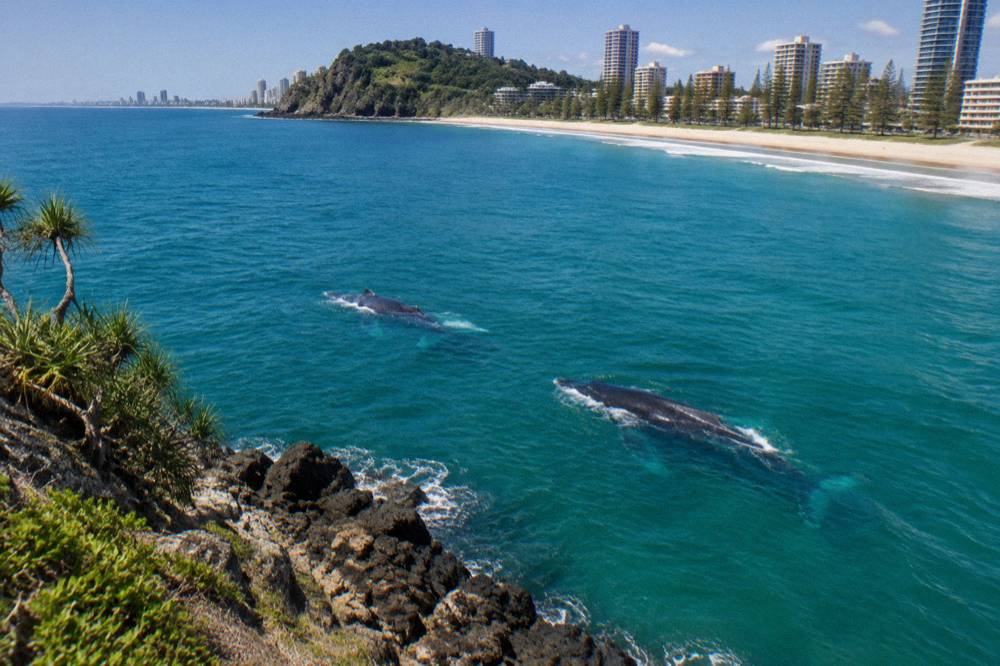
The third source is you, from a headland, for free. The tourism board names Point Danger at Coolangatta as its pick for the best free whale watching spot, along with Burleigh Heads including Tumgun Lookout, Miami and Greenmount Point. Local guides add further vantage points: Currumbin around Elephant Rock, Main Beach and The Spit, Kirra Hill and Snapper Rocks via the Point Danger paths. These are reported spots rather than official picks, and this page keeps that distinction. The Queensland Government's own advice is that whales can be seen from headlands and even open beaches with binoculars or a spotting scope, and that calm mornings, before the wind picks up, are the best time to look. Our guide to the free whale watching spots on the Gold Coast walks each of them in detail.
| Report Source | What It Actually Tells You | What It Cannot Tell You |
|---|---|---|
| Cruise operator trips | What the boats found today or this week, in reviews and crew accounts | A published count, a sighting rate, or tomorrow |
| Humpbacks and Highrises surveys | Volunteer-verified sightings from fixed headland points, on survey days | Continuous daily coverage between surveys |
| The late-June whale census | One national snapshot of the corridor's volume | Anything about any individual day after it |
| Free public lookouts | What you can verify with your own eyes, right now, for nothing | Distance detail without binoculars, or a guarantee |
| Dated news reports | Specific events, rescues and season firsts, with dates attached | The general state of any given morning |
The pattern to notice is that every real source is either a person on the water, a person on a headland, or a dated report written after the fact. There is no fourth source, no radar of whales, no app that counts them. When a page claims to list "today's Gold Coast sightings" without naming who saw what and when, it is repackaging the season window and calling it news.
What The 2026 Season Has Shown So Far
So far, 2026 has looked like a strong season: the first sighting came very early on 2 June, a census weekend in late June was busy, and September and October reviews described whales on trip after trip, with a roughly 10 metre humpback freed from shark nets off Currumbin around 14 September and a tailless humpback reported off Cabarita Beach in mid-July. None of this predicts your day, but it shows the corridor is carrying plenty of whales.
The early start set the tone. A mother and newborn calf just outside the Seaway in the first days of June, when the previous earliest known arrival was around mid-June, was read by local media as a sign of a record season ahead, and operators along the coast expected exactly that, with Byron Bay tours beginning 1 June and the first passing whales reported there in late May. The population backdrop supports the optimism: the east coast estimate of more than 50,000 humpbacks in 2024, reported by ABC News science in a preliminary estimate, sits around 20,000 above the early-1900s pre-whaling figurethe ABC's reporting on the recovery.
The individual stories from the season are the ones worth knowing. Around 14 September 2026, a roughly 10 metre humpback entangled in shark nets off Currumbin, wrapped around its head and blowhole, was freed by Sea World Foundation teams. In mid-July, a tailless humpback, likely from an earlier entanglement, was reported swimming beside another whale off Cabarita Beach on the Tweed coast, described by researchers as potentially a first confirmed case of its kind in Australia. And Migaloo, the famous white humpback, has only unconfirmed 2026 reports, all off NSW; no confirmed Gold Coast sighting exists, and any page claiming one is ahead of the evidence.
For someone asking about today, the useful takeaway from all this is that the 2026 season has been consistently active rather than patchy. Cruises through September and October reported mothers and calves, breaching and tail-slapping, plus the supporting cast cruises commonly log: dolphins, turtles and seabirds. That is the normal texture of a southbound Gold Coast season, and it is what the boats going out tomorrow will be looking for.
Why No Page Can Promise Today's Whales
Because whales are wild, mobile and underwater most of the time, and no verified source tracks them in real time off the Gold Coast. A whale can dive for ten minutes, surface 500 metres away, and be invisible to every boat and headland in between. What a page can honestly promise is a season window, a set of operators with sighting policies, and a refund or return-cruise rule if the day goes quiet.
The legal frame matters here too, because it shapes what boats can even do. Queensland's rules for watching marine mammals, updated 5 March 2026, keep boats at least 100 metres from a whale and 300 metres in front of or behind it, with a 6 knot speed limit inside the 300 metre caution zone and no more than three boats sharing one animal's caution zone. A person in the water must stay 100 metres clear. There is a special rule for predominantly white whales: 500 metres for boats, because an animal like Migaloo draws crowds. These rules, published by the Queensland Government, mean a cruise cannot chase, corner or hover over a whale to manufacture an encounter. The good days happen because the whales are there and, often enough, because they choose to come close themselves.
That is also why the sighting policies read the way they do. Five of the seven listings on this roster state a sighting policy of some kind, and every one of them is the listing's own offer, not a promise of nature. Sea World Cruises states a 100% whale sighting guarantee with a free return cruise. Spirit of Gold Coast guarantees a humpback sighting from June to November or a complimentary second cruise. Boattime's superyacht trip states a 100% sightings guarantee. Blue Seafaris offers a free tour on the next available slot if no whales are sighted. The swim trip guarantees a sighting but not a swim. Kokomo and the Cooly Eco boat trip state no guarantee at all, and this page attaches none to them. The guarantee, wherever it exists, is a second chance, not a forecast.
| Listing | Policy As Stated On The Listing | What It Means For Your Day |
|---|---|---|
| Sea World Cruises premium cruise | 100% whale sighting guarantee, free return cruise | A quiet day buys you another trip, not a refund of the experience |
| Spirit of Gold Coast tour | Humpback sighting guaranteed June to November, or a second cruise free | Same structure, deepest review pool on the roster at 920 reviews |
| Boattime superyacht cruise | 100% whale sightings guarantee stated | The cheapest listed price on the roster, from $52 per person |
| Blue Seafaris small boat | Free tour on the next available slot if no whales are sighted | Small group of around 21, departs Tweed Heads South in NSW |
| Kokomo and Cooly Eco boat trips | No sighting guarantee stated | No return-cruise backstop; the day is simply the day |
The deeper reason no page can promise today's whales is that the honest data does not exist at that resolution. No operator publishes per-trip sighting logs. No government body counts whales off the Gold Coast daily. The census is one weekend a year. The volunteer surveys happen on scheduled days. Everything else is a review written after the fact or a news story about a rescue. A page that says "whales are being seen today off the Gold Coast" is doing one of two things: describing the season window in the present tense, or inventing a confidence nobody has earned. If you want to know how to read the water yourself once you are out there, our piece on how to tell if a whale is near covers the signs, the blow, the birds, the surface behaviour, that crews actually watch for.
What To Do On The Day You Go
Pick a morning in the peak window, book a cruise with a return-cruise policy, and check the conditions before you leave. Calm mornings before the wind picks up are the best conditions both for spotting whales and for enjoying the boat, the Gold Coast Seaway is a coastal bar where conditions can change quickly, and operators cancel or reschedule when the sea is unsafe. Free cancellation on the listing means a weather call rarely costs you anything.
The practical sequence for a good day is short. Choose July to October if you have the flexibility, and September or October if mothers and calves are what you most want to see. Book the cruise that fits your style: the Sea World Cruises trip from Main Beach, the Spirit of Gold Coast cruise, the most-reviewed trip in the roster, the Kokomo boat with the strongest rating of the four cruises, or the Boattime superyacht if you want the luxury framing. Hotel pickup is not part of any of them, so plan your own way to the departure point. Go in the morning. Take binoculars even on the boat. And if the sea looks doubtful, let the operator make the call, because their terms are built for exactly that: rough seas flagged at check-in mean a choice to proceed, reschedule or take a full refund if it is unsafe, and Sea World Cruises notifies passengers by SMS at least two hours ahead when it cancels.
If you would rather not spend anything, or you want a backup plan for a quiet cruise day, the headlands are free and they work. Point Danger at Coolangatta, the tourism board's own pick, Burleigh Heads and Tumgun Lookout, Miami and Greenmount Point are the named vantage points, and the local guides' additions, Currumbin's Elephant Rock, The Spit, Kirra Hill and Snapper Rocks, are worth the walk in the right conditions. Early morning, calm water, binoculars: that is the whole method. A whale that is there will show itself eventually, and a whale that is not there cannot be summoned by any page, including this one.
One last framing thought. The question "are there any whale sightings today" assumes the answer is a fact someone else knows. In practice it is closer to a bet you place with good odds: a season window that is five months wide, a population of around 50,000 animals passing a coastline that is directly on their route, and boats that go out every day of it. The bet pays often enough that four operators on this roster are willing to stake a free return cruise on it. That is about as close to a promise as honest whale watching gets, and it is a better deal than a promise, because it is true.
Common Questions About Today's Gold Coast Whale Sightings
Are There Any Whale Sightings On The Gold Coast Today?
Nobody can say for certain from a desk, because no live sighting feed for the Gold Coast exists. If today falls between June and November, whales are passing the coast in numbers, the cruises are running daily, and reviews through the 2026 season describe whales on trip after trip. Check the season window, then check the water from a headland or a boat.
Where Do Today's Gold Coast Whale Reports Come From?
Three places: the cruise operators on the water daily, the Humpbacks and Highrises volunteer surveys from the headlands, and the free public lookouts where anyone can watch. The late-June whale census adds one national snapshot a year. None of it is real time, and all of it is at least a day behind the present.
Can A Cruise Guarantee I Will See Whales Today?
No cruise can guarantee what wild animals do. What some listings state is a policy: Sea World Cruises, Spirit of Gold Coast and Boattime each state a sighting guarantee with a free return or second cruise if no whales appear, and Blue Seafaris offers a free tour on the next slot. Kokomo and the Cooly Eco boat trip state no guarantee. The backstop is a second chance, not a forecast.
What Happened In The 2026 Gold Coast Whale Season?
The first humpbacks were reported off the Gold Coast Seaway on 2 June 2026, a mother and newborn calf, noted as very early. Peak numbers passed in July and August, and September and October brought the southbound mothers and calves. A roughly 10 metre humpback was freed from shark nets off Currumbin around 14 September by Sea World Foundation teams.
Can I Check For Whales Myself Without Paying?
Yes. Point Danger at Coolangatta, Burleigh Heads including Tumgun Lookout, Miami and Greenmount Point are the free lookouts named by the tourism board, and local guides add Currumbin's Elephant Rock, The Spit, Kirra Hill and Snapper Rocks. Go early in the morning before the wind picks up, and take binoculars.
What If I Go Out And See Nothing?
A quiet day is possible, and the policies are built for it. Depending on the listing, a no-show day means a free return cruise, a complimentary second cruise or a free tour on the next available slot. Our guide to what happens if you do not see a whale on a Gold Coast cruise walks through each policy in detail.
The full picture, the boats, the guarantee policies and the prices compared side by side, lives in the site's Gold Coast cruise comparison, and the trip picker on the homepage narrows it to one listing in three questions. Whale Watching On The Gold Coast is published by the team that verified every figure on this page, and if the day you pick turns out quiet, that is what the return cruises are for.